Empire of Dreams
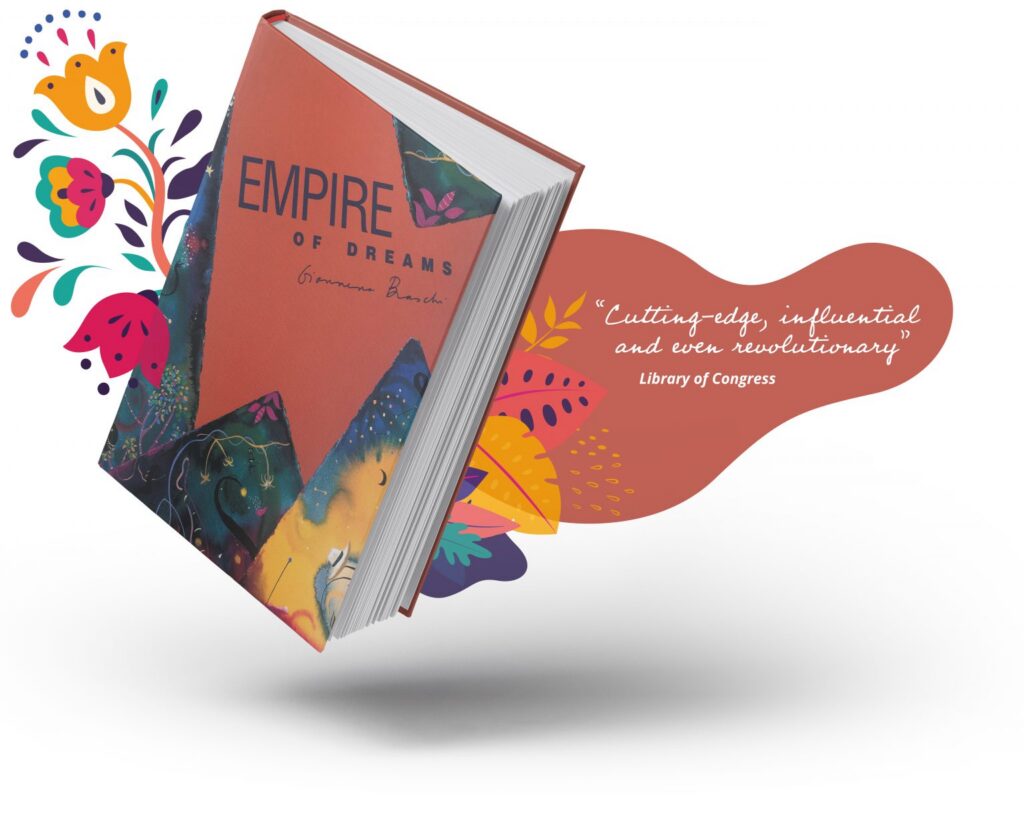
A New York Epic in Six Books
I Love Hiccups
I love hiccups and I love sneezes and I love blinks and I love belches and I love gluttons. I love hair. I love bears. For me, the round. For me, the world. Round is the happy face. And round is the midday. And when the moon is most beautiful is when it’s round. Sex is round. And the heart also. The hand is round. The mouth also. Sneezes are round. And hiccups also. The milk from the breast of Lady Macbeth was also round. I would have liked to be like her and be bad. I am good. I am Bacchus. I am sex. And I am hiccup. And I am sneeze. And I am cough. Hoarse. Hoarse. Hoarse. I am thunder. I am voice. I am obscene. Obscene. Obscene. I am pure like the tit or the milk. I am water, sea, or fish, or tadpole. I am round.
— Giannina Braschi, from Empire of Dreams, translated by Tess O’Dwyer
Inside Empire of Dreams
Written in Spanish in New York in the 1980s, El imperio de los sueños gathers six books of poetry and fiction into one epic of the immigrants who remake the city, in three parts: Assault on Time, Profane Comedy, and Intimate Diary of Solitude. Golden Age pastoral invades Fifth Avenue, Mariquita Samper plans to renounce her American citizenship, and a chorus of voices answers solitude with song, all the way to the closing “Requiem for Solitude.”
A Love Letter to New York
At its core, Empire of Dreams is a high-voltage love letter to New York City, written by a young immigrant electrified by the frenetic energy of her new home. Alicia Ostriker praised its relentless intensity and inventiveness: the work cross-dresses poetry in the garb of advertisement, love letter, TV commercial, diary, movie criticism, celebrity confession, literary theory, bastinado, and manifesto.
Shepherds on Fifth Avenue
In the midsection, “Pastoral; or the Inquisition of Memories” (1983), Braschi upends the Spanish Golden Age by unleashing a bucolic invasion of the Big Apple. Here, ancient elegies no longer mourn a lost Arcadia; instead, they mobilize a migrant revolution on Fifth Avenue. This radical reclamation—a “reverse colonization” where the marginalized seize the quintessential American skyline—reaches its apotheosis on the city’s iconic landmark:
On the top floor of the Empire State a shepherd has stood up to sing and dance. What a wonderful thing. That New York City has been invaded by so many shepherds. That work has stopped and there is only singing and dancing. And that the newspapers – the New York Times, in headlines, and the Daily News-call out: New York. New York. New York. Listen to it. Hear it on the radio. And on television. Listen to the loudspeakers. Listen to it. The buffoons have died. And the little lead soldier. Shepherds have invaded New York. They have conquered New York. They have colonized New York. The special of the day in New York’s most expensive restaurant is golden acorn. It’s an egg. It’s an apple. It’s a bird. Fish. Melody. Poetry. And epigram. Now there is only song. Now there is only dance. Now we do whatever we please. Whatever we please. Whatever we damn well please.
From Spain’s Golden Age to the New York Subway
Braschi not only poeticizes the evolution of the Spanish language across historical ages, but also across shifting geographical terrains of the Spanish diaspora. Though the poems are set in New York, María Mercedes Carrión finds “allusions to the Quartier Latin, the barrios chinos of Barcelona and Seville, the Borgesian labyrinths of Buenos Aires, San Juan’s colonial architecture, and loci from literatures and societies of the past and present.” Chilean novelist Carlos Labbé described Braschi’s language as “anti-Spanish colonized by the United States, from the imperial Castilian lexicon of Golden Age poetry that barely conceals the Mozarabic, the Berber, the Saharawi, and the Sephardic, from the Taíno syntax that defiantly survives in street-corner chatter.”
“Good poets write great poems. Great poets create a new language. Giannina Braschi is a brilliant artist who has invented a syntax that reveals how we think, suffer, and take delight in the twenty-first century. Though the tone can be playful, her work has deep roots in the subversive side of classical literature. The scale is epic.”
D. Nurkse
From the Periphery to the Center of Meaning and Power
As literary critics Laura Loustau and Arnaldo Cruz-Malavé have shown, by recasting New York as a theater of liberation for nomadic characters and writing, Braschi dissolves the borders between the Golden Age and the digital era, effectively propelling the immigrant from the periphery to the vanguard of a new cultural empire.
Adapted from Tess O’Dwyer, “Giannina Braschi,” The Literary Encyclopedia (2026).
Editions, Translations, Adaptations, and Artist Books
El imperio de los sueños was first published in Barcelona by Anthropos Editorial (1988). Epic in scale, it gathers six books in three parts: Asalto al tiempo (1981), La comedia profana (1985), and Diario íntimo de la soledad (1988). Spanish editions followed from the Editorial de la Universidad de Puerto Rico (1999) and AmazonCrossing (2011).
Braschi’s poems have been widely anthologized and published in a myriad of editions, formats, and languages. Of note, Tess O’Dwyer’s English translation, Empire of Dreams, won the Columbia University Translation Center Award and inaugurated the Yale Library of World Literature in Translation (Yale University Press, 1994), with an introduction by Alicia Ostriker. A Swedish translation by Helena Eriksson and Hanna Nordenhök was published as Drömmarnas imperium (Tranan, 2012).
Braschi’s poems have been incorporated into artworks by her contemporaries in the fields of illustration, painting, and mixed media. Her collaborations on artist books include Libro de payasos y bufones with Italian printmaker Giorgio Upiglio (Grafica Uno, 1987) and Two Crowns of the Egg with photographer Michael Somoroff (Damiani, 2014). Her poems also inform architecture and design projects, such as Urbanismo ecológico en América Latina, edited by Mohsen Mostafavi (Harvard University Graduate School of Design/GG, 2019). Her poems from El imperio de los sueños have also moved into music and theater. Composer Gabriel Bouche Caro set them in his song cycle Que tus ojos no se cansen de brillar (Americas Society, 2022), and the artist Montserrat Pecanins built a teatrín called The Intimate Diary of Giannina.
Order books →
Reviews
“Empire of Dreams is a masterpiece, brilliantly translated. Braschi writes as an accomplished cosmopolitan heiress to the traditions of Lorca, Neruda, Mistral, and Márquez.”
Alicia Ostriker (Chancellor Emerita, Academy of American Poets)
“Braschi is a Spanish Arthur Rimbaud, reinventing surrealism, creating a maze of characters—clowns, shepherds, magicians, madmen, witches and artists who perform their fantasies in the city streets. In substantial ways, Braschi is the brightest new voice in her generation writing in the Spanish language. Empire of Dreams has been called a modern classic.”
Willis Barnstone and Tony Barnstone (Literatures of Asia, Africa, and Latin America: From Antiquity to Present)
“Braschi writes with a strong poetic tradition behind her, and from her erudite standpoint she forges an odd mixture of poetry, prose, drama, and a little of what could be considered music. She imbues her text with jollity and a brilliant energy that stretches its audience from lovers of modernism to seekers of a broadened artistry of language.”
Carolyn Kuebler (Review of Contemporary Fiction)
“The three parts of this collection—Assault on Time, Profane Comedy, and The Intimate Diary of Solitude—allude in different ways to the play of language, life as a grand theater, and the solitude of big cities…As with any empire, there are invasions, conquests, and colonization of territories in Empire of Dreams.”
Laura Loustau (Chapman University)
“This striking collection of brief, evocative prose pieces describes moments of experience and their contingencies…at times with humorous gusto. As translated by O’Dwyer, her rhythmic, energetic prose is challenging yet accessible.”
(Publishers Weekly)
“Braschi invites us into a world in which objects, places, and elements are animated, a world in which the profane comedy of literature is staged in an entirely new way. Empire of Dreams is an absolute joy-ride!”
Jean Franco (Columbia University)
“A surge of deep emotion runs through anyone who listens to or reads Giannina Braschi because she writes the most compelling work – the dramatic, philosophical, humorous and always unpredictable in its experimental form. Braschi enlightens us with her passionate energy.”
Pia Tafdrup (Danish poet)
“The Big Apple seems to be the central thematic axis. However, this is a bohemian space with allusions to the Quartier Latin, the barrios chinos of Barcelona and Seville, the Borgesian labyrinths of Buenos Aires, San Juan’s colonial architecture, and loci from literatures and societies of the past and present … In a pastiche of virtual reality, this rendition of New York is a poetic world invaded by parodies of bucolic voices from the Spanish literary past.”
María Mercedes Carrión (Emory University)
“Revelation-ary! You get the feeling that every single word is touching the inside of your own senses. Connecting them to the world. For the first time. Revealing something you didn’t know you have always experienced. Enlarging the mind of the future.”
Ann Jäderlund (Swedish poet)
“Empire of Dreams is a modern classic, informed with all of the major concerns of our contemporary culture.”
Arnaldo Cruz-Malavé (Fordham University)
For more on Empire of Dreams, Read World Literature Today’s feature “The Braschian Wave: All the Solitude of an Empire in a Bottle Thrown into the Sea” by Carlos Labbé.
Empire of Dreams gathers six books in three parts: Assault on Time, Profane Comedy, and Intimate Diary of Solitude.
Selections from Empire of Dreams, in Spanish and in English.
Watch: Giannina Braschi reads “Yo he sido adivina” (“I have been a fortune-teller”) from El imperio de los sueños, in a film by Williams Cole for the Adrian Brinkerhoff Poetry Foundation.
Critical essays, reviews, and interviews on Empire of Dreams.
Carlos Labbé, “The Braschian Wave: All the Solitude of an Empire in a Bottle Thrown into the Sea,” World Literature Today, 2023