
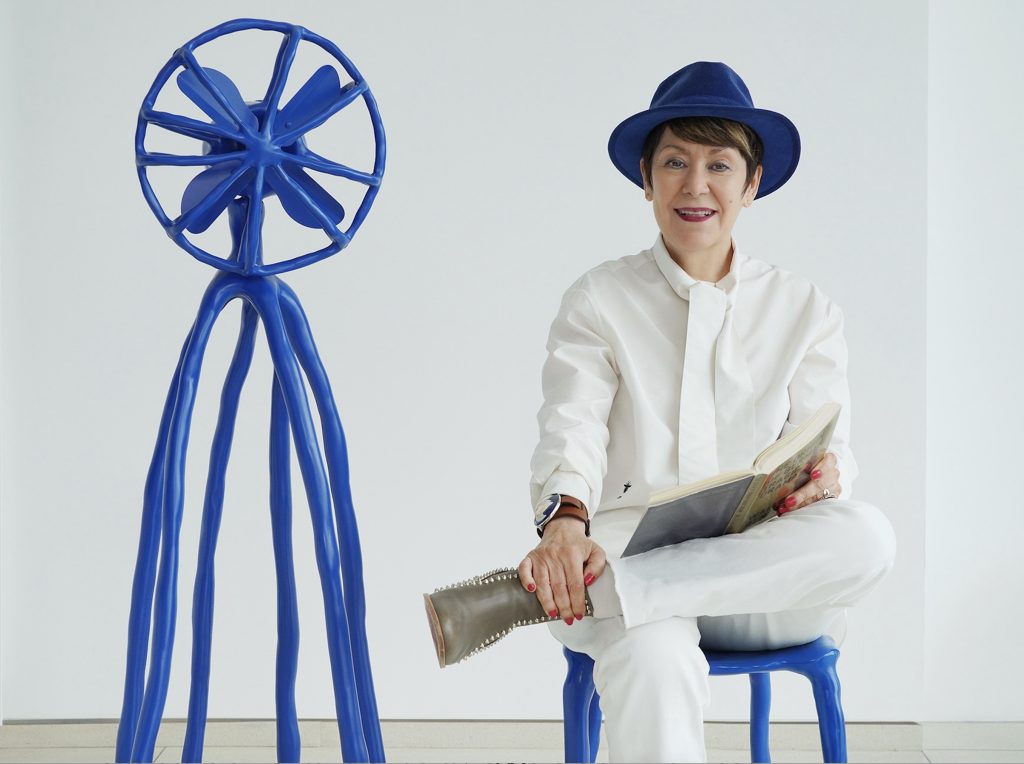
Giannina Braschi joins American Studies scholars in Macerata, Italy, to explore how literature rewrites the promises of independence, freedom, and equality.
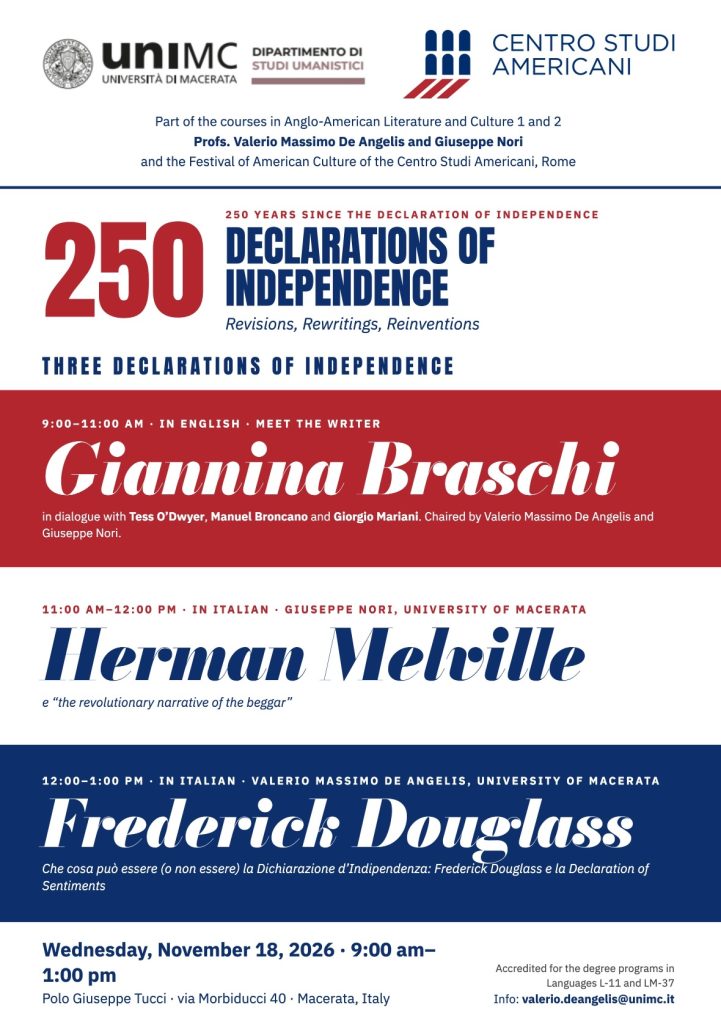
The Centro Studi Americani and the Department of Humanities at the University of Macerata (Dipartimento di Studi Umanistici dell’Università di Macerata) present “Declarations of Independence: Revisions, Rewritings, Reinventions” on November 18, 2026, from 9:00 a.m. to 1:00 p.m., at Polo Giuseppe Tucci in Macerata.
Puerto Rican writer and poet Giannina Braschi, who now lives in Rome, will participate in the opening conversation alongside Tess O’Dwyer, Manuel Broncano, and Giorgio Mariani. The program continues with talks by Giuseppe Nori and Valerio Massimo De Angelis on Herman Melville, Frederick Douglass, and the Declaration of Sentiments.
The conference’s Italian title is “Dichiarazioni d’indipendenza: revisioni, riscritture, reinvenzioni.”
Declarations of independence: who speaks, and who is heard?
In the year of the 250th anniversary of the U.S. Declaration of Independence, the conference asks how the language of freedom travels beyond a founding document. Who can claim its promises? Who remains excluded? How do writers turn inherited declarations into new arguments about citizenship, sovereignty, and belonging?
Literature gives these questions voices, characters, conflicts, and unexpected forms. Douglass’s challenge to the nation’s celebration of independence and the demands for women’s equality articulated in the Declaration of Sentiments expose the distance between proclaimed rights and lived experience. Melville and Braschi offer further ways to examine authority, resistance, and the possibilities of political imagination.
The plural “declarations” opens the discussion to successive acts of revision: the promise of independence can be contested, extended, and reinvented by those whom it has failed to include.
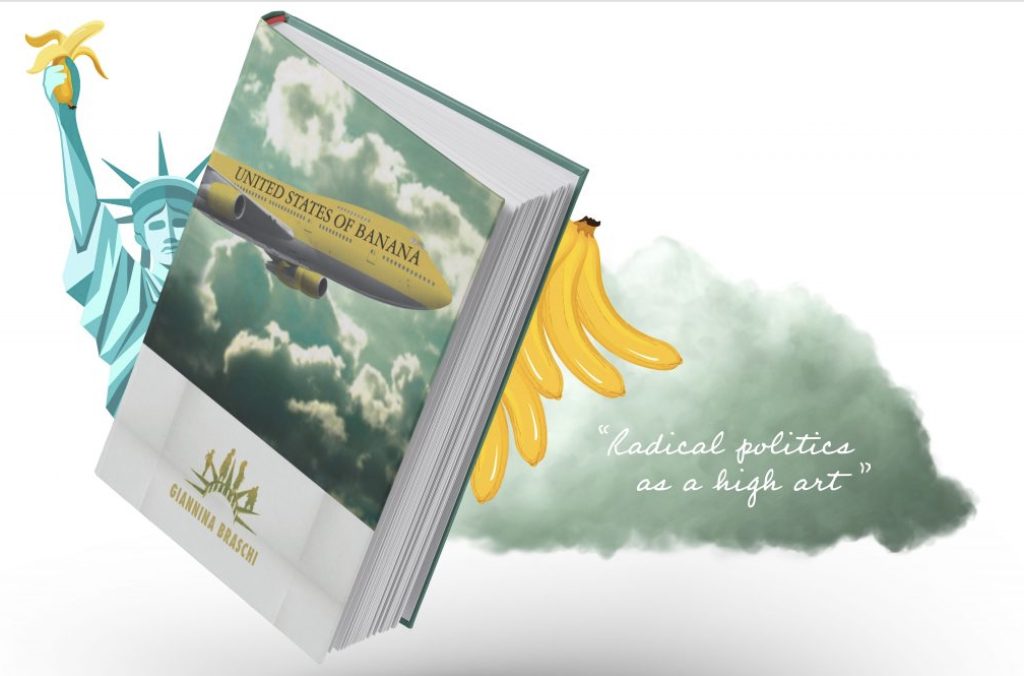
United States of Banana as a Declaration of Puerto Rican Independence
Braschi’s contribution to contemporary American literature crosses Spanish, English, and Spanglish, as well as poetry, fiction, theater, and philosophy. Her work examines Puerto Rico’s relationship with the United States while challenging the boundaries through which nations, languages, and literary genres define belonging.
In United States of Banana, Puerto Rico’s liberation becomes part of a geopolitical tragicomedy about the American empire. Yo-Yo Boing! turns movement between languages into an arena of artistic invention and cultural conflict. Putinoika draws on Greek tragedy to confront frenzy, plague, and authoritarian power in the Putin and Trump era.
For Braschi, questions of political freedom also become questions of form: who controls the language, who enters the conversation, and what can be imagined when familiar structures break open?
These concerns connect the Macerata conference with Cristina Garrigós’s contribution to the EAAS conference “1776–2026: Visions of Freedom” in Bologna. Her paper, The Liberation of Wires: Creative Resistance, Power, and Freedom in Giannina Braschi’s Putinoika, examines freedom across the formal, linguistic, and political dimensions of Braschi’s writing.

Conference program
9:00–11:00 a.m. — Opening conversation, in English
Giannina Braschi in conversation with:
- Tess O’Dwyer, Academy of American Poets;
- Manuel Broncano, Texas A&M International University;
- Giorgio Mariani, Sapienza University of Rome.
Moderated by Valerio Massimo De Angelis and Giuseppe Nori.
11:00 a.m.–12:00 p.m. — Giuseppe Nori, in Italian
Herman Melville e “the revolutionary narrative of the beggar”
12:00–1:00 p.m. — Valerio Massimo De Angelis, in Italian
Che cosa può essere (o non essere) la Dichiarazione d’Indipendenza: Frederick Douglass e la Declaration of Sentiments
The latter talk asks what the Declaration of Independence can—or cannot—be, through readings of Frederick Douglass and the Declaration of Sentiments.
Read Braschi in Italian
Italian editions of ** Yo-Yo Boing! and Putinoika ** are published by Campanotto Editore and listed in Feltrinelli’s online catalog.
The Italian edition of Yo-Yo Boing!, translated by Alessia Patanè, includes a preface by Cristina Garrigós, president of the Spanish Association for American Studies. Its experiments with language offer a companion to the conference’s questions about identity and equal rights.
Related reading: Braschi in Italy
- Language, rights, and Yo-Yo Boing! in il manifesto
Daniela Daniele’s Italian-language interview with Giannina Braschi and Tess O’Dwyer explores Spanglish, translation, and the tensions of cultural belonging. Published in Alias Domenica on February 18, 2024. - “To Create a Genre”: Braschi at the University of Trieste
This bilingual post introduces Braschi’s lecture within Sergia Adamo’s course on narration and storytelling, connecting literary invention with the freedom to cross established forms. - “American Feminist Epics in the Age of Disaster”: University of Udine
A seminar directed by Daniela Daniele brings together Braschi, Jennifer Scappettone, and Tess O’Dwyer through criticism, translation workshops, and readings. Its reconsideration of epic provides another perspective on literature’s responses to conquest, empire, and exclusion. - Visions of Freedom at 250: 1776–2026: Visions of Freedom, the 36th biennial conference of the European Association for American Studies (EAAS), held at the University of Bologna from September 1 to 4, 2026.
Declarations of Independence Event Details
Declarations of Independence: Revisions, Rewritings, Reinventions
Wednesday, November 18, 2026 · 9:00 a.m.–1:00 p.m.
Polo Giuseppe Tucci · Via Morbiducci 40 · Macerata, Italy
Presented by: Centro Studi Americani and the Department of Humanities at the University of Macerata.
The opening conversation will take place in English; the subsequent talks will be in Italian. The event is accredited for the university’s L-11 and LM-37 language degree programs.
Bringing contemporary writing into conversation with historical challenges to the founding declaration, the conference treats independence as a question that literature continues to reopen: who has the freedom to give shape to a shared future?