
American Experimental Fiction
What Is Experimental American Fiction?
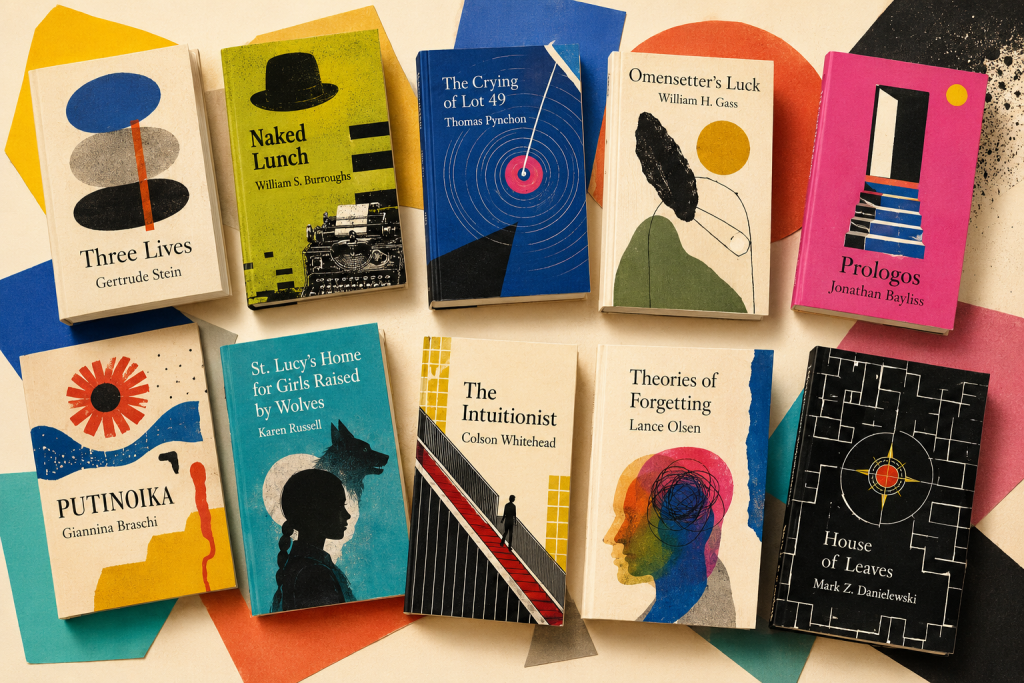
Experimental American fiction challenges established ideas about how stories should be written, organized, and read. Instead of treating plot as a simple sequence of events, experimental writers may fracture chronology, shift among competing voices, mix literary genres, disrupt conventional syntax, or use the physical page as part of the narrative. Their innovations range from Gertrude Stein’s repetition and radical approach to language to William S. Burroughs’s fragmented narratives, Thomas Pynchon’s encyclopedic plots, Giannina Braschi’s multilingual genre crossings, and Mark Z. Danielewski’s typographical constructions.
“Experimental” does not describe a single movement or style. It is a broad category encompassing modernism, postmodernism, metafiction, maximalism, fabulism, multilingual literature, and hybrid writing that combines fiction with poetry, drama, philosophy, history, or visual art. Some experimental novels make readers work through uncertainty; others use unconventional forms to reconsider race, gender, national identity, technology, memory, or political power.
The following is a selective guide rather than a definitive canon. It highlights American and Puerto Rican writers whose formal innovations demonstrate different possibilities within experimental American fiction.
Major Experimental American Authors and Novels
Gertrude Stein
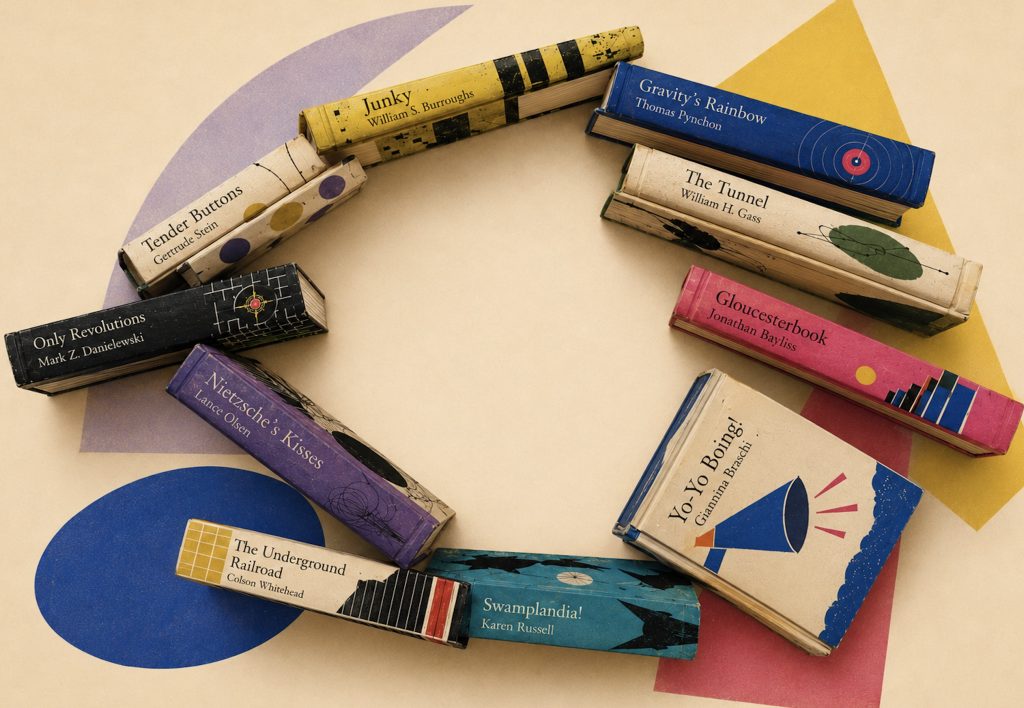
Gertrude Stein transformed literary prose through repetition, rhythmic variation, unconventional syntax, and sustained attention to the sound and material character of words. Three Lives experiments with voice and psychological portraiture, while The Making of Americans uses recursive language and repeated patterns to examine personality, family, and national identity. Tender Buttons pushes further from conventional narrative, presenting enigmatic verbal portraits of objects, food, and rooms.
Where to begin: Three Lives provides the most accessible introduction to Stein’s fiction. Tender Buttons offers the most concentrated encounter with her experiments in language and perception.
William S. Burroughs
William S. Burroughs replaced linear storytelling with disjunction, collage, abrupt changes of scene, and a hallucinatory blend of science fiction, crime, and social satire. Junky and Queer retain comparatively recognizable autobiographical narratives, whereas Naked Lunch breaks continuity apart and invites readers to enter its episodes without following a conventional beginning-to-end progression. His work helped make fragmentation itself a narrative method.
Where to begin: Read Junky for Burroughs’s more direct early style or Naked Lunch for the radical fragmentation most closely associated with his name.
Thomas Pynchon
Thomas Pynchon combines historical research, popular culture, scientific ideas, slapstick comedy, songs, conspiracy, and large casts of interconnected characters. His novels withhold definitive explanations, leaving readers to decide whether apparent patterns reveal systems or the human desire to impose order on chaos. V. introduces this method, The Crying of Lot 49 condenses it, and Gravity’s Rainbow expands it into an encyclopedic account of war, technology, desire, and control.
Where to begin: The Crying of Lot 49 is the shortest and most approachable entry into Pynchon’s fiction. Gravity’s Rainbow is his more demanding maximalist landmark.
William H. Gass
William H. Gass treated fiction as an art made from sentences rather than a vehicle for plot. His writing is distinguished by dense imagery, elaborate sound patterns, philosophical reflection, verbal play, and narrators whose language reshapes the worlds they describe. Omensetter’s Luck explores voice and consciousness within a rural community; The Tunnel combines history, typography, illustration, and an unreliable narrator; and Middle C examines identity through repetition, contradiction, and linguistic performance.
Where to begin: Omensetter’s Luck introduces Gass’s intensely musical prose in a more compact form. The Tunnel is the major undertaking for readers interested in his most expansive formal experiment.
Jonathan Bayliss
Jonathan Bayliss developed an extensive fictional world centered on Gloucester, Massachusetts, drawing on mythology, philosophy, local history, wordplay, and an unusually large network of characters. His four-volume Gloucesterman cycle—Prologos, Gloucesterbook, Gloucestertide, and Gloucestermas—treats a particular American place as the center of an encyclopedic investigation into community, memory, work, and civilization. The scale and interconnected structure of the sequence reward cumulative reading.
Where to begin: Start with Prologos, the opening volume of the Gloucesterman cycle, before proceeding through the remaining books in order.
Giannina Braschi
Gianinna Braschi expands American experimental fiction through multilingualism, code-switching, political satire, and the collision of genres. Yo-Yo Boing! moves among English, Spanish, and Spanglish while dramatizing debates about language, culture, art, and assimilation. United States of Banana combines fiction, poetry, theater, manifesto, and philosophy in an exploration of empire, liberty, debt, and Puerto Rico’s political status. PUTINOIKA continues this hybrid practice through epic tragicomedy and geopolitical satire.
Where to begin: United States of Banana offers a broad example of Braschi’s fusion of literary and philosophical forms. Whereas PUTINOIKA offers a timely introduction to Braschi’s experimental method, combining epic tragicomedy, political satire, philosophy, and geopolitical critique to explore war, power, and the instability of the contemporary world order.
Karen Russell
Karen Russell brings experimentation into contemporary short fiction through fabulism, surreal premises, invented communities, and narrators positioned between childhood imagination and adult experience. Her stories often make the impossible feel ordinary, using alligator wrestlers, vampires, ghosts, and other fantastic figures to explore grief, family, exploitation, and belonging. St. Lucy’s Home for Girls Raised by Wolves and Vampires in the Lemon Grove display the range of her short fiction, while Swamplandia! extends her strange, unstable world-building into the novel.
Where to begin: St. Lucy’s Home for Girls Raised by Wolves provides the best introduction to Russell’s blend of emotional realism and the fantastic.
Colson Whitehead
Colson Whitehead experiments by adapting and unsettling recognizable genres, including detective fiction, speculative fiction, historical narrative, satire, and horror. The Intuitionist turns an investigation involving elevator inspectors into an inquiry into race, knowledge, and competing ways of understanding the world. The Underground Railroad makes a historical metaphor physically real, while The Nickel Boys uses a carefully controlled narrative structure to reconsider memory, testimony, and institutional violence.
Where to begin: The Intuitionist most clearly announces Whitehead’s experimental approach to genre. The Underground Railroad demonstrates how formal invention can reshape historical fiction.
Lance Olsen
Lance Olsen’s fiction questions chronology, stable identity, and the physical boundaries of the book. His narratives often move through fragments, parallel possibilities, visual structures, and shifts in perspective rather than conventional linear plots. Nietzsche’s Kisses imagines alternative versions of the philosopher’s final hours; Theories of Forgetting uses intersecting narratives and an unconventional page design; and Dreamlives of Debris reworks the myth of the Minotaur through a fragmented consciousness.
Where to begin: Nietzsche’s Kisses is an accessible introduction to Olsen’s speculative treatment of history. Theories of Forgetting foregrounds his experiments with layout and the act of reading.
Mark Z. Danielewski
Mark Z. Danielewski makes typography, page layout, footnotes, color, and textual arrangement integral to narrative meaning. House of Leaves encloses a story about an impossible house within layers of commentary, documents, and competing narrators. Only Revolutions presents two interdependent narratives that require the reader to rotate and navigate the book, while The Familiar develops a serialized, multimedia form across multiple characters and visual systems. In these works, reading becomes a physical as well as interpretive activity.
Where to begin: House of Leaves is Danielewski’s best-known and most approachable demonstration of how a book’s material design can become part of its story.
Experimental Writing Resources
Academic Research on Experimental Literature
- Aldama, Frederick Luis, editor. Poets, Philosophers, Lovers: On the Writings of Giannina Braschi. University of Pittsburgh Press, 2020.
- Cowart, David. Thomas Pynchon and the Novel of Visions. Louisiana State University Press, 2012.
- Dydo, Ulla E., with William Rice. Gertrude Stein: The Language That Rises: 1923-1934. Northwestern University Press, 2003.
- Flynn, Kevin Tracy, editor. The Gist of GLOUCESTER: A Jonathan Bayliss Companion. 2010.
- Gibbons, Alison. Multimodality, Cognition, and Experimental Literature. Routledge, 2012.
- Giles, Paul. The Global Remapping of American Literature. Princeton University Press, 2011.
- La Torre Lagares, Elidio. Hyperglossia and the Novel: The Production of (Non)Space. Routledge, 2025.
- Maus, Derek C. Understanding Colson Whitehead. University of South Carolina Press, 2014.
- Murphy, Timothy S. Wising Up the Marks: The Amodern William Burroughs. University of California Press, 1997.
- Renker, Elizabeth. Strike through the Mask: Herman Melville and the Scene of Writing. Johns Hopkins University Press, 1996.
- Saltzman, Arthur M. The Metafictional Muse: The Works of Robert Coover, Donald Barthelme, and William H. Gass. University of Pittsburgh Press, 1982.
- Starre, Alexander. Metamedia: American Book Fictions and Literary Print Culture after Digitization. University of Iowa Press, 2015.
Literary Societies Supporting Experimental American Literature
The Don DeLillo Society brings together scholars, critics, teachers, and general readers interested in DeLillo’s fiction. Its areas of inquiry include postmodernity, history, technology, media, political systems, and American culture.
The International David Foster Wallace Society supports the study and teaching of Wallace’s fiction, essays, and other writing while providing a forum for scholarly exchange and critical discussion.
The Ezra Pound Society promotes the study of Pound as a poet and man of letters. Its resources illuminate his role in literary modernism, experimental poetics, translation, and the development of The Cantos.
The William Gaddis Society supports readers and scholars of Gaddis’s demanding, polyphonic novels. The Society provides resources concerning works such as The Recognitions and J R, both central to discussions of American maximalism and postmodern fiction.
The Gertrude Stein Society encourages scholarship on Stein’s fiction, poetry, drama, and experiments with language. Affiliated with the American Literature Association, the Society organizes scholarly panels and discussions devoted to Stein’s work and continuing influence.
The Jonathan Bayliss Society and the Wider Experimental Tradition
American Literature Association CFP on Experimental Literature
Although the following call for papers is now closed, it remains an illuminating example of how a literary society devoted to one author can foster discussion of a much wider tradition. The Jonathan Bayliss Society placed his work within a lineage of American experimental fiction extending from Herman Melville and Gertrude Stein to contemporary writers working across languages, genres, and media.
The roundtable invited scholars to consider how American writers have disrupted conventions of genre, style, syntax, diction, narrative form, and page design. Its scope reflects an important function of author societies: preserving the work of an individual writer while creating opportunities for comparison, reassessment, and broader literary scholarship.
From the Archive: A Call for Papers on American Experimental Fiction
The Jonathan Bayliss Society invited proposals for an American Literature Association roundtable devoted to American experimental fiction. Beginning at least as early as Moby-Dick, the call situated Bayliss within a tradition flourishing in the work of Stein, Burroughs, Pynchon, and Gass and continuing in the writing of Giannina Braschi, Karen Russell, Colson Whitehead, Lance Olsen, and Mark Z. Danielewski.
Participants were invited to submit papers on individual authors or works, as well as comparative and theoretical approaches to experimental fiction. The proposed subjects included disruptions of genre, style, syntax, diction, propriety, narrative form, and page layout.
Historical note: This call for papers is preserved for its relevance to the study of experimental American fiction. The submission period and associated conference event have concluded.
Why Experimental Fiction Matters
Taken together, these writers show that literary experimentation is not novelty for its own sake. Unconventional language, fractured chronology, multilingual dialogue, genre crossings, and typographical design allow fiction to represent forms of experience that traditional realism may not adequately contain. From Stein’s reinvention of the sentence and Pynchon’s systems of conspiracy to Braschi’s collisions of language and empire, Whitehead’s remaking of historical narrative, and Danielewski’s transformation of the printed page, experimental fiction continually enlarges what the American novel can examine—and what readers can expect a novel to do.
Related Reading
- American Feminist Epics
- World Literature Today on Putinoika
- Latin American Women Authors
- Hysterical Realism
Editorial note: This selective guide was independently prepared by the site’s editorial team for general readers, educators, and students. It is not authored by Giannina Braschi.
Last reviewed and updated August 22, 2026