
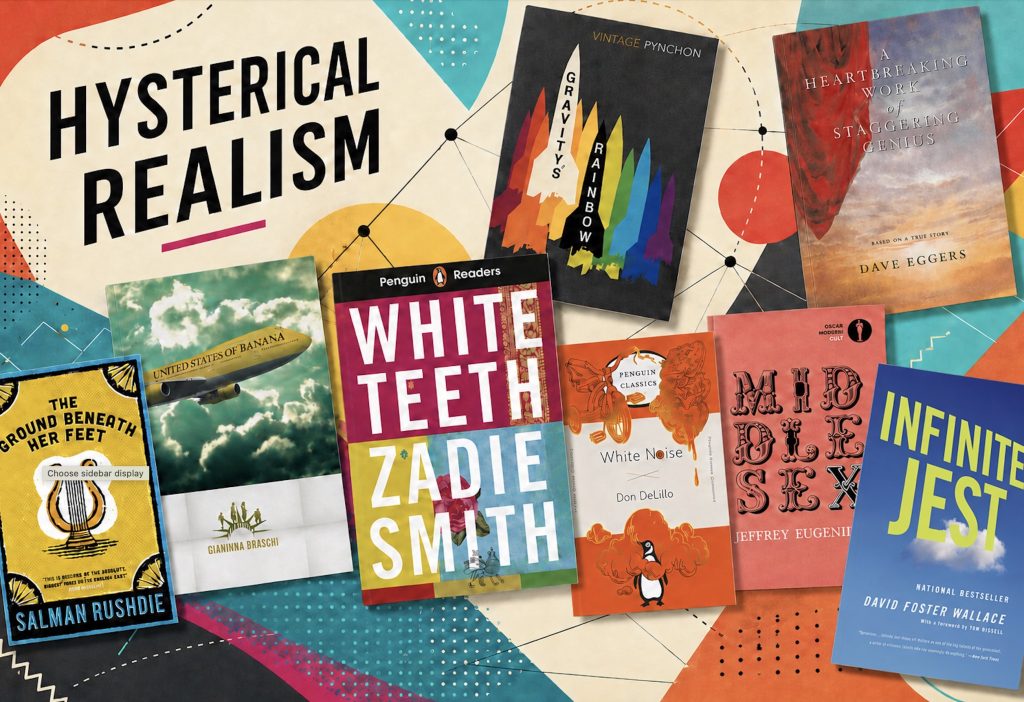
Hysterical realism describes ambitious fiction driven by narrative excess: extravagant plots, improbable coincidences, encyclopedic knowledge, manic comedy, and an urgent desire to explain the social systems shaping contemporary life. The term is most often associated with novelists such as Zadie Smith, David Foster Wallace, Don DeLillo, Salman Rushdie, and Thomas Pynchon.
Critic James Wood coined “hysterical realism” in 2000 as a rebuke, not a compliment. He argued that certain sprawling novels pursued “vitality at all costs,” accumulating characters, information, and incident while neglecting emotional depth. Yet the term has outgrown its originally dismissive purpose. It now offers a useful—if contested—way to describe fiction whose elaborate form reflects the overwhelming scale, speed, absurdity, and interconnectedness of modern life.
Giannina Braschi’s United States of Banana belongs in this conversation. Its manic velocity, exaggerated characters, encyclopedic references, and political satire share central traits of hysterical realism. Yet the book also resists the category: rather than overloading the conventions of the realist novel, it breaks them open into poetry, theater, manifesto, philosophical dialogue, and political declaration.
What Is Hysterical Realism?
Hysterical realism is a mode of fiction that combines wildly elaborate storytelling with detailed attention to recognizable social realities. Its novels may contain improbable plots, exaggerated characters, intellectual digressions, historical catastrophes, competing voices, and vast networks of political and cultural reference.
The “realism” lies in the work’s attention to actual systems: capitalism, colonialism, immigration, technology, bureaucracy, consumer culture, media, race, religion, and global politics. The “hysteria” lies in the intensity with which the narrative tries to contain those systems.
In his essay “Human, All Too Inhuman,” Wood distinguished hysterical realism from magical realism. These books do not necessarily replace reality with magic. Instead, they strain and overwork realism through relentless storytelling.
The term remains controversial. “Hysterical” carries a long history of pathologizing emotional excess, particularly in women. It also risks turning very different writers into a single movement that none of them formally joined. Zadie Smith acknowledged that the term captured something about the manic amplitude of White Teeth while warning that collective literary labels cast very wide nets.
Hysterical realism is therefore best treated as a critical lens rather than a fixed genre.
Who Coined the Term Hysterical Realism?
British literary critic James Wood coined the term while reviewing Zadie Smith’s debut novel, White Teeth, in 2000. He connected Smith’s exuberant storytelling to earlier work by writers including Thomas Pynchon, Salman Rushdie, and Don DeLillo, as well as to the encyclopedic ambition of David Foster Wallace.
Wood admired these writers’ intelligence and energy but believed their elaborate social machinery sometimes displaced sustained attention to individual consciousness.
That distinction has generated a lasting debate. Supporters of expansive fiction argue that systems are not separate from human experience. Empire, migration, debt, race, war, media, and technology shape how people feel—and who is permitted to flourish, move, belong, or survive. For many later critics and readers, the scale of these novels is not an evasion of human reality but an attempt to represent it.
“Fiction’s about what it is to be a fucking human being.”
—David Foster Wallace, interview with Larry McCaffery, 1993
Wallace’s blunt formulation challenges the idea that formal complexity necessarily comes at the expense of human feeling. The elaborate structure of a novel may be the means by which a writer confronts isolation, suffering, attention, and the difficulty of reaching another consciousness.
Six Characteristics of Hysterical Realism
No single trait defines hysterical realism. The term generally describes books in which several of the following characteristics operate together.
1. Narrative Excess
Hysterical realist novels generate plots, subplots, digressions, coincidences, and secondary characters at a remarkable rate. The narrative may appear to expand faster than its form can contain it.
In White Teeth, the lives of two families open into questions of British colonial history, immigration, religious fundamentalism, genetics, generational conflict, and cultural assimilation. The apparent disorder is part of the design: private lives become inseparable from historical forces.
2. Encyclopedic Knowledge
These works absorb specialized bodies of information—history, science, sports, politics, philosophy, media, popular culture, or technology—and incorporate them into the movement of the story.
David Foster Wallace’s Infinite Jest, for example, encompasses addiction, entertainment, competitive tennis, political separatism, rehabilitation, and corporate power. Don DeLillo’s Underworld moves across Cold War history, waste management, baseball, art, nuclear anxiety, and mass culture.
3. Manic Energy and Comedy
Hysterical realism often swings rapidly between intellectual argument, absurd comedy, catastrophe, satire, and dread. Jokes do more than offer relief. They expose the irrationality of systems that society has learned to consider normal.
Comic exaggeration also gives these novels their distinctive velocity. Ideas and incidents collide before the reader can settle into a single tone.
4. Exaggerated or Emblematic Characters
Characters may be psychologically complex, but they also function as social types, cultural symbols, political positions, or embodiments of ideas. Historical and fictional figures may appear together, while realistic characters encounter events that verge on cartoon, allegory, or myth.
Wood considered this tendency evidence that characters had been subordinated to intellectual machinery. Other readers see it as a means of connecting individual identity to larger systems.
5. Systems as Protagonists
Institutions and networks assume an importance normally reserved for characters. Capitalism, empire, technology, bureaucracy, colonialism, mass media, and the global circulation of people or goods become active forces in the narrative.
This systemic focus helps explain why hysterical realism is frequently associated with postmodern and postcolonial fiction. The individual is not depicted in isolation but as someone living within structures too large to perceive in their entirety.
6. Real Catastrophe Rendered Through Absurdity
Hysterical realism frequently approaches war, terrorism, ecological danger, colonial violence, racial conflict, or social collapse through extravagant invention. Its absurdity does not necessarily diminish catastrophe. It may reveal how absurdity has already entered political life.
The result is fiction that can be deeply serious without adopting a consistently solemn tone.
Essential Hysterical Realist Authors and Books
Thomas Pynchon
Thomas Pynchon is often treated as a precursor to hysterical realism. Gravity’s Rainbow (1973) combines war, technology, paranoia, sexuality, scientific knowledge, corporate power, and a vast cast of characters in a narrative that continually threatens to exceed interpretation. Mason & Dixon (1997) similarly combines historical research with comic invention, anachronism, and digression.
Pynchon established an important premise for later writers: the systems governing modern life may be so vast and elusive that only an excessive, unstable novel can begin to represent them.
Salman Rushdie
In Midnight’s Children (1981), Salman Rushdie binds the life of Saleem Sinai to the birth and political history of independent India. National history becomes personal destiny through exuberant language, comic exaggeration, myth, political satire, and magical transformation.
The Ground Beneath Her Feet (1999) expands into music, celebrity, mythology, alternative history, migration, and globalization. Rushdie’s fiction illustrates the overlap—but not the equivalence—between magical realism, maximalism, postcolonial fiction, and hysterical realism.
Don DeLillo
Don DeLillo explores how institutions, media, technology, consumerism, and political fear enter ordinary consciousness. White Noise (1985) makes environmental disaster, academic culture, advertising, pharmaceuticals, and the fear of death parts of the same comic system.
His monumental novel Underworld (1997) connects private histories with the Cold War, nuclear weapons, waste, art, religion, and American popular culture. Its scale is encyclopedic, but its historical networks remain grounded in individual memory and loss.
David Foster Wallace
Infinite Jest (1996) is one of the most frequently cited examples of both hysterical realism and literary maximalism. Its fragmented chronology, enormous cast, extensive endnotes, specialized vocabularies, and interlocking institutions create a world governed by entertainment, addiction, competition, and political absurdity.
Yet Wallace complicates Wood’s charge that systemic fiction lacks human feeling. Beneath the novel’s intellectual density lies an intense concern with loneliness, suffering, attention, recovery, and the desire for meaningful human connection.
Zadie Smith
Wood coined “hysterical realism” in response to White Teeth (2000), making Zadie Smith inseparable from the history of the term. The novel brings together families shaped by British colonialism, migration, race, religion, science, and generational change.
Its crowded plot, improbable convergences, eccentric characters, and comic momentum exemplify the form Wood criticized. At the same time, its emotional and historical range demonstrates why readers have resisted reducing such narrative abundance to mere cleverness.
Giannina Braschi
Giannina Braschi writes mixed-genre epic works in Spanish, Spanglish, and English. Her books combine poetry, fiction, theater, memoir, manifesto, satire, and political philosophy. That formal hybridity places her within hysterical realism while also making any single classification incomplete.
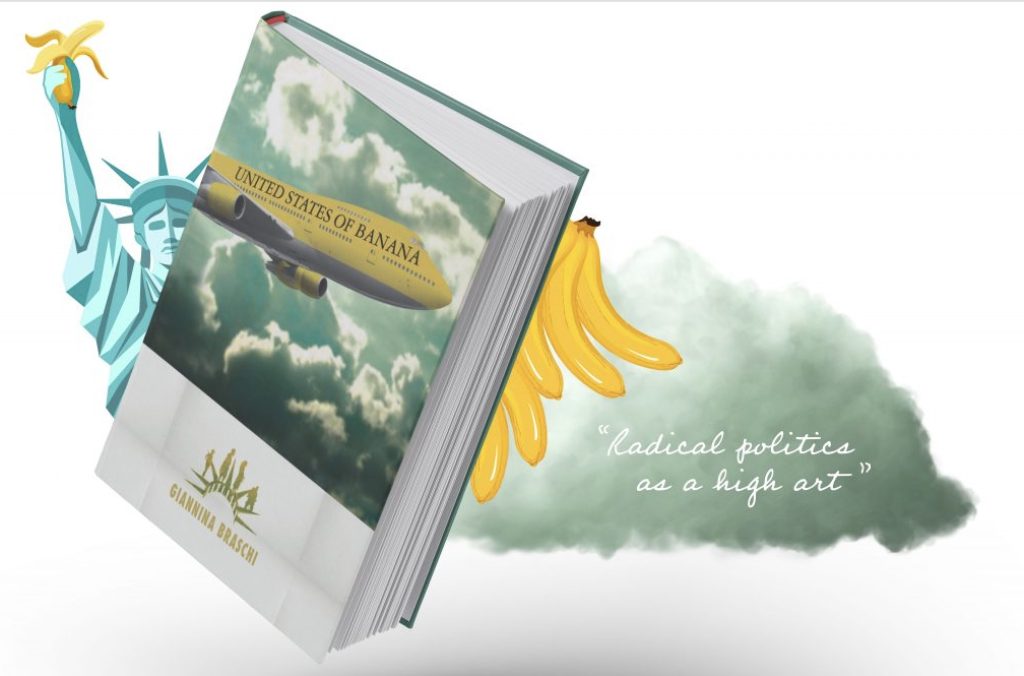
United States of Banana (2011) is the clearest point of comparison. Set in the aftermath of September 11, the geopolitical tragicomedy stages the collapse of the American empire and the liberation of Puerto Rico through a cast that includes Hamlet, Zarathustra, Segismundo, the Statue of Liberty, current world leaders, and political prisoners.
Sources including Latin American Literature Today and The Literary Encyclopedia associate Braschi with hysterical realism. But the more revealing question is not whether the label can be attached to her work. It is what the comparison illuminates—and what it cannot explain.
“The writing that goes overboard and over borders—and that is on the edge of breaking—and finds a light—and beams.”
—Giannina Braschi, interview with Famous Writing Routines
United States of Banana: A Hysterical Realist Exception
United States of Banana unleashes the manic energy and fury of post-9/11 America. The collapse of the Twin Towers erupts into a geopolitical tragicomedy about the War on Terror, political prisoners, mass incarceration, border control, rising nationalism, and Puerto Rico’s colonial condition.
With hysterical-realist velocity, the work races among dialogue, poetry, philosophy, satire, manifesto, and fiction. Its narrative excess, tonal instability, encyclopedic references, and emblematic characters turn empire, debt, immigration, and national identity into dramatic forces. Absurd comedy exposes a culture already destabilized by catastrophe and fear.
Yet the fit is not exact. Rather than overloading the realist novel, the work breaks it open into theater, poetry, philosophy, manifesto, and political revolution. The plot ignites when Hamlet, Zarathustra, and Giannina storm the dungeon beneath the Statue of Liberty’s skirt to liberate Segismundo. His liberation produces a declaration of Puerto Rican independence, moving the text from systemic diagnosis to transformation.
Related Movements and Overlapping Terms
Hysterical realism overlaps with several major literary movements, but the terms are not interchangeable. Distinguishing them allows particular books to be described more accurately.
Maximalism
Maximalist literature is defined by scale, abundance, structural complexity, multiple genres, and encyclopedic ambition. A maximalist novel may contain hundreds of characters, extensive digressions, unusual typography, multiple narrative systems, or an enormous historical range.
Many works called hysterical realism are also maximalist. But maximalism does not necessarily depend on the manic social realism Wood criticized. Danielewski’s House of Leaves and Bolaño’s 2666, for example, are securely maximalist even when their relationship to hysterical realism remains debatable.
Stefano Ercolino’s The Maximalist Novel: From Thomas Pynchon’s Gravity’s Rainbow to Roberto Bolaño’s 2666 offers an important framework for understanding this tradition.
Postmodernism
Postmodern literature employs metafiction, parody, fragmentation, pastiche, contradiction, self-reference, and unstable narrative authority. Writers frequently associated with its many traditions include Jorge Luis Borges, Vladimir Nabokov, Italo Calvino, John Barth, Donald Barthelme, Angela Carter, Kathy Acker, and Umberto Eco.
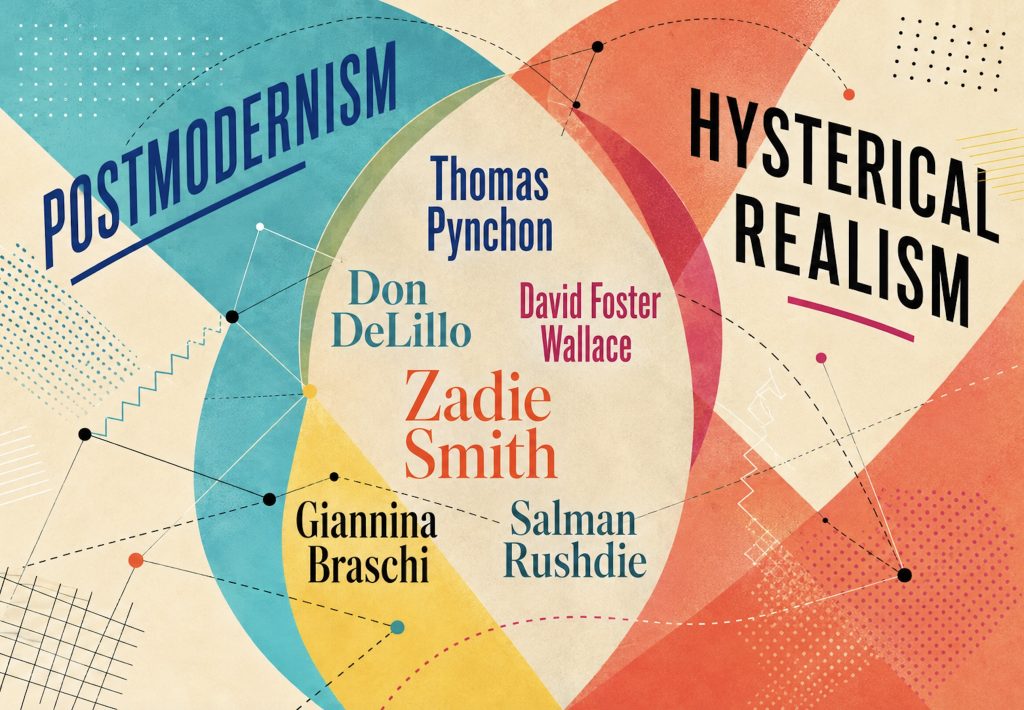
Hysterical realism emerged from this wider field but retains a strong investment in recognizable social systems. Rather than abandoning realism, it drives realism toward narrative excess. Major writers associated with both postmodernism and hysterical realism include Thomas Pynchon, Don DeLillo, David Foster Wallace, Zadie Smith, Giannina Braschi, and Salman Rushdie.
Magical Realism
Magical realism presents supernatural or impossible occurrences as part of ordinary reality. It is strongly associated with Latin American writers such as Gabriel García Márquez, Juan Rulfo, and Mario Vargas Llosa although its history extends across many languages and regions.
Hysterical realism may include improbable events, but improbability alone does not make a work magical realist. Its defining tension lies between extravagant storytelling and detailed social systems.
Rushdie’s Midnight’s Children demonstrates how a book can participate in both traditions without making the terms synonymous.
Post-Boom Literature
Post-Boom describes the diverse Latin American writing that followed the international Boom of the 1960s and 1970s. Writers associated with this broad formation include Manuel Puig, Cristina Peri Rossi, Luisa Valenzuela, Isabel Allende, Elena Poniatowska, Severo Sarduy, Diamela Eltit, Roberto Bolaño, and Giannina Braschi. Women writers assumed greater visibility, while authors explored mass culture, urban life, exile, sexuality, dictatorship, migration, linguistic experimentation, and new forms of political experience.
Several writers adjacent to hysterical realism can also be situated within this changing Latin American field, although Post-Boom names a historical and regional formation rather than a single narrative style.
McOndo Novels
Mcondo emerged in the 1990s as a response to expectations that Latin American literature should reproduce magical realism. The term was popularized by the influential 1996 anthology McOndo, edited by Chilean writers Alberto Fuguet and Sergio Gómez. Writers associated with the movement include Edmundo Paz Soldán, Rodrigo Fresán, Giannina Braschi, Jaime Bayly, and Pia Barros. Their work foregrounds cities, technology, consumer culture, media, migration, popular music, and globalization. Read more about McOndo novels and writers.
Hyperglossia
Puerto Rican writer and scholar Elidio La Torre Lagares uses “hyperglossia” to describe a textual force that exceeds stable language, space, structure, and interpretation. Hyperglossic writing does not merely contain many words or voices. Its linguistic abundance disrupts the boundaries through which narrative meaning is ordinarily controlled.
His study Hyperglossia and the Novel: The Production of (Non)Space considers writers including Olga Tokarczuk, Roberto Bolaño, Giannina Braschi, Edmundo Paz Soldán, and Maryse Condé.
Hyperglossia helps explain dimensions of excessive writing that hysterical realism cannot. While hysterical realism emphasizes narrative vitality and social systems, hyperglossia focuses on language itself as an unstable and transformative space.
Other Expansive and Adjacent Writers
Not every sprawling, experimental, or encyclopedic novel should be described as hysterical realism. Several important writers share some of its traits but may be understood more clearly through related categories.
Roberto Bolaño
The Savage Detectives (1998) and 2666 (2004) feature international casts, proliferating narratives, literary mysteries, historical violence, and vast geographical movement. Bolaño shares hysterical realism’s scale and narrative abundance, but the silences, absences, and unresolved horrors of his fiction often work against the term’s emphasis on continuous manic vitality.
Bolaño may be situated more securely within Latin American Post-Boom literature, postmodernism, and the maximalist novel.
Mark Z. Danielewski
House of Leaves (2000) and The Familiar (2015) are formally and typographically expansive. Recursive narratives, competing documents, visual arrangements, footnotes, and unstable reading paths make the physical page part of the fiction.
Danielewski is essential to discussions of experimental and maximalist literature. However, because his work disrupts the conventions of realism so radically, he is better treated as adjacent to hysterical realism than as one of its defining writers.
Dave Eggers
A Heartbreaking Work of Staggering Genius (2000) combines memoir, metafiction, grief, comedy, self-conscious performance, and formal play. Its title announces the excess that Wood’s term identifies, but its autobiographical intimacy also complicates the claim that expansive postmodern fiction lacks human feeling.
Jonathan Franzen
The Corrections (2001) connects family conflict to finance, pharmaceuticals, technology, consumerism, and global capitalism. Although Franzen’s narrative is expansive, its sustained attention to domestic psychology places it at the border between hysterical realism and the traditional social novel.
Jeffrey Eugenides
Middlesex (2002) brings family history, immigration, industrial Detroit, race, gender, genetics, and national identity into a multigenerational narrative. It shares the historical convergence and wide social field of hysterical realism while retaining the structure of an intimate family chronicle.
Is Hysterical Realism Still a Useful Term?
Hysterical realism remains useful when it identifies a genuine formal tension: the contrast between absurd narrative extravagance and careful attention to real social systems. It becomes less useful when applied as a fashionable synonym for anything long, experimental, postmodern, or strange.
The term also retains the limitations of Wood’s original judgment. It can imply that political systems and psychological experience are competing literary interests when, for many writers, they cannot be separated. Migration, colonialism, race, gender, capitalism, technology, and war do not surround private life from a distance. They enter memory, language, desire, grief, and identity.
Hysterical realism remains most valuable not as a rigid classification but as a way of asking how contemporary fiction uses excess to represent a world that already exceeds comprehension.
Hysterial Realism Further Reading
- Wood, James. “Human, All Too Inhuman: On the Formation of a New Genre: Hysterical Realism.” The New Republic, 24 July 2000.
- Garrigós, Cristina. “Postmodernist Latinx Literature in the 21st Century? The Writings of Giannina Braschi.” American Studies after Postmodernism: Renewing the American Narrative, edited by T. Tsimpouki, K. Blatanis, and A. Tseti, Palgrave Macmillan, 2024.
- Notes on Metamodernism Editorial. “Jonathan Franzen’s Post-Postmodernism.” Notes on Metamodernism, 21 August 2012.
- Aldama, Frederick Luis, and Tess O’Dwyer, editors. Poets, Philosophers, Lovers: On the Writings of Giannina Braschi. University of Pittsburgh Press, 2020.
- Ercolino, Stefano. The Maximalist Novel: From Thomas Pynchon’s Gravity’s Rainbow to Roberto Bolaño’s 2666. Bloomsbury Academic, 2014.
- González, Christopher. Permissible Narratives: The Promise of Latino/a Literature. Ohio State University Press, 2017.
- La Torre Lagares, Elidio. Hyperglossia and the Novel: The Production of (Non)Space.
- LeClair, Tom. The Art of Excess: Mastery in Contemporary American Fiction. University of Illinois Press, 1989.
- McCaffery, Larry. “A Conversation with David Foster Wallace.” The Review of Contemporary Fiction, vol. 13, no. 2, Summer 1993, pp. 127–50.
- Smith, Zadie. “This Is How It Feels to Me.” The Guardian, 13 October 2001.
Related Resources
- The Modern Novel
- Postboom Latin American Literature
- History of Experimental Literature
- Experimental American Writers
- The Literary Encyclopedia: Giannina Braschi
- American Epic Poems
- McOndo Writers
Editorial note: Curated by the Site Editors as an introductory guide, this post does not constitute writing by Giannina Braschi. Last reviewed and updated August 2026.