
Puerto Rican philosophy belongs to a wider tradition of Puerto Rican thought encompassing ethics, education, sovereignty, colonialism, race, gender, language, aesthetics, popular culture, and national identity. From Eugenio María de Hostos and Luisa Capetillo to contemporary writing on colonial debt and decoloniality, these works ask what freedom and collective life mean under continuing colonial rule. They also examine how Puerto Rico has been imagined, governed, represented, and contested across the archipelago and its diaspora.
Not every title in this guide is a work of academic philosophy. The selection also includes cultural theory books, political speeches, feminist and anticolonial writing, popular histories, criticism, and philosophical fiction. Authors such as Pedro Albizu Campos, Julia de Burgos, José Luis González, Frances Negrón-Muntaner, and Giannina Braschi develop ideas through oratory, poetry, cultural analysis, satire, and dialogue.
Read together, these books show Puerto Rican thought moving across disciplines and literary forms to confront sovereignty, discrimination, cultural power, artistic freedom, and the unfinished question of Puerto Rico’s political future.
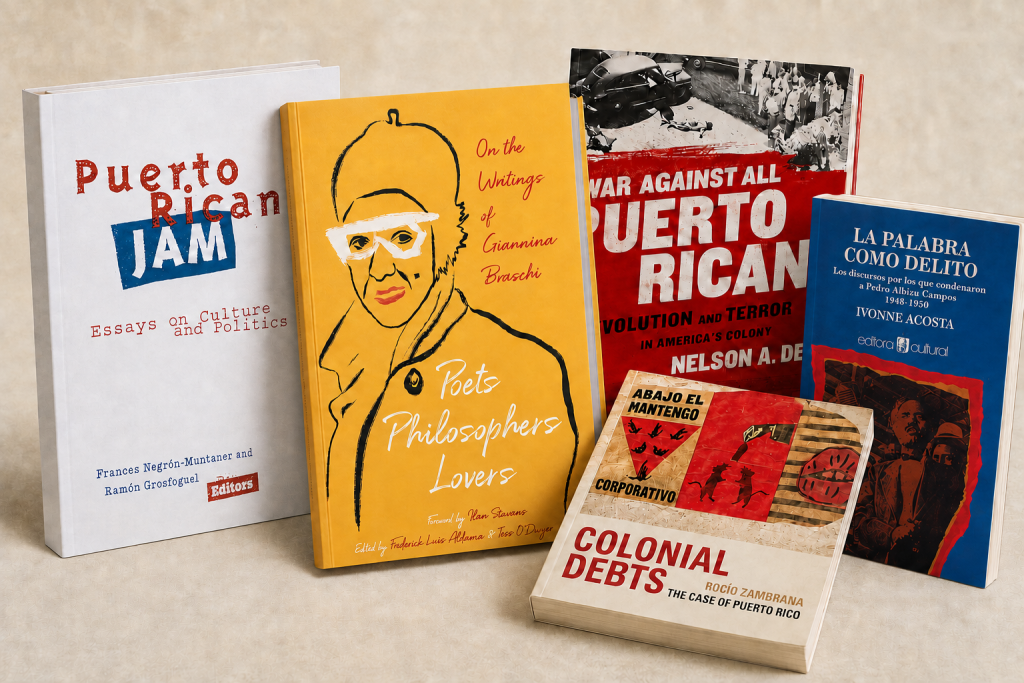
Featured Book: Poets, Philosophers, Lovers
Poets, Philosophers, Lovers: On the Writings of Giannina Braschi, edited by Frederick Luis Aldama and Tess O’Dwyer, brings fifteen scholars into conversation around four decades of poetry, fiction, theater, political philosophy, translation, and performance. Its essays examine freedom and “feardom,” artistic creation as knowledge, colonialism and sovereignty, language and power, political liberation, and the relationship between ethics and aesthetics.
Madelena Gonzalez reads United States of Banana as a defense of the creative imagination against neoliberal culture. Francisco José Ramos confronts the American trinity of money, power, and success. Ronald Mendoza-de Jesús considers freedom beyond the sovereign nation-state, while Maritza Stanchich examines Braschi’s concept of “feardom”—the fear of freedom that structures both post-9/11 life and Puerto Rico’s colonial condition. Together, the contributors approach Braschi’s books as laboratories of political possibility.
Foundations of Puerto Rican Philosophy
- Moral social — Eugenio María de Hostos (1888). Hostos grounds morality in human interdependence, joining personal responsibility to education, justice, and the ethical development of society.
- Hostos: apreciación filosófica — Carlos Rojas Osorio (1988). A sustained interpretation of Hostos as a systematic philosopher rather than only an educator, patriot, or political reformer. Biblioteca Virtual Miguel de Cervantes
- Pensamiento filosófico puertorriqueño — Carlos Rojas Osorio (2002). The essential historical map of philosophy in Puerto Rico, tracing its Enlightenment, positivist, vitalist, existentialist, phenomenological, and contemporary currents.
- Estética del pensamiento — Francisco José Ramos. Across this philosophical trilogy, Ramos treats thinking as an art and an event shaped by rhythm, metaphor, drama, contemplation, and the difficult work of inventing oneself.
Colonialism, Debt, and Cultural Thought
- Colonial Debts: The Case of Puerto Rico — Rocío Zambrana (2021). Debt emerges not merely as money owed but as an apparatus that reorganizes public institutions, everyday life, and the limits of democratic choice.
- Catastrophic Historicism: Reading Julia de Burgos Dangerously — Ronald Mendoza-de Jesús (2024). A philosophically demanding return to Poema en veinte surcos that questions how modern subjectivity is constructed through racialized and gendered forms of exclusion.
- Mi opinión sobre las libertades, derechos y deberes de la mujer — Luisa Capetillo (1911). Capetillo attacks women’s economic and sexual subordination while joining feminism to labor organizing, free love, education, and anarchist social transformation.
- La palabra como delito: Los discursos por los que condenaron a Pedro Albizu Campos, 1948–1950 — Pedro Albizu Campos; compiled and edited by Ivonne Acosta (1993). Twelve speeches used to prosecute Albizu Campos under Puerto Rico’s Gag Law reveal the political force—and legal peril—of nationalist oratory.
- El país de cuatro pisos y otros ensayos — José Luis González (1980). González overturns elite accounts of national identity by rebuilding Puerto Rican history from the ground up through labor, migration, class, and its Afro-Caribbean majority.
- Puerto Rican Jam: Rethinking Colonialism and Nationalism — edited by Frances Negrón-Muntaner and Ramón Grosfoguel (1997). An energetic collection that unsettles fixed political camps and asks whether nationalism alone can describe Puerto Rico’s mobile, diasporic, and racially complex society.
- I Am My Own Path: Selected Writings of Julia de Burgos — edited and translated by Vanessa Pérez-Rosario (2025). Poetry, journalism, essays, and letters recover de Burgos as a feminist public intellectual moving among Puerto Rico, Havana, and New York.
Popular Books on Puerto Rican Politics and History
- War Against All Puerto Ricans — Nelson A. Denis (2015). A propulsive narrative of Pedro Albizu Campos, the Nationalist revolts, and US repression that brought an obscured history to a mass readership, although historians dispute some of its claims.
- Fantasy Island: Colonialism, Exploitation, and the Betrayal of Puerto Rico — Ed Morales (2019). Morales follows the money—from US tax policy and corporate privilege to Wall Street debt—to explain how Puerto Rico became profitable to outsiders while increasingly unlivable for many residents.
- Puerto Rico: A National History — Jorell Meléndez-Badillo (2024). A panoramic history that moves beyond governors and official institutions to center the workers, migrants, organizers, and ordinary people who repeatedly remade the nation.
Literature as Radical Thinking
- Yo-Yo Boing! — Giannina Braschi (1998). In rapid-fire dialogues, characters confront Puerto Rican independence and sovereignty, racial and linguistic discrimination, artistic freedom, and the creative power of “in-betweenies” who refuse fixed cultural and political categories.
- United States of Banana — Giannina Braschi (2011). Hamlet, Zarathustra, and Giannina set out to liberate Segismundo from beneath the Statue of Liberty in a comic geopolitical revolt against borders, prisons, empire, and the nation-state.
Puerto Rican thought does not reside in a single discipline. It moves among philosophical treatises, political speeches, feminist manifestos, cultural criticism, popular history, poetry, and fiction. Across these forms, its recurring question is not only what Puerto Rico is, but what freedom might yet allow it to become.
Related Posts
- Postcolonial Political Philosophy
- Latin American Philosophers and Poets
- Puerto Rican Thought
- Rethinking the Latin American Canon
- Puerto Rican philosophers
- Latin American women philosophers
Editorial note: This independently prepared reading guide was written and reviewed by the editors of GianninaBraschi.com. It was not written by Giannina Braschi.
Last reviewed August 25, 2026.