
Postcolonial political philosophy examines how empire shapes freedom, sovereignty, citizenship, language, and political identity. Puerto Rican poet and philosopher Giannina Braschi transforms these questions into literature through satire, Spanglish, dramatic dialogue, and radical experiments in form and genre.
Across Empire of Dreams, Yo-Yo Boing!, United States of Banana, and PUTINOIKA, Braschi confronts colonialism, debt, capitalism, migration, nationhood, and liberation. Scholars including Grace Whistler, Hamid Dabashi, Ronald Mendoza-de Jesús, Francisco José Ramos, Tess O’Dwyer, and Arnaldo Cruz-Malavé read her literature as a form of political and philosophical thought. Her standing as a radical thinker was recognized by the American Studies Association, which awarded her the 2024 Angela Y. Davis Prize.
What Is Postcolonial Political Philosophy?
Postcolonial political philosophy asks how colonial rule and its continuing structures shape concepts often presented as universal. It questions who is recognized as sovereign, who receives the rights of citizenship, whose language carries authority, and whether the political vocabulary inherited from imperial powers can adequately describe liberation.
Braschi tests these questions from Puerto Rico’s unresolved position as a territory of the United States. Her writing belongs to a wider tradition of Puerto Rican philosophy that confronts colonialism, sovereignty, education, ethics, political economy, language, and national identity.
In United States of Banana, Puerto Rico appears as Segismundo, the political prisoner from Pedro Calderón de la Barca’s Life Is a Dream, confined beneath the skirt of the Statue of Liberty. Giannina, Hamlet, and Zarathustra travel there to liberate him. Through this improbable philosophical comedy, Braschi exposes the contradiction between the United States’ universal language of liberty and Puerto Rico’s continuing colonial status.
The novel transforms Puerto Rico’s political alternatives—independence, commonwealth, and statehood—into the comic figures Wishy, Wishy-Washy, and Washy. Its satire does not simply argue among established choices. It asks whether freedom can be achieved through political categories created and administered by colonial power.
Braschi names the tension between fear and freedom with the word “feardom”:
“What they bring is fear. Not freedom. Feardom is what they bring.”
The term describes more than fear. It exposes the possibility that a state may speak continuously of freedom while governing through insecurity, confinement, debt, surveillance, and exploitation.
Grace Whistler: Literature, Moral Philosophy, and the Monsters of Reason
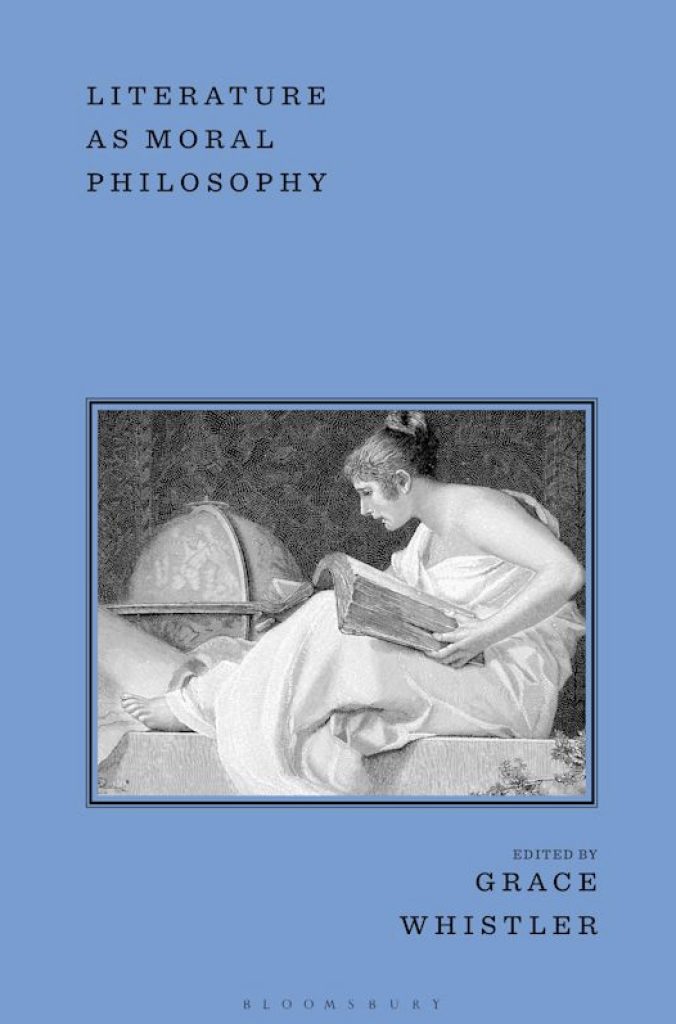
Grace Whistler’s “The Dream of Reason: Parables and Monsters in the Novels of Giannina Braschi” appears in the newly published collection Literature as Moral Philosophy (Bloomsbury Academic, 2026), which Whistler also edited.
The chapter’s title invokes Francisco Goya’s celebrated etching The Sleep of Reason Produces Monsters—El sueño de la razón produce monstruos—and Braschi’s own engagement with that proposition. The conjunction is telling: in Braschi, reason does not stand outside political monstrosity; her literature turns reason toward its diagnosis.
This anthology places Braschi alongside discussions of Kant, Judith Butler, Mikhail Bakhtin, Albert Camus, Mary Shelley, Dostoevsky, moral growth, and the ethics of reading. It offers scholars a new route into Braschi’s work through moral philosophy, aesthetics, and the philosophical capacity of literary form.
Tess O’Dwyer: The Life and Works of a Poet-Philosopher
In her 2026 article “Giannina Braschi” for The Literary Encyclopedia, Tess O’Dwyer presents Braschi as “a leading force of innovation in American and Latin American literature and political philosophy.” She traces Braschi’s development from her early formation in Puerto Rico and Spain and her first poetry collection, Asalto al tiempo (1981), to her latest work, PUTINOIKA (2024).
O’Dwyer shows how Braschi transforms the constraints of Puerto Rico’s colonial condition into an expansive avant-garde territory where art and language become catalysts for liberation. She situates Braschi’s writing amid “the erosion of civil liberties; the disintegration of the United States; the collapse of democracies; the escalation of militarism, oligarchy, and nationalism; and the formation of new geopolitical alliances that threaten the core of Western values and economies.” Against this collapse, Braschi calls for “new noises, new values, new genres” in the “void where nothing works” (PUTINOIKA 276).
Giannina Braschi as a Radical Thinker
Braschi’s political philosophy unfolds through characters in Socratic dialogue, a chorus of anonymous voices, arguments, jokes, declarations, reversals, and manifestos. Her writing repeatedly asks:
- Can freedom exist without sovereignty?
- Can sovereignty liberate, or does it reproduce domination?
- What happens when capitalism presents economic power as political freedom?
- How do debt and colonial status determine the limits of citizenship?
- Can a colonized people become free through the political categories of the colonizer?
- Can linguistic and literary experimentation create forms of thought unavailable within established institutions?
These questions have drawn philosophers and literary scholars working in political theory, Latinx studies, postcolonial philosophy, comparative literature, and decolonial thought.
Ronald Mendoza-de Jesús: Freedom Beyond Sovereignty
In “Free-dom: United States of Banana and the Limits of Sovereignty,” Ronald Mendoza-de Jesús places Braschi in conversation with Jacques Derrida. His analysis begins from one of Braschi’s most condensed philosophical propositions:
“Free from freedom. Free.”
Mendoza-de Jesús asks whether conventional freedom remains bound to sovereign mastery—the ideal of a person or state possessing itself completely and exercising power without dependency. By breaking freedom into free and -dom, his essay discovers in Braschi the possibility of an “improper freedom”: freedom no longer grounded in possession, mastery, or obedience.
This interpretation is particularly important for Puerto Rican political thought. It moves the discussion beyond the acquisition of formal sovereignty and asks whether sovereignty itself carries assumptions inherited from imperial political philosophy.
Francisco José Ramos: Money, Power, and Success
Puerto Rican philosopher Francisco José Ramos reads United States of Banana as a confrontation with what he calls the “Holy Trinity of the American Way of Life: Power, Money, and Success.”
In Ramos’s account, these values become the dominant criteria by which reality and human worth are judged. Capitalism passes itself off as democracy; economic power appears as freedom; success becomes the measure of the person. Braschi’s satire disrupts this trinity by exposing the emptiness, violence, and absurdity concealed beneath its authority.
Ramos demonstrates why Braschi’s treatment of capitalism cannot be separated from her political philosophy. Money is not merely an economic subject in her work. It structures value, aspiration, recognition, sovereignty, and the limits of political imagination.
John “Rio” Riofrio: Catastrophic Bravery and Financial Terrorism
In “Rompiendo esquemas: Catastrophic Bravery in United States of Banana,” John “Rio” Riofrio describes Braschi’s novel as a sustained meditation on freedom, contentment, critical thought, and the courage required to become uncomfortable. The Spanish phrase romper los esquemas—to break established patterns or schemas—links Braschi’s radical form to her rejection of political habits that make colonial inequality appear natural.
Riofrio develops the economic dimension of this argument in “Falling for Debt: Giannina Braschi, the Latinx Avant-Garde, and Financial Terrorism in United States of Banana.” There he connects debt, austerity, neoliberal reform, and financial insecurity with forms of systemic violence.
His work opens Braschi to scholars studying Puerto Rico’s debt crisis, PROMESA, colonial capitalism, and the political vocabulary of terrorism. These questions also connect Braschi with the thinkers and titles featured in Puerto Rican Philosophy Books.
Anne Ashbaugh: Exile and Ontological Sameness
Anne Ashbaugh’s “Exile and Burial of Ontological Sameness: A Dialogue between Zarathustra and Giannina” reads Braschi alongside Friedrich Nietzsche’s Thus Spoke Zarathustra.
Ashbaugh examines Braschi’s resistance to fixed identities, stable interpretations, and supposedly neutral forms of knowledge. Braschi turns authors into characters, characters into philosophers, and philosophical authorities into participants in unruly conversations. Rather than replacing one dominant worldview with another, her writing keeps identity and interpretation in motion.
This refusal of ontological sameness links Braschi’s experimental form to a postcolonial challenge: the right to exist without being reduced to categories imposed by nation, empire, language, gender, or literary genre.
Madelena Gonzalez: Art Against Commodification
Madelena Gonzalez’s “The Uncommon Wealth of Art: Poetic Progress as Resistance to the Commodification of Culture in United States of Banana” examines the political force of Braschi’s aesthetic experimentation.
Gonzalez positions art against a marketplace that attempts to convert culture into property and monetary value. Braschi’s “uncommon wealth” lies in imaginative freedom, linguistic invention, and forms of creation that resist standardization. The essay is useful for scholars interested in the relationship among aesthetics, neoliberalism, cultural value, and political resistance.
Arnaldo Cruz-Malavé: Gender, Empire, and Camaraderie from Below
In “‘Under the Skirt of Liberty’: Giannina Braschi Rewrites Empire,” published in American Quarterly, Arnaldo Cruz-Malavé situates Braschi within a long tradition of Latino anticolonial writing about New York—the “Empire City.” He examines how that predominantly male tradition projected the disorienting effects of metropolitan modernity onto feminized and sexually ambivalent figures.
In United States of Banana, the space beneath the Statue of Liberty’s skirt becomes an “undercommons” inhabited by Segismundo, an allegorical Puerto Rico, and a multinational company of fugitives and so-called terrorists. Braschi imagines resistance through dispossession, deterritorialization, cooperation, compañerismo, and what Cruz-Malavé calls horizontal “camaraderie from below.”
Peter Hitchcock: Novel Form and Decolonization
Peter Hitchcock’s “Novelization in Decolonization, or, Postcolonialism Reconsidered,” published in Other Globes: Past and Peripheral Imaginations of Globalization, considers Braschi within debates about Puerto Rico, globalization, and the unfinished work of decolonization.
Hitchcock’s study is valuable because it joins political content to literary form. In dramatizing the colonial condition, Braschi alters the conventions through which the nation, the globe, and the postcolonial world are imagined. Her formal experimentation becomes part of the work of decolonization.
Hamid Dabashi: Nations Without Borders
In “On Nations Without Borders,” Hamid Dabashi turns to Braschi’s United States of Banana while questioning the nation-state as the presumed destination of anticolonial struggle.
Braschi’s declaration of Puerto Rican independence and her demand for open borders allow Dabashi to imagine political belonging beyond the territorial logic of bordered sovereignty. Her work contributes to a conception of liberation not confined to the replication of European nation-state models.
Dabashi’s analysis brings Braschi into conversation with transnational political thought, migration, exile, and postcolonial critiques of the state. His essay appears in Global Middle East: Into the Twenty-First Century, published by the University of California Press.
Alexandra Perisic: Migration, Precarity, and Atlantic Undercommons
In Chapter 5, “Atlantic Undercommons,” of Precarious Crossings: Immigration, Neoliberalism, and the Atlantic, Alexandra Perisic places United States of Banana within a transatlantic study of migration and neoliberal globalization.
Perisic examines Braschi’s juxtaposition of the immigrant and the so-called terrorist—figures brought into proximity through precarity, statelessness, and indefinite detention without trial. She argues that their potential solidarity produces new political and linguistic possibilities, including what Braschi calls “foreign speaking English.” Braschi’s characters do not simply cross geographical borders. They move across languages, political identities, literary genres, and unequal systems of value, creating what Perisic describes as an Atlantic undercommons.
Braschian Language as Political Philosophy
Braschi’s movement among Spanish, English, and Spanglish is not merely stylistic ornament. Her languages carry the histories of Spanish colonialism, United States imperial power, migration, assimilation, and resistance.
Francisco Moreno-Fernández reads Yo-Yo Boing! as translingual rather than simply bilingual. Maritza Stanchich examines the colonial histories carried by English and Spanish. Their scholarship demonstrates that Braschi’s linguistic experimentation contests the classifications through which cultural and political authority is organized.
A language may promise entry into citizenship while marking its speaker as foreign. It may carry imperial authority while being transformed by those expected to assimilate. In Braschi, code-switching becomes a way of thinking politically across structures that demand singular allegiance.
Braschi at the Cambridge Union
In the 2025 Cambridge Union debate “This House Would Not Judge Yesterday’s Art by Today’s Politics,” Giannina Braschi speaks for the proposition on the relationship between artistic freedom, political judgment, and historical change. The appearance offers a rare public demonstration of Braschi’s political and aesthetic thought beyond the page.
Why Giannina Braschi Matters to Postcolonial Philosophy
Braschi gives postcolonial political philosophy an unusually dramatic and imaginative vocabulary. “Feardom,” “free from freedom,” the imprisoned Segismundo, the Holy Trinity of money, power, and success, and the comic status figures Wishy, Wishy-Washy, and Washy are not illustrations added to a political theory. They are concepts produced through literature.
Her work also expands the field beyond a familiar canon of theoretical prose. Braschi demonstrates that poetry, satire, theatrical dialogue, Spanglish, parody, and tragicomedy can undertake philosophical work. They can expose contradictions, test political ideas, and imagine modes of freedom that discursive argument alone may not reach.
For readers seeking new scholarship in postcolonial philosophy, political aesthetics, Puerto Rican thought, moral philosophy, sovereignty studies, and decolonial literature, Braschi offers both a major primary author and a growing critical field.
Essential Scholarship on Braschi’s Radical Thinking
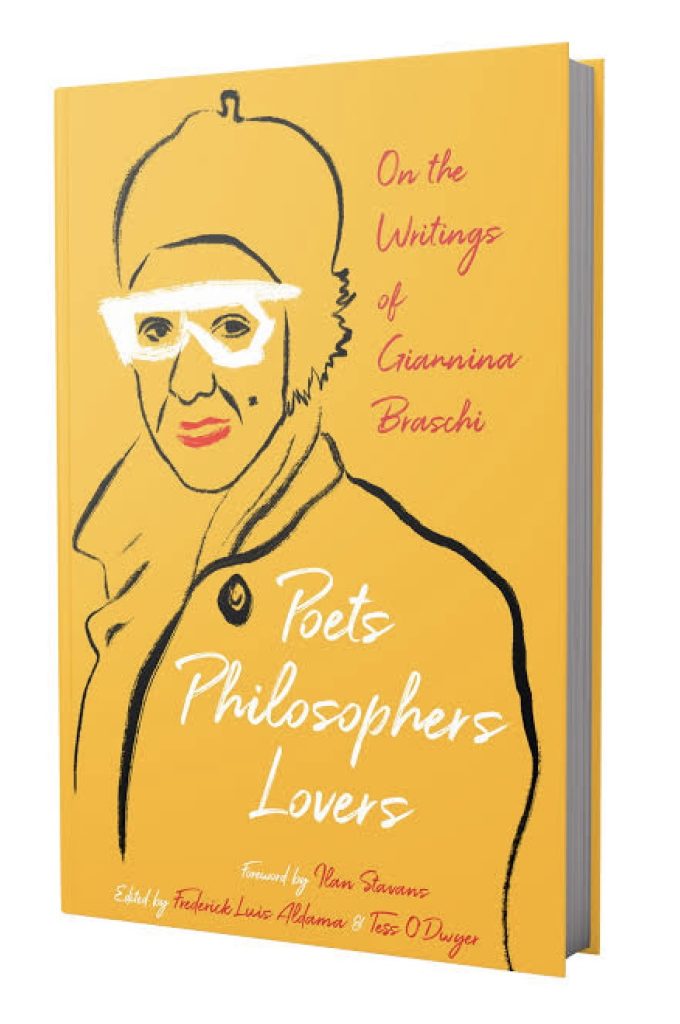
- Aldama, Frederick Luis, and Tess O’Dwyer, editors. Poets, Philosophers, Lovers: On the Writings of Giannina Braschi. University of Pittsburgh Press, 2020.
- Ashbaugh, Anne. “Exile and Burial of Ontological Sameness: A Dialogue between Zarathustra and Giannina.” Poets, Philosophers, Lovers: On the Writings of Giannina Braschi, edited by Frederick Luis Aldama and Tess O’Dwyer, University of Pittsburgh Press, 2020.
- Cruz-Malavé, Arnaldo Manuel. “‘Under the Skirt of Liberty’: Giannina Braschi Rewrites Empire.” American Quarterly, vol. 66, no. 3, 2014, pp. 801–18.
- Dabashi, Hamid. “On Nations Without Borders.” Global Middle East: Into the Twenty-First Century, edited by Asef Bayat and Linda Herrera, University of California Press, 2021.
- Gonzalez, Madelena. “The Uncommon Wealth of Art: Poetic Progress as Resistance to the Commodification of Culture in Giannina Braschi’s United States of Banana.” Poets, Philosophers, Lovers: On the Writings of Giannina Braschi, edited by Frederick Luis Aldama and Tess O’Dwyer, University of Pittsburgh Press, 2020.
- Hitchcock, Peter. “Novelization in Decolonization, or, Postcolonialism Reconsidered.” Other Globes: Past and Peripheral Imaginations of Globalization, edited by Simon Ferdinand, Irene Villaescusa-Illán, and Esther Peeren, Palgrave Macmillan, 2019, pp. 177–94.
- Mendoza-de Jesús, Ronald. “Free-dom: United States of Banana and the Limits of Sovereignty.” Poets, Philosophers, Lovers: On the Writings of Giannina Braschi, edited by Frederick Luis Aldama and Tess O’Dwyer, University of Pittsburgh Press, 2020.
- O’Dwyer, Tess. “Giannina Braschi.” The Literary Encyclopedia, vol. 3.2.7, Chicano/Latino Writing and Culture of the United States, edited by Thomas Nulley-Valdés, first published 19 Mar. 2026.
- Perisic, Alexandra. Precarious Crossings: Immigration, Neoliberalism, and the Atlantic. Ohio State University Press, 2019.
- Ramos, Francisco José. “The Holy Trinity: Money, Power, and Success in United States of Banana.” Poets, Philosophers, Lovers: On the Writings of Giannina Braschi, edited by Frederick Luis Aldama and Tess O’Dwyer, University of Pittsburgh Press, 2020. On Postcolonial Political Philosophy.
- Riofrio, John. “Falling for Debt: Giannina Braschi, the Latinx Avant-Garde, and Financial Terrorism in United States of Banana.” Latino Studies, vol. 18, 2020.
- Riofrio, John. “Rompiendo esquemas: Catastrophic Bravery in United States of Banana.” Poets, Philosophers, Lovers: On the Writings of Giannina Braschi, edited by Frederick Luis Aldama and Tess O’Dwyer, University of Pittsburgh Press, 2020.
- Whistler, Grace. “The Dream of Reason: Parables and Monsters in the Novels of Giannina Braschi.” Literature as Moral Philosophy, edited by Grace Whistler, Bloomsbury Academic, 2026.
Further Reading in Puerto Rican and Decolonial Thought
- Césaire, Aimé. Discourse on Colonialism. Translated by Joan Pinkham, Monthly Review Press, 2000.
- Dussel, Enrique. Politics of Liberation: A Critical World History. Translated by Thia Cooper, SCM Press, 2011.
- Fanon, Frantz. The Wretched of the Earth. Translated by Richard Philcox, Grove Press, 2004.
- James, C. L. R. The Black Jacobins: Toussaint L’Ouverture and the San Domingo Revolution. First published in 1938.
- Lebrón Ortiz, Pedro. Filosofía del Punto Medio: Thoughts on Decoloniality and Puerto Rican Existence. Editorial Educación Emergente, 2021.
- Maldonado-Torres, Nelson. Against Coloniality: Imperiality, Decolonization, and Critical Thought. Duke University Press, 2023.
- Mbembe, Achille. Out of the Dark Night: Essays on Decolonization. Columbia University Press, 2021.
- Mendoza-de Jesús, Ronald. Catastrophic Historicism: Reading Julia de Burgos Dangerously. Fordham University Press, 2024.
- Mignolo, Walter D. The Darker Side of Western Modernity: Global Futures, Decolonial Options. Duke University Press, 2011.
- Murdoch, H. Adlai. The Struggle of Non-Sovereign Caribbean Territories: Neocolonialism and Anti-Colonial Discourse. Rutgers University Press, 2021.
- Zambrana, Rocío. Colonial Debts: The Case of Puerto Rico. Duke University Press, 2021.
Explore Giannina Braschi and Political Philosophy
- Giannina Braschi’s Biography
- United States of Banana
- Latinx Literature: A Very Short Introduction
- Essential Puerto Rican Philosophy Books
- Caribbean Philosophy Today
Editorial Note
This article introduces scholarship on Giannina Braschi, postcolonial political philosophy, and Puerto Rican thought. Interpretations are based on the cited books and scholarly sources. Unless expressly identified as a quotation, the descriptions and interpretations presented here are editorial and should not be attributed directly to Braschi or to the scholars cited.
Last updated October 2026.