
Puerto Rican philosophers have turned the island’s unresolved political condition into a source of radical thought. Across ethics, aesthetics, political theory, poetry, and cultural criticism, they ask what freedom means inside an empire; how debt becomes rule; whether education can produce liberation; and how language, memory, and migration shape a people.
The categories below overlap by design. Puerto Rican thought has rarely respected the border between philosophy and literature, or between theory and political life.
Education, Ethics, and Liberation Philosophy
Eugenio María de Hostos (1839–1903) made education inseparable from freedom. In Moral social (1888) and the writings collected as Tratado de moral, reason becomes an ethical practice: a way to prepare people for civic responsibility and self-government. The “Citizen of the Americas” also fought for abolition, women’s education, Puerto Rican independence, and an Antillean confederation.
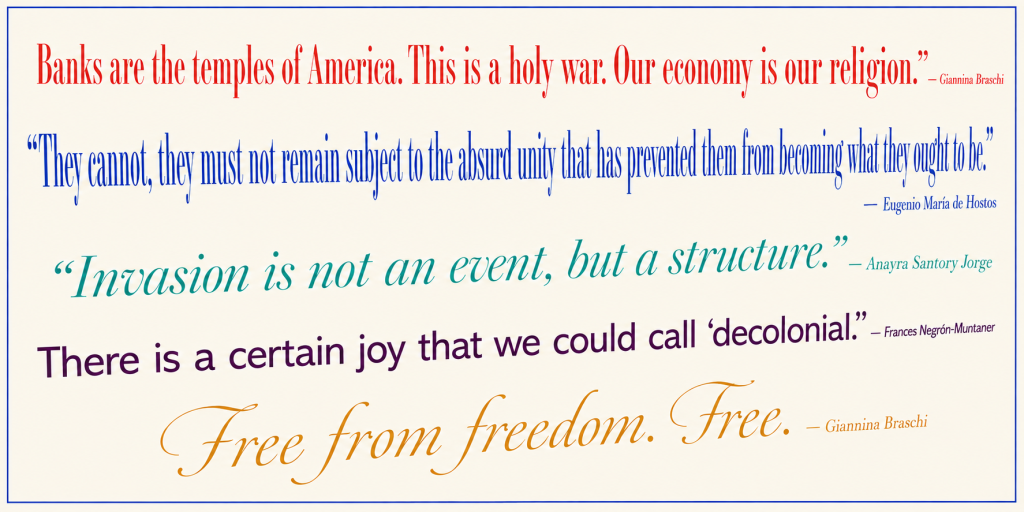
“They cannot, they must not remain subject to the absurd unity that has prevented them from becoming what they ought to be.”
—Eugenio María de Hostos, address at the Ateneo de Madrid
Identity, Insularity, and the Nation
Antonio S. Pedreira (1899–1939) posed a question Puerto Rican thinkers have never stopped disputing: what historical forces produce a national character? Insularismo (1934) interpreted the island through geography, colonial inheritance, language, and cultural isolation.
Its portrait of Puerto Rico proved enormously influential—and deeply contestable. Pedreira matters not as a final authority, but as the author of an argument later generations have repeatedly dismantled and rebuilt.
Aesthetics and the Act of Philosophical Writing
Francisco José Ramos (1950–) refuses to separate philosophy from poetry, the body, or artistic experience. His multivolume Estética del pensamiento, beginning with El drama de la escritura filosófica (1998), moves among ontology, Nietzsche, psychoanalysis, Buddhism, ethics, and aesthetics. For Ramos, aesthetics is not the study of beauty. It is an awakening to the unruly abundance of the real. Thinking does not merely describe the world; it takes shape through language, art, perception, and encounters with what resists explanation.
Theories on Colonialism, Debt, and Resistance
Anayra Santory Jorge brings philosophy down from abstraction and into the damaged textures of daily life. Her writing joins political philosophy, feminism, ethics, colonialism, and collective survival. Nada es igual: Bocetos del país que nos acontece reads contemporary Puerto Rico through austerity, disaster, political language, and intimate experience.
Santory Jorge also coedited, with Mareia Quintero Rivera, the Antología del pensamiento crítico puertorriqueño contemporáneo, a wide-ranging collection of Puerto Rican social and political thought.
“Invasion is not an event, but a structure.”
—Anayra Santory Jorge in a discussion of Colonial Debts
Rocío Zambrana names debt as a form of colonial power. In Colonial Debts: The Case of Puerto Rico (2021), she develops “neoliberal coloniality”: a system in which finance intensifies older hierarchies of race, gender, and class while disguising colonial domination as fiscal necessity.
The book also turns toward protest, occupation, feminist organizing, and other practices that refuse the positions debt assigns.
New Concepts of Freedom, Sovereignty, and “Feardom”
Giannina Braschi makes philosophy happen through poetry, fiction, dialogue, manifesto, satire, and theater. El imperio de los sueños (1988), Yo-Yo Boing! (1998), United States of Banana (2011), and PUTINOIKA (2024) test freedom against colonialism, capitalism, migration, incarceration, censorship, and empire.
In United States of Banana, Puerto Rico’s political options become Wishy, Wishy-Washy, and Washy: independence, commonwealth, and statehood turned into philosophical caricatures. Braschi calls the fear of freedom “feardom” and asks whether sovereignty can liberate without reproducing domination.
Free from freedom. Free.
—Giannina Braschi, United States of Banana
Memory, History, Empire
Arcadio Díaz-Quiñones writes about the fractures in Puerto Rican memory. La memoria rota (1993) tracks what nations remember, suppress, and mythologize. His work on 1898 reopens the histories of empire, race, Hispanism, and national belonging. Princeton describes Díaz-Quiñones as one of the foremost Caribbean public intellectuals of his generation.
Ronald Mendoza-de Jesús rethinks how literary history turns writers into monuments. In Catastrophic Historicism: Reading Julia de Burgos Dangerously (2024), he challenges inherited interpretations of Puerto Rico’s canonical poet and reads Poema en veinte surcos as a poetics of Puerto Rican modernity. Moving through philosophy, literary theory, race, gender, and sovereignty, the book asks how historical narratives domesticate the past—and what becomes possible when we read it dangerously.
Popular Culture, Visibility, and Decolonial Joy
Juan Flores (1943–2014) redrew the cultural map between Puerto Rico and New York. From Bomba to Hip-Hop (2000) follows music, migration, literature, and popular culture across the island and its diaspora. Flores rejected the idea that Puerto Rican culture loses authenticity when it travels. Movement, mixture, and reinvention are the tradition.
Frances Negrón-Muntaner finds colonial politics in unexpected places: West Side Story, Jennifer Lopez, beauty, shame, celebrity, film, archives, and media visibility. Her award-winning Boricua Pop (2004) showed that popular culture is one of the principal stages on which Puerto Ricanness is produced, consumed, and contested. She also coedited Puerto Rican Jam: Rethinking Colonialism and Nationalism.
“There is a certain joy that we could call ‘decolonial.’”
—Frances Negrón-Muntaner, “Public Thinker” interview
Philosophy as a Literary Genre
The boundary between philosopher and cultural theorist is useful but porous. Puerto Rican intellectual life has long treated essays, poems, performances, and political interventions as forms of thought.
Poets, Philosophers, Lovers: On the Writings of Giannina Braschi brings these methods together. Edited by Frederick Luis Aldama and Tess O’Dwyer, with a foreword by Ilan Stavans, the collection of essays by 15 scholars approaches Braschi through philosophy, political theory, cultural studies, linguistics, gender studies, and literary criticism.
Its central questions concern freedom vs feardom, sovereignty, debt, language, love, artistic creation, and revolution.
Where Puerto Rican Philosophy Is Studied
Puerto Rican philosophy belongs to overlapping Caribbean, Latin American, Latinx, and decolonial traditions. These organizations and publications offer paths into the wider field:
- The Caribbean Philosophical Association unites scholars and public intellectuals working across the Caribbean and its diasporas. Its guiding project, “Shifting the Geography of Reason,” challenges conventional assumptions about where philosophy originates.
- CENTRO Journal is a leading peer-reviewed journal of Puerto Rican Studies, encompassing cultural theory, colonialism, diaspora, race, gender, history, politics, and the arts.
- The C.L.R. James Journal, the association’s peer-reviewed journal, publishes work on Caribbean philosophy, political thought, history, literature, and decolonization.
- Diálogos, founded by the Department of Philosophy at the University of Puerto Rico, Río Piedras, has published philosophical scholarship in Spanish, English, and French since 1964.
- The American Philosophical Association Committee on Hispanics/Latinxs promotes Latin American and Latinx philosophy within the profession and publishes APA Studies on Hispanic/Latino Issues in Philosophy.
- The Stanford Encyclopedia of Philosophy entry on Latinx Philosophy places Puerto Rican thought within wider debates about identity, race, language, ethics, politics, and knowledge.
Further Reading
- Postcolonial Political Philosophy
- Puerto Rican Philosophy Books
- Puerto Rican Thought
- Latin American Philosophers
- Caribbean Philosophy Today
Editorial note: This selective introduction was prepared by the editors of GianninaBraschi.com as a starting point rather than a comprehensive directory. It was not written by Giannina Braschi.
Last reviewed August 2026.