
United States of Banana Summary: The Literary Encyclopedia
Imperial Pax Banana
United States of Banana Summary: The Literary Encyclopedia
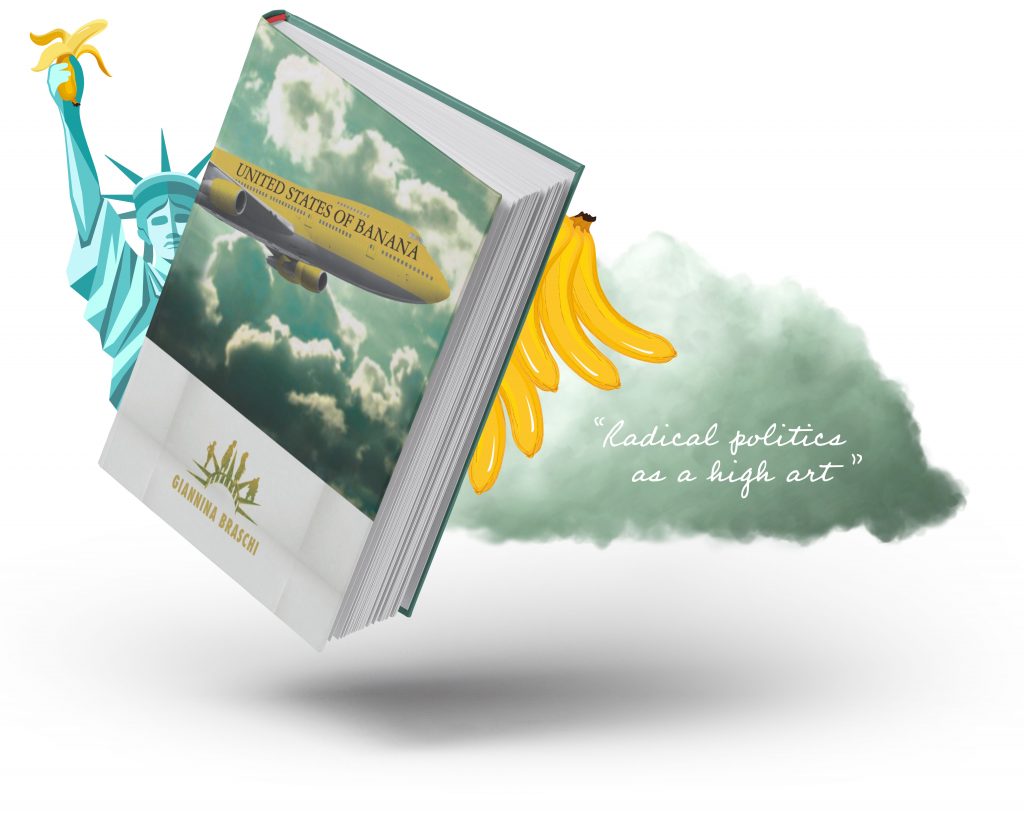
United States of Banana, Giannina Braschi’s first work written in English, rewrites “radical politics as high art” by dramatizing the collapse of the Twin Towers as a metaphor for the fall of the American empire (Gonzalez 23). Described by Library Journal as “bizarre but intriguing” philosophical fiction for Nietzsche fans, the text targets a reader who is “heady, creative, and up for a challenging read” (Beck 2011; O’Dwyer 2021).
Cultural theorist Hamid Dabashi hails the work as one of the most brilliant postcolonial texts of the 9/11 era, “savagely critical of the predatory capitalism and its ravages in Puerto Rico and around the globe” (Dabashi 65). Opening at “Ground Zero” with a rhythmic series of sardonic meditations on life in the “Darwinist capital of the capitalist world”, the work pivots from ruin to revolution in Part Two (Banana 28). Here, high-levity theater recasts iconic figures from Shakespeare and Calderón de la Barca. In an absurdist coup, the melancholy Hamlet, the prophetic Zarathustra, and the revolutionary Giannina infiltrate the dungeon beneath the skirt of the Statue of Liberty to liberate the Puerto Rican prisoner Segismundo. In a desperate attempt to preserve the crumbling “United States of Banana”, King Basilio and Queen Gertrude plot to co-opt the revolution by offering statehood and American passports to all Latin Americans. Rejecting this “Imperial Pax Banana”, the insurgents wage an existential war of coconuts and philosophy against the empire (Mendoza-de Jesús 141). Giannina negotiates a New World Order with China, the United States’ creditor, by trading a lychee for a quenepa to settle the debt of independence. Through this theater of diplomacy, Braschi compels readers “to rethink what we mean by freedom, what we regard as a right, and what we understand by sovereign power” (Mendoza-de Jesús 153).
Ultimately, United States of Banana serves as “a masterclass on how to romper esquemas” (break with established norms) (Riofrio 32). By casting iconic literary figures alongside a “chorus of the masses”—undocumented immigrants and political prisoners—Braschi marshals a “literary multitude” at the intersection of theater, philosophy, and activism (Perisic 173). The work culminates in a reimagined Symposium where erudite humor peaks: Parmenides eats ice cream on a cloud, Diotima instructs Socrates, and a taxi driver named Hasib teaches Giannina the meaning of gratitude—redefining the Republic as a site where gratitude is the “eradication of envy” and the manifestation of a profound “love for life” (Morgado, “Love for Life”).
About the Author Giannina Braschi
Giannina Braschi is a leading force of innovation in American and Latin American literature and political philosophy of the late twentieth and early twenty-first century. Braschi writes mixed-genre epic works in Spanish, Spanglish, and English about the marvels and travesties of the human flow—of mass migration, mass incarceration, democracy, economy, and revolution—and of enduring humanistic themes of creativity, love, liberty, and hope.
The United States Library of Congress qualified Braschi’s genre-defying writings as cutting-edge, influential, and revolutionary. Her works include the epic poem El imperio de los sueños (1988) [Empire of Dreams, 1994], the groundbreaking Spanglish novel Yo-Yo Boing! (1998), and the geopolitical tragicomedy United States of Banana (2011). Her magnum opus PUTINOIKA (2024) is a mixed-genre tragicomedy in the era of the late-stage American empire marked by collusion, pollution, and delusion.
Braschi creates “hard-hitting, no-holds-barred, mind-expanding story-worlds” that testify to some of the gravest manmade and natural catastrophes of the contemporary period, including the September 11th attacks on the World Trade Center and the COVID-19 pandemic (Aldama and O’Dwyer 15). Her politically charged and radical texts presciently prophesize further erosion of civil liberties; the disintegration of the United States; the collapse of democracies; the escalation of militarism, oligarchy, and nationalism; and the formation of new geopolitical alliances that threaten the core of Western values and economies. And yet, amidst the disintegration of civil society, there is an unrelenting hope in Braschi’s work. The Puerto Rican cultural icon urgently calls for the creation of “new noises, new values, new genres” in the “void where nothing works” (PUTINOIKA 276).

United States of Banana Podcast : Workers Lit
Listen to the Worker’s Lit Podcast on the postmodern United States of Banana with Karlo Yeager Rodríguez.
Highly Influential Yet Notoriously Unclassifiable
(Excerpted from The Literary Encyclopedia)
Eccentric, strange, bizarre, original, visionary, prophetic, revolutionary, and unclassifiable are the go-to adjectives applied to both Braschi and her lifework. However, in academic terms, Braschi is associated with a range of fields. These include stylistic movements such as postmodern literature and hysterical realism; linguistic and regional categories like Spanglish, McOndo, and Nuyorican poetry; theoretical frameworks spanning postcolonial theory, Latinx philosophy, and transnational studies; and genre-specific discourses on speculative fiction, experimental writing, and post-dramatic theater (Broncano 2023).
Braschi is frequently situated within the foundational Latin American canon alongside Nobel laureates Gabriela Mistral, Pablo Neruda, and Octavio Paz, yet she is equally categorized among the iconoclastic McOndo and Post-Boom novelists—including Alberto Fuguet, Sergio Gómez, Edmundo Paz Soldán, Roberto Bolaño, Luisa Valenzuela, and Diamela Eltit—whose collective project dismantled magical realism. Beyond this regional lens, scholars identify formal affinities between her work and postmodern maximalists such as Don DeLillo and David Foster Wallace, while placing her in dialogue with the radical experimentalism of Kathy Acker, Anne Carson, and Mark Z. Danielewski. This curricular versatility extends into postcolonial studies, in which critics evaluate United States of Banana alongside works by J. M. Coetzee, Maryse Condé, and Salman Rushdie to interrogate the weight of imperial legacies. Within Hispanic American literature, her translanguaging experimentation is often contrasted with the realist leanings of Sandra Cisneros and Junot Díaz, while her Spanglish ruptures are framed as structural manifestations of Gloria Anzaldúa’s Borderlands theories. In the realm of political philosophy, Braschi’s inquiries on sovereignty and liberty are seen to intersect with the discourses of Giorgio Agamben, Jacques Derrida, and Friedrich Nietzsche. Ultimately, whether situated on a syllabus alongside Dante’s epic poetry, Sophoclean tragedy, Margaret Atwood’s speculative fiction, or the Nuyorican verse of Pedro Pietri and Julia de Burgos, Braschi’s writing functions as a quintessential academic disruptor; its linguistic dynamism and prophetic imagination compel a rigorous rethinking of contemporary literary boundaries.
Consequently, critics often survey various schools of thought only to conclude—as the editor of Latin American Literature Today did in a dossier dedicated to her work—that Braschi, like all masters of such an unclassifiable style, “is all these things and none of them at once” (Rioseco 2023). Sergio Gutiérrez Negrón observes that Braschi’s reader—educated after the postmodern heyday—is often “at odds to explain what is happening, how it is allowed to happen, and why—despite all this—it works so well”, noting that one must simply “give in to the excess, to the vivacious audacity of the project, to the sense that something is at stake in every line, even—and especially—the funniest ones” (Negrón 2021). Synthesizing this vast stylistic range, Elidio La Torre Lagares concludes in his study of hyperglossia (excessive writing) that “Braschi is a literary genre in herself” (160).
Citation: O’Dwyer, Tess. “Giannina Braschi”. The Literary Encyclopedia. First published 19 March 2026 [https://www.litencyc.com/php/speople.php?rec=true&UID=13027, accessed 25 March 2026.]
United States of Banana Study Guides
- Love for Life: Notes on Giannina Braschi and United States of Banana by Nuria Morgado
- Falling for Debt: Giannina Braschi, the Latinx avant-garde, and financial terrorism in the United States of Banana by John Riofrio
- Giannina Braschi’s Biography in The Literary Encyclopedia by Tess O’Dwyer
- “Postmodern Latinx Literature in the 21st Century: The Writings of Giannina Braschi” by Cristina Garrigos.
- “Bilingual Big Bang” by Maritza Stanchich (United States of Banana Summary)
- “Free-dom. United States of Banana and the Limits of Sovereignty” by Ronald Mendoza de Jesus
- Under the Skirt of Liberty by Arnaldo Cruz Malave (United States of Banana Summary)
- “The Wedding of the Century: Review of United States of Banana” by Thomas Rothe (United States of Banana Summary)
United States of Banana: A Graphic Novel– ABook of Liberation and Becomings by Rolando Pérez - Poets Philosophers Lovers: On the Writings of Giannina Braschi by Frederick Luis Aldama and Tess O’Dwyer
- Worker’s Lit Podcast on United States of Banana with Karlo Yeager Rodríguez