
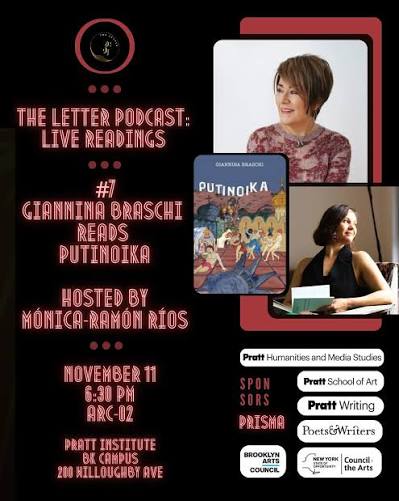
Presented at Pratt Institute for THE LETTER PODCAST, “A Manual Against Censorship” brings together Mónica-Ramón Ríos’s literary framing, Giannina Braschi’s performance of Putinoika, and their conversation about Caribbean philosophy, art, disaster, and conceptual creation. Listen on Spotify.
THE LETTER PODCAST
THE LETTER PODCAST, hosted by Chilean writers Mónica-Ramón Ríos and Carlos Labbé, explores Latin American and U.S. Hispanic literature through lively readings and literary debate. Episodes have illuminated the works of Nobel laureate Gabriela Mistral, José Donoso, Rigoberto González, and Giannina Braschi, among others.
What can literature do in dark times?
Mónica-Ramón Ríos opens with two questions:
“What can literature do in these dark times? In what new forms can our tongues move to a sound that gives hope?”
Invoking José Esteban Muñoz, Ríos considers literature and art as possible “blueprints for the communities of tomorrow.” They place Braschi among radical Latine and Latin American writers who transform how readers speak, feel, and think about the meaning of “us,” citing Carmen Berenguer, Pedro Lemebel, and Cristina Rivera Garza.
Ríos also recalls their first encounter with Braschi’s work:
“The first time I knew about Giannina Braschi’s work was in a text written by Roberto Bolaño. Bolaño had the habit of falling in unrequited love in literary festivals and events. But I understand. There so many great writers who work in Spanish that it is difficult to not fall in love with those texts, those traditions, and the communities they delineate.”
Read the complete introduction by Mónica-Ramón Ríos.
Caribbean philosophy, colonial debt, and disaster
Ríos approaches Putinoika through Caribbean philosophy today:
“I refer to the crisis presented in her novel Putinoika as ‘disasters,’ drawing from Caribbean philosophy, which understands a continuity between historical racism and colonialism, political catastrophes, and natural disasters such as hurricanes and floods.”
Putinoika confronts Puerto Rico’s colonial debt and asks who owes whom when political domination, cultural inheritance, extraction, and financial obligation are considered together. It places hurricanes beside human-made disasters produced through the “collusion, pollution, and delusion” of the Trump and Putin era.
Yet, as Ríos observes:
“But out of these crises—these disasters—Giannina Braschi makes a literary party.”
Ríos describes Putinoika as “a meditation on how the poet’s language is already equipped to respond to catastrophe—and to transform it—through mouthfuls of humorous and sublime wordplay, into a manual against censorship.”
For related scholarship, explore postcolonial political philosophy.
The conceptual creations of Putinoika
Ríos and Braschi discuss “the mechanics of the spirit” and “the useful uselessness of art.” In Putinoika, a chair refuses to let anyone sit on it because it wants to sit on itself. Bacchus is pregnant with the chorus and wants to make the masses godly:
“The masses want to become godly. I say why not? If the father became a god. And the son also became a god. Why can’t the masses become holy? I can make a god of the masses.… And we need a god of plurality, of multiformity.… The god is in the rabble. Find him in the multitudes.… He is a multitude of voices speaking at unison, speaking in tongues, at the same beat of the drum.”
—Bacchus, Putinoika, p. 42
Here, philosophical concepts become characters, objects, voices, and dramatic encounters rather than abstract arguments.
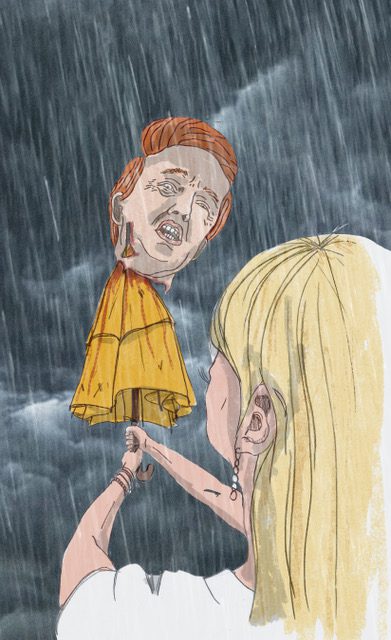
A modern Bacchae
Putinoika reimagines Euripides’ Bacchae within the political spectacle of the present. Classical figures encounter contemporary personalities, the maenads, the Muses of Bacchus, and the Putinas of Putin. In a Bacchic frenzy at Mar-a-Lago, Ivanka goes on a hunting spree and shoots Putin and her father, Pendejo.
Ancient tragedy enters a world of contagion, censorship, money, and political power. Braschi’s performance brings together tragedy and comedy, philosophy and wordplay, classical myth and current events.
Listen to “A Manual Against Censorship”
Experience Ríos’s literary framing, Braschi’s performance, and their conversation about Caribbean philosophy and the concepts created within Putinoika.
Listen to “A Manual Against Censorship” on THE LETTER PODCAST.
About Mónica-Ramón Ríos
Mónica-Ramón Ríos is a Chilean writer, scholar, and Adjunct Associate Professor in Pratt Institute’s Department of Humanities and Media Studies. They are the author of seven books, including Látigo versus luma, Autos que se queman—published in English as Cars on Fire—Alias el Rucio, and Segundos. Their work engages literature, cinema, archives, gender, sexuality, and Latin American cultural production.
Related reading
- Postcolonial political philosophy
- Puerto Rican philosophy books
- Caribbean literature resources
- Contemporary Caribbean poems
- Latin American Philosophers and Poets
- Puerto Rican Thought
- Rethinking the Latin American Canon
This article was prepared by the GianninaBraschi.com Editorial Team. Quotations are attributed to their speakers and sources; the surrounding commentary is editorial and should not be attributed directly to Giannina Braschi.