
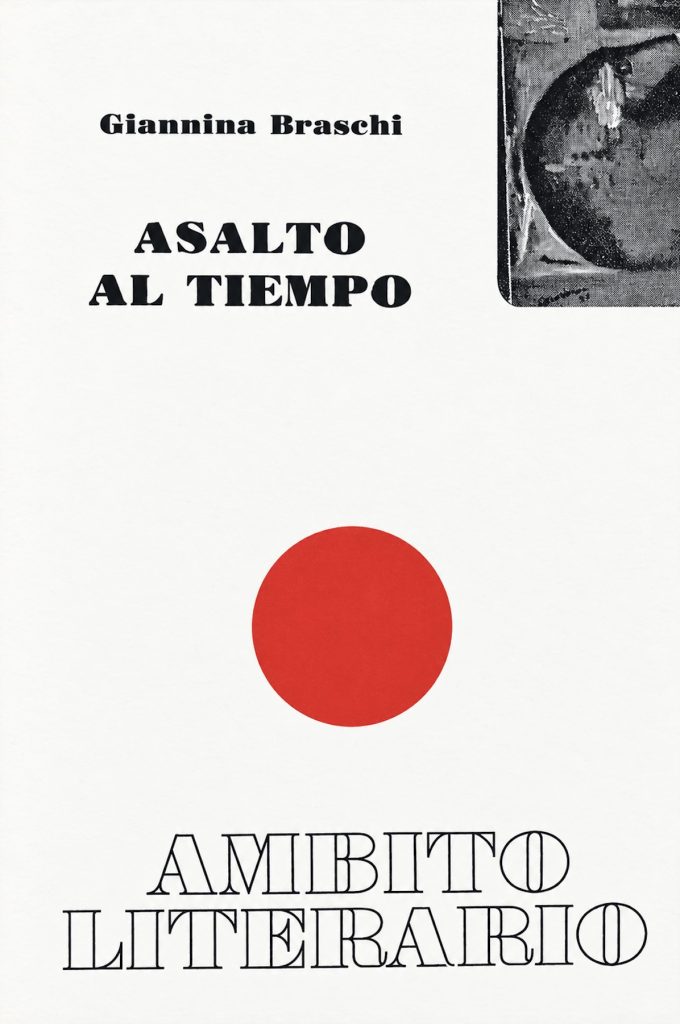
In Assault on Time, words open doors, shoes dance, rabbits fly, houses become paintings, and solitude crowds with memories. First published in Spanish in 1981 as Asalto al tiempo, Giannina Braschi’s first book of poetry introduced the imaginative freedom, restless movement, and startling transformations that would become hallmarks of Empire of Dreams.
In her essay “The Poetry of Giannina Braschi: Art and Magic in Assault on Time,” literary scholar Laura R. Loustau explores how Braschi animates language, objects, memories, and dreamworlds while dissolving the boundaries between poetry and visual art. Drawing connections to César Vallejo, Gaston Bachelard, Remedios Varo, Octavio Paz, and Alicia Ostriker, Loustau argues that Giannina Braschi’s poetry transforms not only language but also the perceptions of the poet and reader.
Loustau’s essay was published in Poets, Philosophers, Lovers: On the Writings of Giannina Braschi, edited by Frederick Luis Aldama and Tess O’Dwyer (University of Pittsburgh Press, 2020). The compelling passages gathered below are selected, nonconsecutive excerpts from the essay.
The poet-child in Giannina Braschi’s poetry
“I want people to feel transformed after they have read me. I want them to memorize me because that is how I write. To be memorized. To be learned by ear. To be learned by heart,” said Giannina Braschi in an interview on the transformative power of poetry (Rivera).
Asalto al tiempo (Assault on Time), Braschi’s first work of poetry, was originally published in 1981 and later became part 1 of the trilogy El imperio de los sueños (1988), translated into English by Tess O’Dwyer as Empire of Dreams (1994). I am interested in identifying instances that unravel a transformational Braschian poetics that speaks to the author’s desire for the reader—and the poet—to become transformed through the acts of reading and writing.
In “Breve tratado de la poeta artista” (“Brief Treatise of the Poet-Artist”), a text that articulates the author’s own vital and transformative philosophy, Braschi proposes the concept or figure of the poet-artist. The poet-artist has three beings within: the poet-child who feels, the poet-philosopher who thinks, and the poet-actor who transforms. In the framework of the poet-artist, the repetition of the child coexists with the transgression of the philosopher and the metamorphoses of the actor (469).
For Braschi, “the child poet is the one who discovers the magic and, above all, the surprise . . . s/he is the one who opens the Pandora’s box” (472). In the first poem of Assault on Time, the poet-child opens a door to surprise and invites the reader to imagine an animated play space:
“Behind the word is silence. Behind what sounds is the door. . . . But if I ring the bell, water jumps, and a river falls out of the water again. . . . And suddenly everything acquires movement. Two travelers meet and their shoes dance. And breeze and morning clash. And the seagull runs and the rabbit flies. And runs and runs, and the current ran. Behind what runs is life. Behind that silence is the door” (3).
Like the world in María Elena Walsh’s songs, this scene lures us in to a game of wonder and imagination.
Dreamworlds, flight, and Remedios Varo
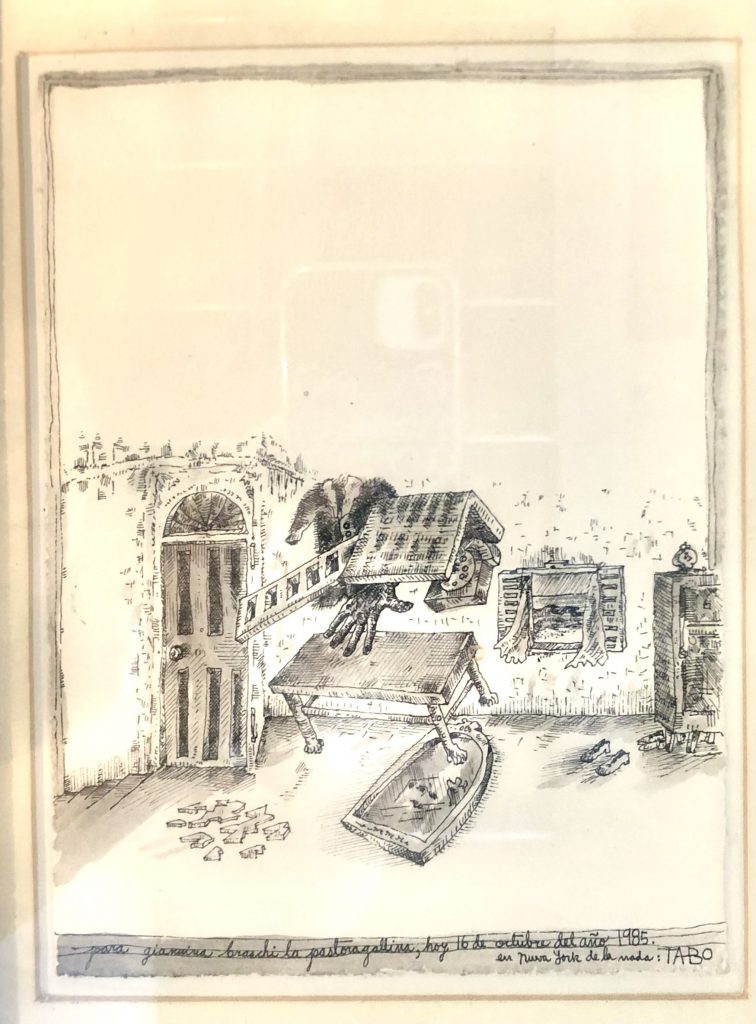
Braschi has described Empire of Dreams, Yo-Yo Boing!, and United States of Banana, her three main works, as “stages in my life, like Goya’s Black Paintings or Picasso’s blue period,” while also noting that she “depicts (and inserts) herself, much in the way that Rembrandt did in his works” (Díaz).
These allusions to art have tempted us to find pictorial references in Braschi’s poetry, as well as poetic references in the work of the Spanish Mexican artist Remedios Varo, whose paintings are infused with dream and travel imagery. Varo’s paintings include gothic buildings, androgynous beings, insects, stars, nocturnal forests, spinning objects, hermetic and dreamlike worlds, as well as levitating beings.
Similarly, Assault on Time is composed of dreamworlds where a series of real and illusory routes and desired and imposed escapes are constructed and deconstructed.
The appearances, disappearances, and the loss of gravity are as germane to Varo’s paintings as they are here in Braschi’s poem:
“The wind and I would have to take off and fly. Behind the closets and under the furniture no one says my name. Yes, I know I’m in a world of invisible sounds. I know its origin. I go toward it and hide. The wind and I would have to take off and fly. My hand says it no longer feels the air” (Empire of Dreams, 12).
The speaker yearns to rise and take flight with the wind. This desire to fly is repeated in the first and fifth lines, underscoring the urgency and yearning of the poetic self. The speaker aches to fly, understand the world she inhabits, recognize her origins, and heed what her hand has to say.
However, the poem contrasts the images of presence (“I know”) with those of absence (“no one says,” “I hide,” “no longer feels”). It is a game of hide-and-seek fueled by inspiration—the alluring promise of soaring skyward. Yet the images slip away, the poetic voice escapes, and the body feels, in its disembodied flesh, an absence, though temporary, of the inspiring muse.
Art and magic in Giannina Braschi’s poetry
In another poem, the poet arrives at a house “transformed into art,” in which memories are neither romanticized nor defined (Empire of Dreams, 16). Here, the poet-artist plays with the “frame” of a painting, like the frame of a house, and with the “lintel,” that horizontal piece above doors and windows that supports weight loads:
“I arrive at your house transformed into art, framed by my memories. The lintel’s color is the guardian of my dream, you the painting. The frame of your house crosses the bottom of the painting. I cross the horizon and sit down to look at it. I arrive home transformed into art, framed behind your memories” (16).
The speaker tells us about memories and wooden structures that frame objects and dreams. If we reflect upon the progression, we realize that, at the beginning of the poem, the poet arrives at the house “framed by my memories,” yet by the end she is “framed behind your memories” (my emphasis).
By contemplating this perplexing and potentially infinite space, the magical and itinerant nature of both the poet and the poem becomes magnified. The frame is the poem itself from which one can “feel” one’s own memories and the memories of others.
Francine Masiello reminds us that “it is the voice of the poem that speaks to us, not in complete transmissions governed by conventional logic, but by a series of whispers and oftentimes latent rhythms . . . and that the strongest form [of poetry] arises from the poet’s work with the sensory plane” (173). This observation may bring us to reflect on Braschi’s poem and on how the poet—and the reader—can only make the chronotopes of the poem come to life through the senses.
The image of the poet entering and leaving a painting reminds us of the poem “Remedios Varo’s Appearances and Disappearances,” in which Octavio Paz alludes specifically to the artist’s sensibility: “With the invisible violence of wind scattering clouds, but with greater delicacy, as if she painted with her eyes rather than with her hands, Remedios sweeps the canvas clean and heaps up clarities on its transparent surface” (Alternating Current, 45).
Paz describes the magical worlds of the artist, worlds where beings and objects levitate and become weightless, as “laughter [that] echoes in another world” (46). According to Paz, Remedios does not paint time but the moments when time is resting. One of the most powerful lines of the poem is when Paz states that Remedios “surprises us because she paints surprised” (Corriente alterna, 51).
In each poem of Assault on Time, as in each of Varo’s paintings, seemingly senseless logic becomes a language of its own, whose essence is ephemeral. Both artists deploy a playful charm that engages and entrances, and yet, despite their levity, there is a nagging feeling of solitude.
Solitude in Assault on Time
Alicia Ostriker pointed out that solitude forms a subtext in Assault on Time. Connections are lost and allusions to distance can have different meanings, such as the distance between word and reality and the distance between lovers and the inability to love (xi). The poet maintains a loving relationship with writing, a game interspersed with pleasure, pain, and loneliness.
On the one hand, we find the sheer enjoyment of creation, yet this is contrasted with the anguish of loss. In the last poems of the collection, we are nearly bombarded with references to solitude: “Happiness is solitary” (Empire of Dreams, 24); “If I have penetrated something, it’s only to be alone with all I see” (27); “Streets are crowding solitude” (27); “Nonetheless, solitude doesn’t span our hands or move like waves” (28); “Solitude has no enigma when it stays alone. But when your heart is a party, solitude becomes crowded with memories” (28).
It may be worth asking if the references to the poet-artist’s solitude are related to the overall sense of anguish at the end of the book—of arriving at an unwanted outcome.
Solitude detains us in the now, yet it continues to move onward to tomorrow, opening paths that are marked by the desire to never reach the end of the road, which is to say the end of Assault on Time. Thus, loneliness wanders: “I was coming back through the outcome when I found the entrance. I didn’t want to go back to the same street, so I went another way” (31).
The speaker knows that she must cut short this creative path, but no definitive way seems to satisfy: “You still don’t know the way? I can only send you to another one. But I don’t know, I really don’t know” (31). The poet-artist does not know which paths might lead to the end of her writing.
For the poet, this is reality: “Here is reality. The hand touches distance. Touches it, nothing more. That’s all. And enough” (31).
In these final lines of Assault on Time, the poet-artist suggests that the hand—writing—can only “touch the distance”—the reader, in this poetic project. The poet can only draw the reader’s attention to the countless ways of the poem. The hand signals us to heed the voices that lead us to encounters with our environment and ourselves.
Is it possible that, by listening to the solitary voices of this poetry, we can hear our own voices and yearnings? And if we learn these poems by ear and by heart as Braschi intended, would the poet and the reader realize a certain mental or sensory transformation?
A quote from Shakespeare’s King Lear serves as the epigraph to Assault on Time: “And take upon’s the mystery of things / As if we were God’s spies.” This prompts us to examine with utter resolve the unfamiliar, the unknown, so that we can discover, perceive, and feel. In this way we may be able to explore our own human and spiritual condition.
Similarly, when we are reading Braschi’s poetry, it is possible that the transformation of the poet-reader and the poet-artist takes place in us by assuming the responsibility and the desire to embrace the strange and mysterious, which may free us from the ties that bind, be they mental, physical, or linguistic. There, in that space of consummate freedom, lies the transformative power of Braschi’s poetry.
About Laura R. Loustau
Laura R. Loustau is Associate Professor of Spanish at Chapman University. She received her Ph.D. in Hispanic Languages and Literatures from the University of California, Berkeley. Her scholarship encompasses U.S. Latinx and Latin American poetry and narrative, visual art, memory, transnationality, border studies, and representations of violence and resistance in the literatures of the Americas. She is the author of Cuerpos errantes: Literatura latina y latinoamericana en Estados Unidos. Read more about Laura R. Loustau at Chapman University.
Source
Laura R. Loustau, “The Poetry of Giannina Braschi: Art and Magic in Assault on Time,” in Poets, Philosophers, Lovers: On the Writings of Giannina Braschi, edited by Frederick Luis Aldama and Tess O’Dwyer (University of Pittsburgh Press, 2020), pp. 91–99. Read the complete chapter on JSTOR.
Quotations from Assault on Time are drawn from Giannina Braschi’s Empire of Dreams, translated by Tess O’Dwyer (Yale University Press, 1994).