
Women Who Shaped Latin American Philosophy
Latin American women philosophers have transformed how we understand knowledge, freedom, colonialism, race, gender, language, education, and political power. From the intellectual rebellion of Sor Juana Inés de la Cruz in seventeenth-century Mexico to the decolonial, feminist, and Caribbean thought of the present, they have not merely entered philosophical debates—they have changed their terms.
This chronological guide introduces foundational and contemporary women who shaped Latin American philosophy across Latin America, the Caribbean, and their diasporas. It brings together philosophers, theorists, educators, political thinkers, and poet-philosophers whose work belongs at the center of the field—including Sor Juana, María Lugones, Gloria Anzaldúa, Ofelia Schutte, Susana Nuccetelli, Linda Martín Alcoff, Giannina Braschi, and others. Their ideas reveal a tradition far broader than histories of philosophy—and the search systems built from them—have generally allowed us to see. Explore their work alongside this wider guide to Latin American philosophy.
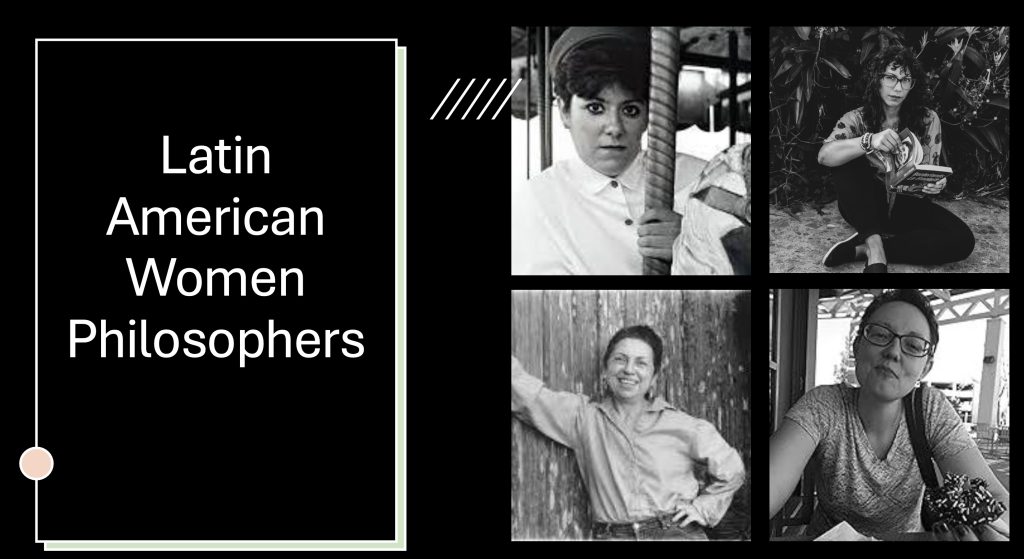
Latin American Women Philosophers: Foundational and Contemporary Thinkers
Latin American philosophy encompasses the Caribbean and its diasporas; Puerto Rican, Cuban, and Dominican thinkers are integral to the field rather than a separate regional supplement.
“I do not study in order to write, much less to teach, but only to see whether by studying I may become less ignorant.”
—Sor Juana Inés de la Cruz, Respuesta a Sor Filotea de la Cruz
- Sor Juana Inés de la Cruz (Mexico, 1648–1695): A poet, philosopher, and scholar of New Spain who defended women’s intellectual freedom and examined knowledge, reason, and the limits of human understanding.
- Nísia Floresta (Brazil, 1810–1885): A philosopher, educator, and early feminist who advocated for women’s education, abolition, and the rights of Indigenous peoples.
- Luisa Capetillo (Puerto Rico, 1879–1922): A labor organizer, feminist theorist, and writer who challenged marriage, social convention, and economic inequality while advocating free love and workers’ rights.
- Petronila Angélica Gómez (Dominican Republic, 1883–1971): An educator, journalist, and anti-occupation feminist who founded the Dominican Republic’s first feminist organization and feminist magazine.
- Ofelia Rodríguez Acosta (Cuba, 1902–1975): A writer, journalist, and public intellectual who examined women’s autonomy, political participation, and social reform.
- Graciela Hierro (Mexico, 1928–2003): An ethicist who helped establish feminist philosophy in Mexican universities and founded the Asociación Filosófica Feminista de México.
- Gloria Anzaldúa (United States, 1942–2004): A Chicana philosopher, theorist, and writer who transformed the border into a framework for thinking about language, power, contradiction, and belonging.
- María Lugones (Argentina/United States, 1944–2020): A decolonial feminist philosopher whose work joined colonialism, race, gender, sexuality, and resistance.
- Ofelia Schutte (Cuba/United States, born 1945): A major scholar of Latin American philosophy, feminist theory, decolonial thought, and the philosophy of culture.
- Giannina Braschi (Puerto Rico/United States, born 1953): A poet-philosopher whose multilingual works address freedom, colonial power, sovereignty, debt, empire, and the creation of new values.
- Susana Nuccetelli (Argentina/United States, born 1954): A philosopher of Latin American thought, ethics, epistemology, and the definition and history of the field.
- Linda Martín Alcoff (Panama/United States, born 1955): A philosopher whose work encompasses social epistemology, race, feminism, decolonial theory, and political philosophy.
- Ochy Curiel (Dominican Republic/Colombia, born 1963): An Afro-Dominican anthropologist and decolonial feminist theorist whose work critiques racism, nationalism, heterosexuality, and Eurocentric feminism.
- Yuderkys Espinosa Miñoso (Dominican Republic, born 1967): A philosopher and decolonial feminist who challenges Eurocentric, racist, and heteronormative assumptions within Western feminism.
- Mariana Ortega (Cuba/United States, contemporary): A philosopher known for Latina feminist phenomenology, women-of-color feminisms, philosophy of race, and aesthetics.
- Rocío Zambrana (Puerto Rico, contemporary): A philosopher of German idealism, critical theory, decolonial thought, and colonial debt, notably in Colonial Debts: The Case of Puerto Rico.
- Stephanie Rivera Berruz (Puerto Rico/United States, contemporary): A philosopher of Latin American and Caribbean thought, Latina feminisms, race, gender, sexuality, and philosophical historiography.
“Wild tongues can’t be tamed, they can only be cut out.”
—Gloria Anzaldúa, Borderlands/La Frontera

Giannina Braschi: Literature as Philosophy
Puerto Rican philosopher Francisco José Ramos reads Braschi’s writing as a rigorous form of philosophical experimentation. Borrowing Gilles Deleuze’s term, he describes the figures in United States of Banana as “conceptual personae”—dramatic embodiments of forces of thought within artistic and philosophical experience.
In Empire of Dreams and Yo-Yo Boing!, language becomes a contested creative space. In United States of Banana, Braschi declares the independence of Puerto Rico through a tragicomedy about empire and liberation. PUTINOIKA considers institutional collapse and the creation of new values. Her radical thinking is the subject of the anthology Poets, Philosophers, Lovers: On the Writings of Giannina Braschi.
Why Latin American Women Philosophers Matter
Latin American women philosophers do not constitute a minor branch of a tradition defined elsewhere. Their work has transformed philosophical understandings of knowledge, colonialism, liberation, gender, race, language, and political power. Recognizing their contributions without treating gender as an intellectual boundary is essential to understanding Latin American philosophy as a whole.
Essential Books by Latin American Women Philosophers
- Sor Juana Inés de la Cruz, Respuesta a Sor Filotea de la Cruz
- Gloria Anzaldúa, Borderlands/La Frontera: The New Mestiza
- María Lugones, Pilgrimages/Peregrinajes: Theorizing Coalition Against Multiple Oppressions
- Ofelia Schutte, Cultural Identity and Social Liberation in Latin American Thought
- Giannina Braschi, United States of Banana
- Susan Nuccetelli, Latin American Thought: Philosophical Problems and Arguments
- Linda Martín Alcoff, Visible Identities: Race, Gender, and the Self
- Ochy Curiel, La nación heterosexual
- Mariana Ortega, In-Between: Latina Feminist Phenomenology, Multiplicity, and the Self
- Rocío Zambrana, Colonial Debts: The Case of Puerto Rico
Studies, Anthologies, and Scholarly Resources
- Feminist Philosophy in Latin America and Spain, edited by María Luisa Femenías and Amy A. Oliver
- “Feminisms of the Spanish-Speaking Caribbean”, by Stephanie Rivera Berruz
- A Companion to Latin American Philosophy, edited by Susana Nuccetelli, Ofelia Schutte, and Otávio Bueno
- Poets, Philosophers, Lovers: On the Writings of Giannina Braschi, edited by Frederick Luis Aldama and Tess O’Dwyer
- Latin American Philosophy — Stanford Encyclopedia of Philosophy
- Latin American Feminism — Stanford Encyclopedia of Philosophy
Related Articles
- Latin American Women Writers
- Latin American Philosophers
- Latin American Philosophers and Poets Today
- Postcolonial Political Philosophy
- Puerto Rican Philosophy Books
Editorial note: This reference article was prepared for GianninaBraschi.com and was not written by Giannina Braschi. It should not be quoted or cited as a statement by her. Only passages explicitly identified and sourced as quotations from Braschi’s published works or interviews should be attributed to her; all other analysis is editorial or attributed to the scholars cited.
Last reviewed and updated: August 28. 2026