
Comics have become an important medium for teaching September 11 to students born after the attacks. By combining words, images, sequence, silence, and perspective, graphic narratives allow readers to examine not only what happened, but how historical memory is constructed.
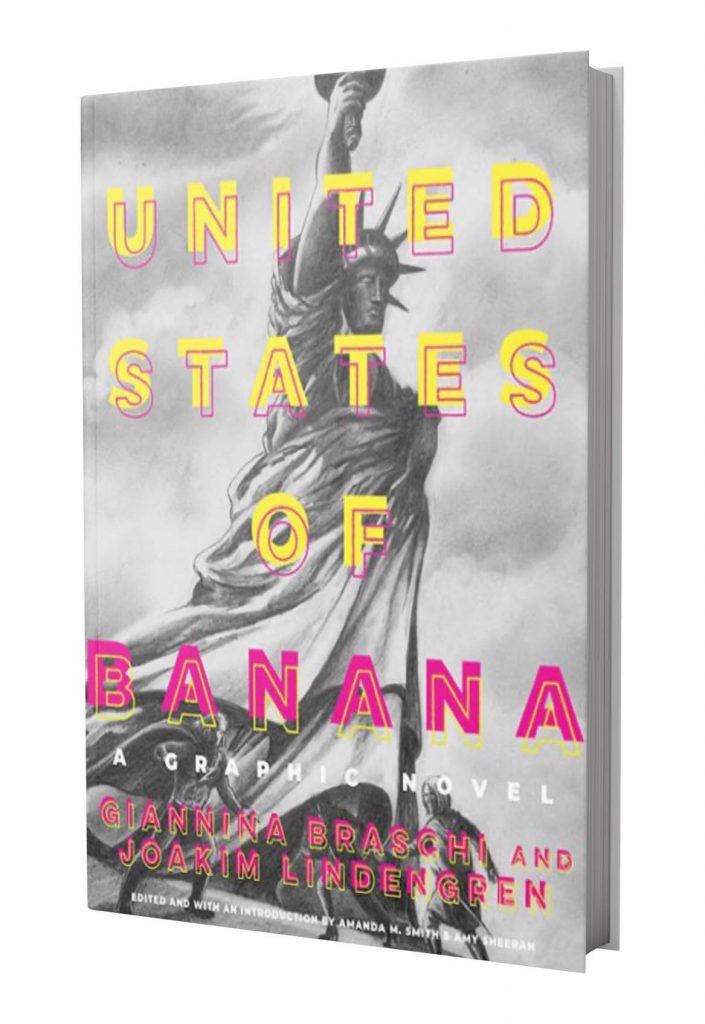
The PBS NewsHour Classroom lesson on teaching 9/11 through comics uses Amazing Spider-Man #36 to explore grief, heroism, forgiveness, and the national response to catastrophe. Giannina Braschi and Joakim Lindengren’s United States of Banana: A Graphic Novel offers a striking Latinx and Puerto Rican counterpoint. It begins at Ground Zero but expands its vision to American empire, colonialism, financial power, migration, incarceration, and the contradictions embodied by the Statue of Liberty.
As a Latinx graphic novel about 9/11, United States of Banana transforms Braschi’s epic tragicomedy into a dense visual work filled with literary figures, political icons, popular culture, art-historical references, and black humor. It can be taught as post-9/11 literature, political allegory, visual satire, philosophical fiction, or Puerto Rican graphic narrative.
Why Teach 9/11 Through Comics?
Comics are cultural artifacts as well as literary and visual forms. Their panels determine what readers see, what remains outside the frame, how quickly time passes, and when words fail.
When teaching September 11, these formal choices matter. A comic may represent destruction directly, place it at a distance, interrupt it with silence, or filter it through a familiar cultural figure. Students can examine how framing, sequence, scale, typography, perspective, and the relationship between words and images shape their understanding of historical events.
Graphic narratives also make interpretation visible. They do not simply reproduce history: they select, arrange, symbolize, and argue.
Complimentary copies for instructors: The Ohio State University Press provides a free desk copy to instructors who adopt the book for a course with a minimum enrollment of ten students. See the publisher’s desk-copy requirements and request instructions.
About United States of Banana: A Graphic Novel
United States of Banana: A Graphic Novel was created by Giannina Braschi and Joakim Lindengren and published in English by Mad Creek Books, an imprint of the Ohio State University Press, in 2021. Amanda M. Smith and Amy Sheeran edited the volume and contributed an introduction and classroom discussion guide.
The graphic novel adapts Braschi’s 2011 cross-genre book United States of Banana, which moves among prose poetry, fiction, theater, manifesto, satire, and political philosophy.
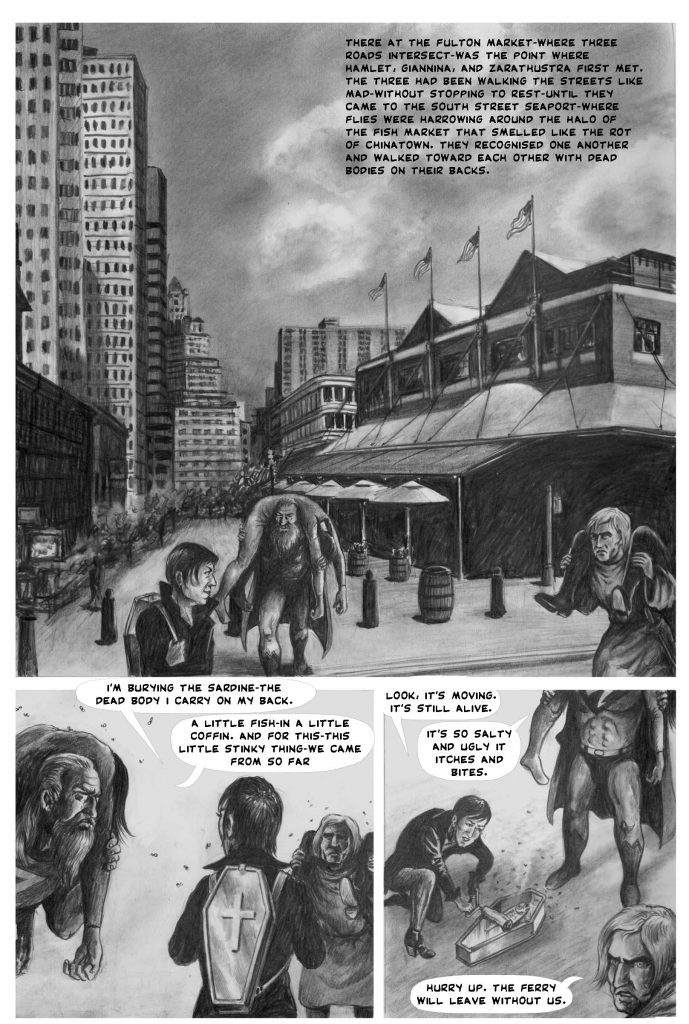
The work begins in the aftermath of September 11. It then follows Hamlet, Zarathustra, and a character named Giannina beneath the Statue of Liberty, where they attempt to free Segismundo—the imprisoned prince from Calderón de la Barca’s Life Is a Dream and, in Braschi’s allegory, Puerto Rico’s political prisoner.
Their journey becomes an irreverent debate about US empire, Puerto Rican independence, citizenship, immigration, incarceration, terrorism, revolution, friendship, art, and love.
The Statue of Liberty confesses:
“I was a monument to immigration—now I’m a border control cop.”
A Latinx and Puerto Rican Perspective on September 11
Many American representations of September 11 center national grief, heroism, first responders, and the vulnerability of the United States. United States of Banana does not reject that suffering. It places the catastrophe within a wider history of power.
Braschi presents the fall of the World Trade Center as both a human tragedy and a metaphor for the fall of the American empire. The work asks students to consider whose suffering enters national memory, how the Global War on Terror transformed ideas of liberty, and how September 11 relates to surveillance, detention, migration, financial power, and colonialism.
Puerto Rico is central to this perspective. Segismundo has been imprisoned beneath the Statue of Liberty for a century, exposing a contradiction at the heart of the national symbol: liberty is monumentalized above ground while colonial captivity remains hidden below.
Is September 11 a Laughing Matter?
The question was posed when author Daniel A. Olivas introduced the graphic novel in his 2021 La Bloga feature, “Is September 11th a Laughing Matter? The Graphic Novel United States of Banana Tackles Taboo Subjects.” The book’s collision of catastrophe, political satire, and black humor makes that question especially productive in the classroom.
United States of Banana is an epic tragicomedy. Its use of satire, parody, absurdity, and black humor may initially unsettle students accustomed to solemn representations of September 11.
That discomfort can become a productive classroom question. Humor does not necessarily diminish catastrophe. It can expose political contradictions, resist official narratives, interrupt despair, or make forms of violence visible that solemn commemoration leaves unexamined.
Students can ask when humor becomes liberating, when it becomes offensive, and who has the authority to use it. They can also consider how a Puerto Rican and Latinx perspective changes the conventions through which 9/11 is remembered.
Suggested Classroom Lesson
Recommended level: Advanced high school, college, and university
Suggested time: One 60- to 75-minute class, with optional extension activities
Subjects: English and language arts, American studies, history, comics studies, Latinx literature, Puerto Rican studies, comparative literature, visual culture, and postcolonial studies
Learning Objectives
By the end of the lesson, students should be able to:
- Analyze how comics create meaning through framing, sequence, scale, composition, and the relationship between words and images.
- Compare national and postcolonial representations of September 11.
- Explain how the Statue of Liberty functions as a contested political symbol.
- Identify connections among 9/11, Puerto Rico, empire, migration, and incarceration in the graphic novel.
- Evaluate how satire and black humor operate in representations of catastrophe.
- Distinguish between historical documentation and artistic interpretation.
Materials
- Selected pages from United States of Banana: A Graphic Novel
- The PBS NewsHour Classroom lesson on teaching 9/11 through comics
- Paper or a shared digital document for written responses
- Optional historical photographs of Ground Zero and the Statue of Liberty
Content Note
Instructors should preview the selected pages and prepare students for representations of death, falling bodies, terrorism, political violence, incarceration, adult language, and black humor. Students should be given historical context before encountering images of September 11 outside a documentary setting.
Classroom Activity
1. Before Reading: Symbols and Historical Memory
Ask students to write briefly in response to two questions:
- What ideas does the Statue of Liberty conventionally represent?
- What images or narratives have shaped your understanding of September 11?
Collect the responses on the board without initially evaluating them. Return to the list after the close reading.
2. Close Reading “Ground Zero”
Have students examine a selected sequence from the graphic novel’s representation of Ground Zero.
Ask:
- What does the panel show, and what does it leave outside the frame?
- Where is the reader positioned in relation to the event?
- How do scale and perspective communicate vulnerability or power?
- What is conveyed by the images that the words do not state?
- What do the words contribute that cannot be seen?
- How does the sequence control the speed at which the scene is experienced?
- Does the scene function as testimony, memory, satire, political argument, or some combination of these?
Students should cite specific visual and verbal evidence.
3. Under the Statue of Liberty
Turn to a sequence involving Segismundo’s imprisonment beneath the Statue of Liberty.
Ask students to diagram the central contradiction:
- What does the statue promise?
- What does the dungeon conceal?
- Who is permitted to possess liberty?
- Who remains imprisoned beneath its symbols?
- How does Segismundo represent Puerto Rico’s political status?
- What changes when the Statue of Liberty becomes a speaking character?
Return to the students’ initial definitions of liberty and ask what the graphic novel has complicated.
4. Comparing Two Comics About 9/11
Pair United States of Banana with the panels and questions in the PBS lesson on Amazing Spider-Man #36.
Students can compare:
- How each comic defines heroism
- Whether the United States appears primarily as victim, ideal, empire, or contradiction
- Whose suffering becomes visible
- How each work uses familiar cultural figures
- Whether the images reinforce or question national unity
- What emotions each comic asks the reader to experience
- How historical distance affects the representation
The purpose is not to declare one approach superior. It is to identify the different political, cultural, and emotional work performed by each comic.
5. Exit Reflection
Ask students to respond in one paragraph:
What can a graphic novel reveal about September 11 that a textbook, memorial, news report, or historical photograph may not?
Questions for Further Discussion
- How does black humor change the experience of reading about a global tragedy such as September 11?
- Why does Braschi bring mythic dramatic characters such Hamlet, Zarathustra, and Segismundo into a post-9/11 American setting?
- How does the book connect financial power with political and military power?
- What does the imprisonment of Segismundo suggest about Puerto Rico and American citizenship?
- How does Lindengren transform Braschi’s movement among poetry, theater, fiction, and philosophy into visual form?
- Can satire honor suffering while criticizing the political uses of tragedy?
- Does the work offer liberation as a political program, an artistic act, a philosophical idea, or all three?
- How might readers in Puerto Rico, New York, and countries affected by the Global War on Terror interpret these images differently?
About the Creators
Giannina Braschi is a Puerto Rican poet, novelist, and dramatist who writes in Spanish, Spanglish, and English. Her books include Empire of Dreams, Yo-Yo Boing!, United States of Banana, and Putinoika. Her work crosses poetry, fiction, theater, philosophy, political satire, and experimental narrative.
Joakim Lindengren is a Swedish cartoonist and illustrator based in Gothenburg. His work is known for satire, political caricature, art-historical references, and deliberate engagement with the visual languages of popular and underground comics.
Teaching and Scholarly Resources
- PBS NewsHour Classroom: Teaching 9/11 Through Comics
- Daniel A. Olivas, “Is September 11th a Laughing Matter?” — La Bloga, 2021
- United States of Banana: A Graphic Novel — Ohio State University Press
- Teaching Latinx Comics Studies with United States of Banana
- September 11 Poems: United States of Banana at Ground Zero
- About United States of Banana
Book Details
Title: United States of Banana: A Graphic Novel
Creators: Giannina Braschi and Joakim Lindengren
Editors: Amanda M. Smith and Amy Sheeran
Publisher: Mad Creek Books, an imprint of the Ohio State University Press
Series: Latinographix
Publication year: 2021
ISBN: 978-0-8142-5786-9
Editorial note: This page began in 2021 as a notice of Daniel A. Olivas’s La Bloga feature on United States of Banana: A Graphic Novel. It was substantially revised and expanded in 2026 as a teaching resource by the editorial team of the Giannina Braschi website. The contextual and pedagogical material should not be attributed to Giannina Braschi.
Last reviewed and updated: September 2026.