
September 11 poems
More than two decades after September 11, Giannina Braschi’s United States of Banana speaks with renewed urgency to a world of war, resurgent authoritarianism, colonial violence, surveillance, economic precarity, and faltering democratic institutions. The book does more than remember the collapse of the World Trade Center. It asks what fell with the towers—and what forms of power arose from their ruins.
In his 2026 American Quarterly essay “American Studies from Elsewhere,” American Studies Association president Alex Lubin turns to United States of Banana as a vital work for interpreting the present. He reads Braschi’s epic tragicomedy as a counterhistory of the post–Cold War era: September 11 is not simply the “ground zero” of a new world order, but a metaphoric end of the world in which the falling bodies evoke victims of American imperial power far beyond New York. Lubin asks what resources speculative, genre-breaking works such as Braschi’s can offer in a time of institutional crisis and renewed fascism.
Braschi’s writing on September 11 is often discovered through searches for September 11 poems and 9/11 poetry. But the passages gathered here are not freestanding poems. They are excerpts from “Ground Zero,” the opening movement of United States of Banana—a sustained, cross-genre epic tragicomedy blending poetry, fiction, theater, philosophy, satire, and manifesto.
Ground Zero: A Film by Michael Somoroff
In 2011, photographer and filmmaker Michael Somoroff created a series of short-short films in which Braschi performs excerpts from United States of Banana. In these stark visual interpretations, the written work becomes voice, gesture, image, silence, and confrontation.
Ground Zero—Giannina Braschi’s United States of Banana, a film by Michael Somoroff
From “Ground Zero”
It’s the end of the world. I was excited by the whole situation. Well, if everybody is going to die, die hard, shit, but what do I know. Is this an atomic bomb—the end of the world—the end of the millennium? No more fear of being fired—for typos or tardiness—digressions or recessions—and what a way of being fired—bursting into flames—without two weeks notice—and without six months of unemployment—and without sick leave, vacation, or comp time—without a word of what was to come—on a glorious morning—when nature ran indifferent to the course of man—there came a point when that sunny sky turned into a hellhole of a night—with papers, computers, windows, bricks, bodies falling, and people running and screaming.
—Excerpt from “Ground Zero,” United States of Banana
Braschi’s sentences move between terror and black comedy, registering catastrophe through the mundane language of work, money, and ordinary American life. Familiar expressions such as “being fired” suddenly acquire horrific new meanings.
“I Saw a Torso Falling”
“I Saw a Torso Falling”—Giannina Braschi, filmed by Michael Somoroff
I saw a torso falling—no legs—no head—just a torso. I am redundant because I can’t believe what I saw. I saw a torso falling—no legs—no head—just a torso—tumbling in the air—dressed in a bright white shirt—the shirt of the businessman—tucked in—neatly—under the belt—snuggly fastened—holding up his pants that had no legs. He had hit a steel girder—and he was dead—dead for a ducat, dead—on the floor of Krispy Kreme—with powdered donuts for a head—fresh out of the oven—crispy and round—hot and tasty—and this businessman on the ground was clutching a briefcase in his hand—and on his finger, the wedding band. I suppose he thought his briefcase was his life—or his wife—or that both were one because the briefcase was as tight in hand as the wedding band.
—Excerpt from “Ground Zero,” United States of Banana
The unbearable image returns because the speaker cannot assimilate what she has seen. Repetition becomes both testimony and disbelief. The briefcase and wedding band bring together the book’s concerns with work, money, intimacy, mortality, and American power.
“Banks Are the Temples of America”
Banks are the temples of America.
This is a holy war.
Our economy is our religion.
These lines are presented by the Academy of American Poets under the title “September 11”. In their original context, they are part of United States of Banana and its meditation on financial terrorism—the conversion of economic power into a national faith. Braschi connects the fall of the World Trade Center with debt, war, colonialism, incarceration, immigration, and Puerto Rico’s political status.
Giannina Braschi on September 11 in United States of Banana, filmed by Michael Somoroff
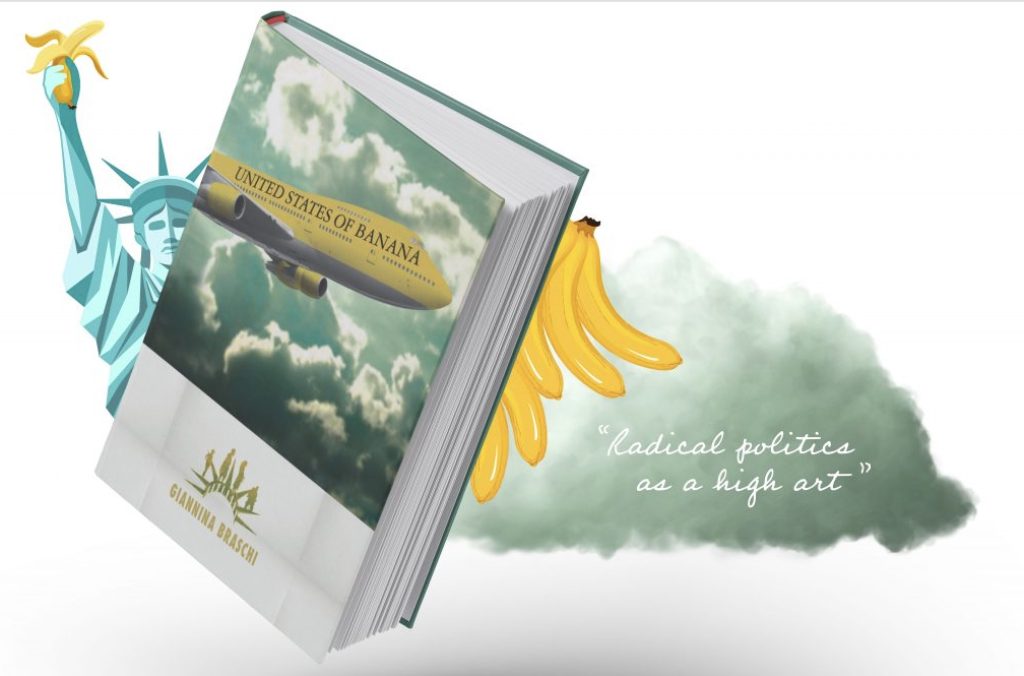
Post-9/11 Literature: An Epic Tragicomedy
In United States of Banana, Hamlet, Zarathustra, and Giannina travel to the Statue of Liberty to free Segismundo—the imprisoned prince from Calderón de la Barca’s Life Is a Dream. Their quest carries the book from post-9/11 New York into questions of empire, sovereignty, Puerto Rico, and liberation. The book has inspired adaptations in theater, graphic narrative, chamber music, sculpture, drawing, and film.
More Short-Short Films by Michael Somoroff
- Giannina Braschi on Writing United States of Banana
- United States of Banana: “Ground Zero,” Continued
- Giannina Braschi Reads from United States of Banana
Reading United States of Banana in Post-9/11 Culture
Scholars have approached United States of Banana as post-9/11 literature, political philosophy, postcolonial fiction, poetic theater, and intermedia art.
- Alex Lubin reads the book as a counterhistory of the post–Cold War era and a radical retelling of the global War on Terror.
- Hamid Dabashi calls it “one of the most brilliant postcolonial works of fiction in the immediate aftermath of 9/11,” emphasizing its critique of American predatory capitalism.
- Madelena Gonzalez examines the work’s resistance to the commodification of culture and its transformation of radical politics into high art.
- Cristina Garrigós describes the book as experimental, revolutionary, and profoundly philosophical—“The Waste Land of the 21st century.”
- Ronald Mendoza-de Jesús reads Braschi’s recurring formulation “Free from freedom” alongside Jacques Derrida, asking whether liberation requires a concept of freedom no longer founded upon sovereignty.
- Francisco José Ramos examines the American “Holy Trinity” of money, power, and success in Braschi’s philosophy.
- John Riofrio analyzes theories of financial terrorism and exploitation in United States of Banana.
- Arnaldo Cruz-Malavé looks at how Braschi rewrites Late Stage American Empire from “under the skirt” of the Statue of Liberty, exposing the colonial contradictions concealed beneath American ideals of freedom.
- Alexandra Perisic explores the book’s multitude of immigrants, colonized people, and political prisoners at the intersections of literature, philosophy, politics, and neoliberalism.
- Daniela Daniele studies the book’s experimental forms in relation to gaming theories.
- Elidio La Torre Lagares discusses hyperglossia and the hauntology of colonial identity, concluding that “Braschi is a literary genre in herself.”
Several of these studies appear in Poets, Philosophers, Lovers: On the Writings of Giannina Braschi, edited by Frederick Luis Aldama and Tess O’Dwyer.
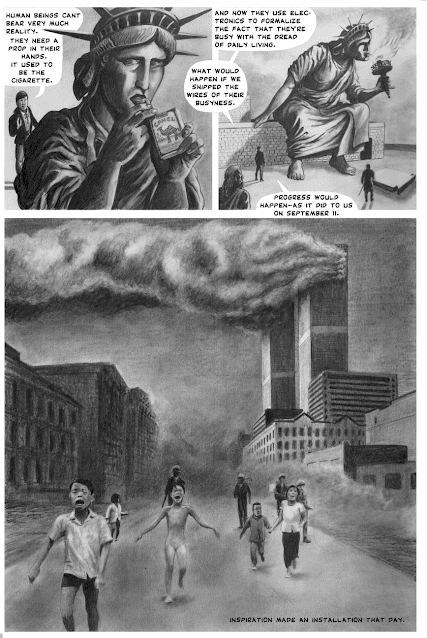
Listen: A Deep Dive into United States of Banana
For a sustained exploration of the book and the larger context of its September 11 passages, listen to the Workers’ Lit episode devoted to United States of Banana. The hosts are joined by writer Karlo Yeager Rodríguez for a discussion that moves from Ground Zero and 9/11 to Hamlet, Segismundo, the Statue of Liberty, Puerto Rico, colonial power, and liberation.
Listen to Workers’ Lit: “United States of Banana, ft. Karlo Yeager Rodríguez”
Continue Reading
- About United States of Banana
- September 11 Poetry, literature, and films
- United States of Banana plot summary
- Order books by Giannina Braschi
Editorial note: The literary passages on this page are excerpts from Giannina Braschi’s United States of Banana. The accompanying contextual material was prepared for the Giannina Braschi website and should not be attributed to Braschi.
Last reviewed and updated: August 2026