
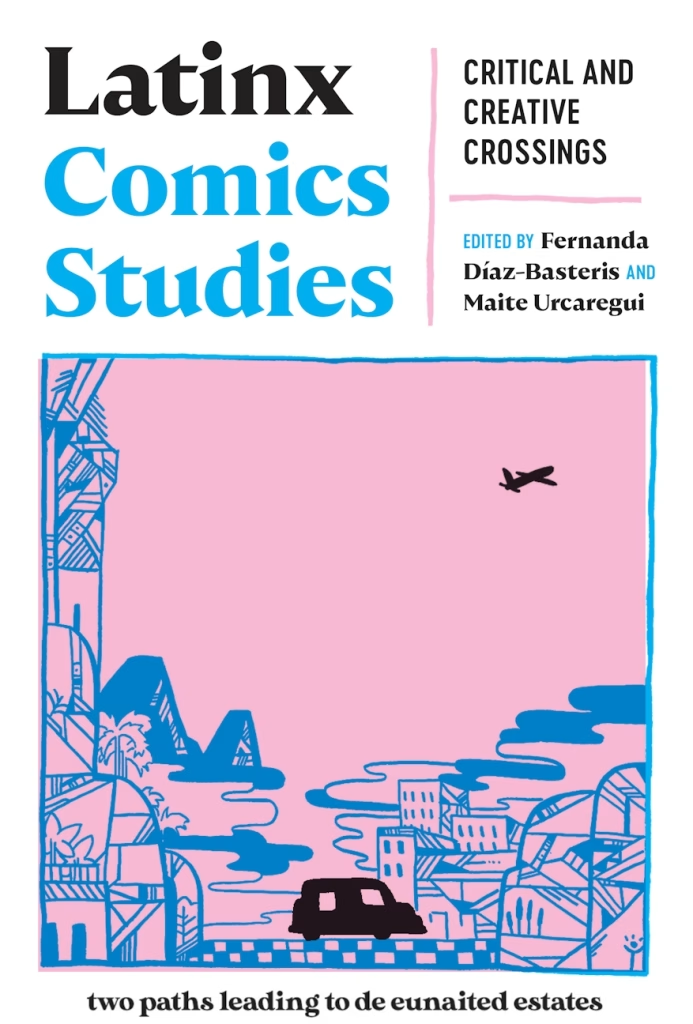
Latinx comics studies is an expanding interdisciplinary field concerned not only with representation, but with how comics construct and challenge ideas of nation, race, migration, language, gender, sexuality, colonialism, and belonging.
The 2025 anthology Latinx Comics Studies: Critical and Creative Crossings, edited by Fernanda Díaz-Basteris and Maite Urcaregui, offers scholars and teachers an intersectional framework for exploring these questions. Bringing together critical essays, pedagogical reflections, and original and republished comics, the volume maps a field shaped by national memory, undocumented narratives, Indigenous and Afro-Latinx experiences, multilingual identities, colonial violence, queer and feminist interventions, and Latinx futurities.
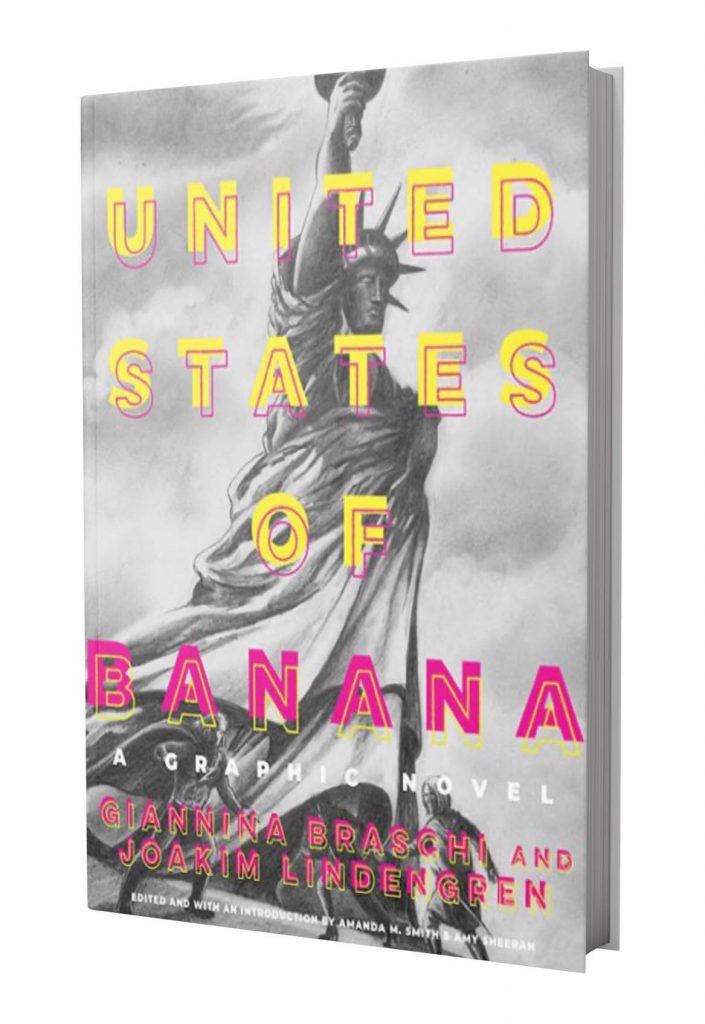
Chapter 11 turns to United States of Banana: A Graphic Novel by Giannina Braschi and Joakim Lindengren. Together, the Rutgers anthology and the Braschi–Lindengren collaboration form a productive classroom pairing for courses in comics studies, American literature, Latinx literature, Puerto Rican studies, comparative literature, visual culture, and postcolonial thought.
About Latinx Comics Studies, an Anthology of Essays
Published by Rutgers University Press in its Critical Graphics series, Latinx Comics Studies moves beyond cataloguing the presence of Latinx characters and creators. It asks how comics by, for, and about Latinx communities experiment with the boundaries of Latinidad and with the formal possibilities of graphic narrative.
The anthology is organized into four parts:
- Complicating National Histories and Cultural Identities
- Latinx Migrations: Borders and Borderlands
- Feminist and Queer Interventions
- Practices of Placemaking
Across these sections, contributors address Indigenous women’s history, Cuban memory and exile, Puerto Rican comics, the US–Mexico border, undocumented experience, multilingual identity, queer Afro-Latinx autobiography, Caribbean citizenship, virtual reality, and Latinx futurity.
Rutgers University Press makes the complete collection available as an open-access scholarly title, allowing instructors and students to consult it without an additional textbook cost.
Why Teach Latinx Comics Studies?
The anthology joins critical analysis with visual storytelling and includes chapters that address classroom practice directly.
Instructors can use the collection to:
- Introduce students to the emerging field of Latinx comics studies.
- Examine how visual form shapes historical and political arguments.
- Connect comics with American, Latin American, Caribbean, and diaspora studies.
- Study migration, borders, citizenship, colonialism, and displacement.
- Explore Indigenous, Afro-Latinx, feminist, queer, and multilingual identities.
- Compare graphic novels, autobiographical comics, independent comics, and digital forms.
- Teach students to analyze framing, sequence, composition, graphic weight, dialogue, and the relationship between words and images.
The anthology also lends itself to selective assignment. Individual chapters can anchor units on Puerto Rican comics, border narratives, queer visual culture, postcolonial placemaking, or the adaptation of literature into graphic form.
United States of Banana and the Decolonizing Journey
Frederick Luis Aldama contributes Chapter 11, “United States of Banana: A Graphic Novel as Decluttering and Decolonizing Doubled Journey of the Self.” The chapter appears in the anthology’s section on placemaking alongside studies of Caribbean citizenship and virtual reality.
Aldama places the collaboration between Braschi and Lindengren within conversations about decolonization, identity, movement, and the doubled work of verbal and visual narration. His essay gives instructors a framework for considering how a cross-genre literary work changes when it becomes a graphic novel—and how that transformation can unsettle inherited ideas about nation, genre, culture, and the self.
Paired with the primary text, the chapter invites students to examine not only what United States of Banana represents, but how its words, images, frames, allusions, and visual disruptions produce meaning.
Complimentary copies for instructors: The Ohio State University Press provides a free desk copy of United States of Banana to instructors who adopt the book for a course with a minimum enrollment of ten students. See the publisher’s desk-copy requirements and request instructions.
About United States of Banana: A Graphic Novel
United States of Banana: A Graphic Novel brings together Puerto Rican writer Giannina Braschi and Swedish cartoonist Joakim Lindengren. Edited and introduced by Amanda M. Smith and Amy Sheeran, the English edition was published in 2021 by Mad Creek Books, an imprint of the Ohio State University Press.
The graphic novel adapts Braschi’s 2011 cross-genre work, which moves among prose poetry, fiction, theater, manifesto, satire, and political philosophy. Lindengren carries its collision of literary voices, political arguments, art history, and popular culture into a black-and-white visual narrative.
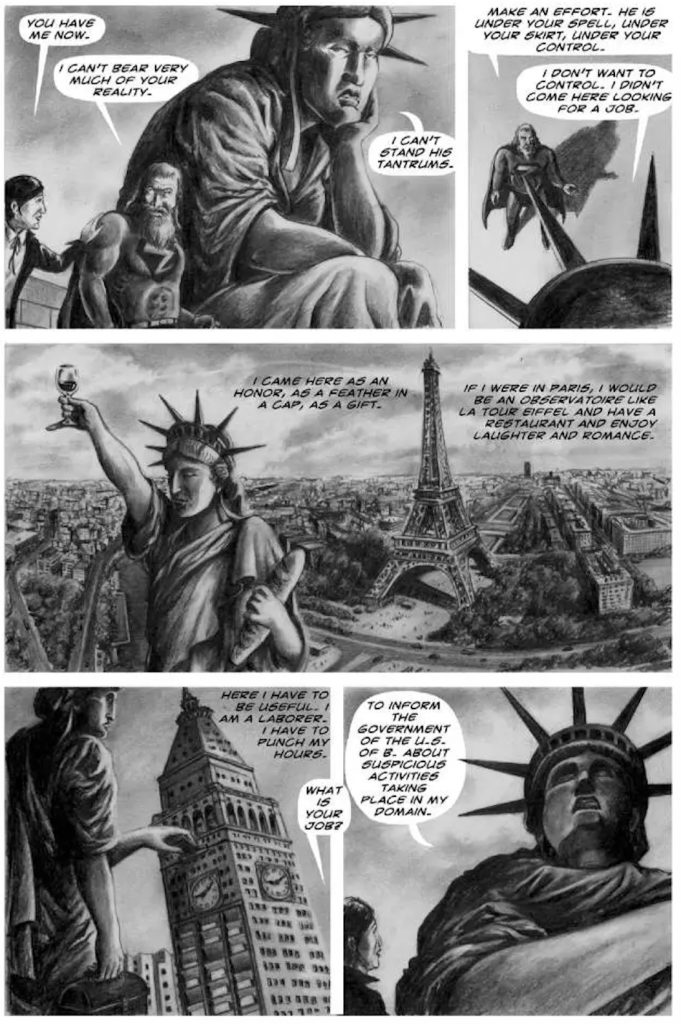
The story follows Zarathustra, Hamlet, and a character named Giannina beneath the Statue of Liberty, where they attempt to free Segismundo—Puerto Rico’s political prisoner. Their journey becomes an irreverent debate about US empire, Puerto Rican independence, citizenship, immigration, incarceration, terrorism, revolution, friendship, art, and love.
The Statue of Liberty confesses:
“I was a monument to immigration—now I’m a border control cop.”
Braschi and Lindengren use parody, visual distortion, theatrical dialogue, philosophical comedy, and cultural collision to challenge the symbols and institutions of American power.
For a lesson focused specifically on Ground Zero and historical memory, see Latinx Graphic Novel About 9/11: A Teaching Guide.
Teaching the Two Books Together
| Course | Classroom focus | Suggested pairing |
|---|---|---|
| Comics and graphic narrative | Adaptation, framing, sequence, visual parody, and relationships between words and images | Aldama’s Chapter 11 with United States of Banana |
| American literature | National mythology, post-9/11 culture, empire, incarceration, and the Statue of Liberty | The graphic novel with Chapters 10 and 11 |
| Latinx literature | Latinidad, multilingual identity, migration, colonial power, and cultural resistance | The anthology’s introduction with the graphic novel |
| Puerto Rican studies | Citizenship, sovereignty, diaspora, colonialism, and independence | Chapters 3, 10, and 11 with United States of Banana |
| Comparative literature | Hamlet, Zarathustra, Segismundo, tragedy, parody, and political allegory | Braschi’s original text alongside the graphic adaptation |
| Visual culture | Political symbols, caricature, page composition, art history, and visual disruption | Lindengren’s artwork with the anthology’s coda |
| Postcolonial studies | Decolonization, imprisonment, contested territory, and alternative forms of belonging | Aldama’s chapter with the Braschi–Lindengren graphic novel |
Questions for the Classroom
- How does Lindengren translate Braschi’s movement among poetry, theater, fiction, manifesto, and political philosophy into visual form?
- What happens when the Statue of Liberty becomes both a symbol of immigration and an agent of border control?
- How does the graphic novel represent Puerto Rico’s political and cultural relationship to the United States?
- Why do Hamlet, Zarathustra, and Segismundo belong in a contemporary Latinx graphic narrative?
- How do parody, caricature, and visual humor operate as forms of political criticism?
- What meanings emerge in the spaces between Braschi’s words and Lindengren’s images?
- How does the journey beneath the Statue of Liberty transform conventional narratives of immigration and American freedom?
- How does Aldama’s concept of a “decluttering and decolonizing doubled journey of the self” illuminate the collaboration between writer and cartoonist?
- What is gained—and what is altered—when a cross-genre literary work becomes a graphic novel?
- Does United States of Banana imagine liberation as a political program, an artistic practice, a philosophical argument, or all three?
Suggested Assignments
Reading a Political Symbol
Students can trace the Statue of Liberty through several pages of the graphic novel. How does the symbol change when it becomes a character, a prison, a border-control agent, and a contested national monument?
Visual Allusion Project
Lindengren draws upon classical and contemporary art, political caricature, advertising, film, photojournalism, and comics. Students can research one visual allusion and explain what new political or aesthetic meaning it acquires within United States of Banana.
Adaptation Map
Ask students to compare a scene from Braschi’s original text with its graphic adaptation. They should identify what Lindengren preserves, omits, rearranges, or adds and explain how those decisions alter the scene’s meaning.
Placemaking and Colonial Space
Pair Aldama’s chapter with Fernanda Díaz-Basteris’s chapter on Caribbean urban belonging. Ask students to compare how the works represent contested citizenship, colonial space, movement, and belonging.
Selected Chapters for Teaching
Instructors may wish to pair United States of Banana with these chapters from Latinx Comics Studies:
- Chapter 3: “Pedagogical Strategies for Teaching the Comic Anthology Puerto Rico Strong in the Latinx Literature Classroom” by Jennifer Caroccio Maldonado
- Chapter 4: “The Fence and the Grid: Reading the US–Mexico Border Fence as an Infrastructure for Latinx Comics” by Marcel Brousseau and Katherine Kelp-Stebbins
- Chapter 9: “Translating Queer Afro-Latinx Experiences through Comics Aesthetics in Breena Nuñez’s Autobiographical Comics” by Maite Urcaregui
- Chapter 10: “Caribbean Urban Belonging: Thinking Paradoxes of Citizenship with Independent Puerto Rican Comics” by Fernanda Díaz-Basteris
- Chapter 11: “United States of Banana: A Graphic Novel as Decluttering and Decolonizing Doubled Journey of the Self” by Frederick Luis Aldama
- Coda: “Drawing Inferences and Reading the Frames of Latinx Media” by Jennifer Gómez Menjívar
These readings allow students to move between close formal analysis and broader questions of history, citizenship, colonialism, identity, and place.
About the Editors and Creators
Fernanda Díaz-Basteris is a scholar of Latinx new media and ethnic studies whose work examines US Caribbean and Latinx resistance to displacement, coloniality, and racial capitalism through literature, popular art, and graphic narrative.
Maite Urcaregui is a scholar of Latinx and multiethnic US literature, visual culture, and comics. Her work brings feminist, queer, and critical race approaches to twentieth- and twenty-first-century literature and visual media.
Giannina Braschi is a Puerto Rican poet, novelist, dramatist, and radical thinker who writes in Spanish, Spanglish, and English. Her books include Empire of Dreams, Yo-Yo Boing!, United States of Banana, and Putinoika.
Joakim Lindengren is a Swedish cartoonist and illustrator whose work draws upon satire, political caricature, art history, popular culture, and the visual traditions of underground comics.
Book Details
Latinx Comics Studies: Critical and Creative Crossings
Editors: Fernanda Díaz-Basteris and Maite Urcaregui
Publisher: Rutgers University Press
Series: Critical Graphics
Publication date: April 15, 2025
Length: 354 pages
Illustrations: 40 color and 22 black-and-white images
Formats: Open access, paperback, hardback, and digital
Information and access: Rutgers University Press
United States of Banana: A Graphic Novel
Creators: Giannina Braschi and Joakim Lindengren
Editors: Amanda M. Smith and Amy Sheeran
Publisher: Mad Creek Books, an imprint of the Ohio State University Press
Series: Latinographix
Publication year: 2021
Formats: Paperback and digital
Information and ordering: Ohio State University Press
Academic Resources for Latinx Comics
- Latinx Comics Studies: Critical and Creative Crossings
- United States of Banana: A Graphic Novel
- Latin American Comics Archive
- ¡Wepa! Puerto Ricans in the World of Comics
- Latinx Graphic Novel About 9/11: A Teaching Guide
- Latinx Graphic Novel Teaches History and Pop Culture
- Review of United States of Banana: A Graphic Novel
Editorial note: This scholarly and teaching resource was prepared by the editorial team of the Giannina Braschi website. It should not be attributed to Giannina Braschi.
Last reviewed and updated: September 2026.