
21st Century Bacchae Theater Productions
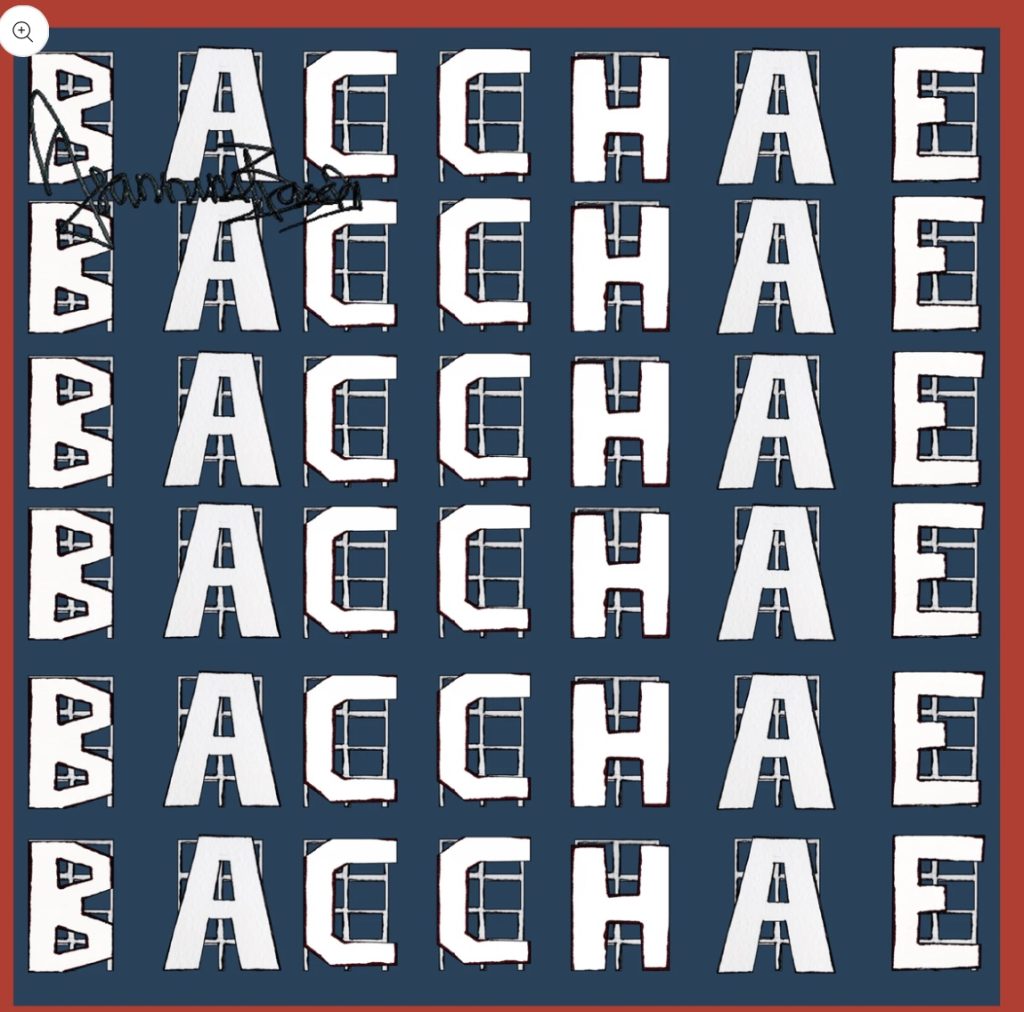
More than 2,400 years after Euripides wrote The Bacchae, Dionysus continues to return in radically different forms. Twenty-first-century playwrights and directors have transformed the tragedy through music, queer performance, feminist choruses, ritual, political satire, dance, masks, multimedia spectacle, and experimental theater. Across these adaptations, the ancient conflicts remain startlingly contemporary: ecstasy confronts authority, gender destabilizes power, the chorus challenges the individual, and collective frenzy threatens the state.
Giannina Braschi’s PUTINOIKA (2024) enters this living tradition by carrying The Bacchae into the political delirium of the Putin-Trump era. Her Bacchus imagines nothing less than the divinity of the masses:
I am pregnant. The chorus wants to come out of me. The masses want to become godly. I say why not? If the father became a god. And the son also became a god. Why can’t the masses become holy? I can make a god of the masses. I can give them ecstasy. The masses will have to make miracles for me to proclaim their godliness. And we need a god of plurality, of multiformity, a god that multiplies equations, a god that lays countless eggs, a god that creates Antigone as Anti-Gone, a god that is the chorus of voices of the masses.
—Bacchus, Giannina Braschi, PUTINOIKA (2024)
In PUTINOIKA, Euripidean frenzy becomes a form for thinking about populism, political spectacle, pandemic, insurrection, and the contagious behavior of crowds. Braschi does not simply modernize The Bacchae. She multiplies it.
Why The Bacchae Keeps Returning
Few Greek tragedies offer contemporary artists so volatile a combination of theater, politics, sexuality, religion, violence, and collective behavior. At its center stands Dionysus, god of theater and ecstasy, returning to Thebes as an outsider and demanding recognition from a political authority determined to contain him.
The confrontation between Dionysus and Pentheus can be continually reinvented because it is simultaneously political and psychological. Order confronts ecstasy; ruler confronts stranger; repression confronts desire. Dionysus destabilizes distinctions between male and female, human and divine, reason and madness, spectator and participant. Pentheus attempts to police those boundaries and is destroyed by them.
Then there is the chorus.
The Bacchae are not simply witnesses to the action. Their collective voice sings, dances, worships, warns, remembers, celebrates, and terrifies. For contemporary theater-makers interested in crowds, gender, protest, populism, collective identity, or the political force of bodies assembled in public, Euripides provides an ancient dramatic machine that remains remarkably difficult to exhaust.
The question is therefore not simply why artists continue to stage The Bacchae, but what each historical moment discovers in Dionysus that it needs again.
Euripides in the 21st Century: Contemporary Bacchae Productions
1. Bacchae — National Theatre, London (2025)
Director: Indhu Rubasingham
Playwright: Nima Taleghani, after Euripides
Nima Taleghani’s new play after Euripides brought the Bacchae themselves forward as individual, stage-storming women rather than leaving the chorus at the margins of male conflict. Rhythm, movement, music, and contemporary language drove the production, which opened Indhu Rubasingham’s tenure as director of the National Theatre.
The production premiered in the Olivier Theatre in September 2025. Its afterlife continues in 2026, when Taleghani’s adaptation is touring secondary schools and colleges across England in a new National Theatre production.
2. The Bacchae — Theodoros Terzopoulos, Pompeii and Ostia Antica (2026)
Director and adapter: Theodoros Terzopoulos
Translation: Edoardo Sanguineti
Theodoros Terzopoulos returns to Euripides in a major new Italian production staged at Pompeii and Ostia Antica. His intensely physical theater places breath, body, ritual, and the chorus at the center of tragedy.
With Roberto Latini as Dionysus, Marco Cacciola as Pentheus, Alvia Reale as Agave, and a substantial chorus, the production demonstrates the continuing vitality of The Bacchae on stages that themselves carry the physical memory of antiquity.
3. The Bacchae — Elli Papakonstantinou / Holland Festival and Romaeuropa (2023)
Director: Elli Papakonstantinou
Text: Elli Papakonstantinou, Chloe Tzia Kolyri, and Kakia Goudeli
Papakonstantinou’s queer musical version begins in a futuristic world awaiting collision with a meteor called Dionysus. Instead of destroying Earth, Dionysus unleashes desire.
The production crosses text-based theater with opera, dance, live music, video, and interactive sound. A giant seismograph registers vibrations from the earth and the dancers, transforming movement into sound and the stage itself into a musical instrument. The work appeared at the Holland Festival and Romaeuropa Festival in 2023.
Here Dionysian disruption becomes not merely a subject of the play but a principle of theatrical form: categories themselves refuse to remain stable.
4. Baccanti — Teatro Greco di Siracusa (2021)
Director: Carlus Padrissa, La Fura dels Baus
Translation: Guido Paduano
At the ancient Greek theater in Syracuse, Carlus Padrissa turned The Bacchae into an immense physical spectacle. Levers, cranes, ropes, aerial movement, music, and a large chorus surrounded the audience and exploited the monumental outdoor setting.
Lucia Lavia played Dionysus, while the Bacchae appeared as a powerful physical collective. The production’s machinery created a contemporary deus ex machina while making the bodies of the chorus part of the architecture of the spectacle.
The result joined one of Europe’s oldest theatrical spaces to the technological vocabulary of La Fura dels Baus: ancient ritual reconstructed through contemporary theatrical machinery.
5. Bakkhai — Almeida Theatre, London (2015)
Director: James Macdonald
New version: Anne Carson
Anne Carson’s Bakkhai returned to an unusually concentrated dramatic model: three actors and a chorus, echoing the structure of ancient Greek performance. Ben Whishaw played Dionysus opposite Bertie Carvel’s Pentheus.
Carson’s language and Macdonald’s production emphasized the play’s collisions between freedom and restraint, rationality and irrationality, human and divine. The chorus was central rather than ornamental, reinforcing the collective force at the heart of Euripides’ tragedy.
The production helped establish Carson’s Bakkhai as one of the most prominent literary reworkings of Euripides in contemporary English.
6. Bacchae — New York Euripides Summer Festival (2023)
Director: Lorca Peress
Producer: American Thymele Theatre
The final season of the New York Euripides Summer Festival culminated appropriately with Bacchae. Produced by American Thymele Theatre and directed by Lorca Peress, the musical drama played at several Manhattan venues in June 2023.
The production completed the festival’s long project of presenting the surviving plays of Euripides in chronological order. In a century increasingly dominated by radical adaptations, the New York production offered another kind of contemporary relevance: sustained public access to Greek tragedy through free performance.
7. The Bacchae — Lyric Hammersmith Theatre, London (2023)
Playwright: Katherine Soper
Director: Kwame Owusu
Katherine Soper’s adaptation begins with young women encountering a mysterious and charismatic Bacchus and forming an intense devotion both to him and to one another. The Lyric Hammersmith commissioned the work for its SPRINGBOARD program, and Kwame Owusu directed the production in July 2023.
Rather than treating the ancient tragedy as a remote cultural artifact, Soper uses its structures to explore desire, belonging, charismatic power, and the combustible energies of youth. The text was subsequently published in Greek Tragedies for Contemporary Times (2024).
8. Bacchae — Thiasos Theatre Company, London and Cyprus (2003–2004)
Director: Margaret Coldiron
Translation: Richard Seaford
Thiasos approached Euripides through music, dance, rhythm, and intercultural performance. Richard Seaford created an actable rhythmic translation, while live percussion and choreography drew on trance-dance traditions from ancient Greece and other cultures.
After performances in London in 2003, the production traveled to the Ancient Greek Drama Festival in Cyprus in 2004. Its emphasis on sung and danced tragedy restored something easily lost in literary readings of Euripides: The Bacchae is not only a text about Dionysian experience. It is a work designed to produce a collective theatrical experience.
Contemporary Bacchae Plays and Adaptations
The twenty-first-century afterlife of The Bacchae exists not only in productions but in new dramatic texts. These adaptations show how radically different writers can use the same ancient structure.
Anne Carson, Bakkhai (2015)
Carson’s version combines philological attentiveness with the compressed, startling language associated with her poetry and essays. Written for the Almeida production directed by James Macdonald, Bakkhai gives contemporary English readers a Dionysus who remains seductive, comic, frightening, and resistant to stable interpretation.
Katherine Soper, The Bacchae (2023; published 2024)
Soper relocates the attraction of Bacchus into a contemporary world of young women, charismatic devotion, and collective belonging. The adaptation was staged at the Lyric Hammersmith in 2023 and published by Methuen Drama in Greek Tragedies for Contemporary Times in 2024.
Nima Taleghani, Bacchae (2025)
Taleghani places renewed emphasis on the women of the chorus and uses rhythm, rhyme, music, movement, and contemporary speech to rethink who possesses power in Euripides’ tragedy. First staged at the National Theatre in 2025, the play extends into educational performance through its 2026 schools tour.
Elli Papakonstantinou, Chloe Tzia Kolyri, and Kakia Goudeli, The Bacchae (2023)
This collaborative adaptation pushes The Bacchae across theatrical genres: musical theater, opera, dance, video art, interactive sound, and queer performance. Dionysus becomes a meteor; the stage becomes a seismograph; tragedy becomes a multimedia event.
Giannina Braschi, PUTINOIKA (2024)
Braschi takes a still more radical approach. PUTINOIKA is not a conventional adaptation of The Bacchae but a cross-genre tragicomedy whose central section is itself titled “Bacchae.” Euripides becomes one of the structural engines through which Braschi confronts frenzy and plague in the age of Vladimir Putin and Donald Trump.
Pentheus becomes Pendejo, an aging tyrant modeled on Trump. The direction of Euripides’ familial violence is reversed: instead of Agave killing her son Pentheus in Bacchic frenzy, Braschi has the daughter Ivanka kill her father Pendejo.
But the deeper transformation occurs in the chorus.
Giannina Braschi’s Bacchae: From Euripides to PUTINOIKA
PUTINOIKA unfolds in three parts—“Palinode,” “Bacchae,” and “Putinoika”—and describes its historical moment through a trinity of collusion, pollution, and delusion. Its characters include figures inherited from Greek tragedy alongside Putin, Pendejo, Ivanka, Maria Callas, Greta Thunberg, and Braschi’s own inventions.
In Euripides, Dionysus arrives in Thebes demanding recognition of his divinity. Braschi pushes that question outward. Her Bacchus asks why divinity should stop with father and son: why not make a god of the masses?
That question transforms the dramatic function of the chorus.
The singular chorus of Greek tragedy proliferates into competing collectivities: the Muses of Bacchus, the Putinas of Putin, and the Agents of Pendejo. The masses are no longer merely represented by a chorus. They multiply into choruses with competing allegiances, voices, rhythms, and forms of frenzy.
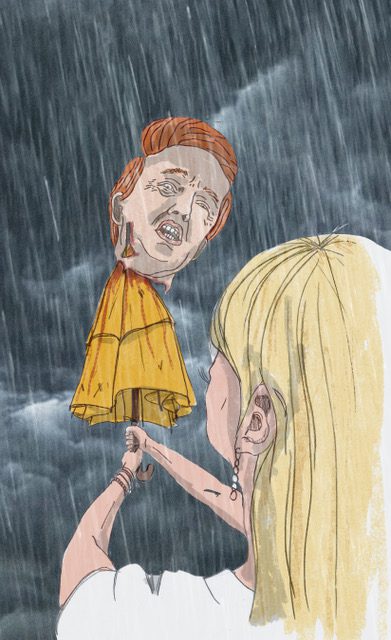
Braschi does not simply modernize The Bacchae. She multiplies it.
This proliferation is formal as well as political. PUTINOIKA moves among tragedy, comedy, poetry, manifesto, dialogue, philosophical argument, song, political satire, and breaking news. Dionysian plurality enters the architecture of the book itself. The collapse of stable political categories is answered by a collapse of stable literary ones.
The reversal of Agave and Pentheus is similarly pointed. Braschi has explained that Pendejo is based on Pentheus: the young tyrannical king becomes an old tyrant, and the mother who kills her son becomes a daughter who kills her father. The ancient family tragedy survives, but history changes its cast.
What remains is frenzy.
For Braschi, however, the crowd is not only dangerous. The possibility that the masses might become “godly” introduces a more hopeful proposition into the Dionysian tradition. Collective energy can produce demagoguery, violence, and delusion—but it can also produce creativity, plurality, resistance, and transformation.
That ambiguity is one reason The Bacchae remains alive. Dionysus is never simply liberation or destruction. The chorus is never simply mob or community. Ecstasy can create and annihilate.
Twenty-first-century artists keep returning to Euripides because the contradiction has not gone away.
Recent Scholarship on The Bacchae and Greek Tragedy
For readers interested in the continuing scholarly life of Euripides and classical reception:
- William Allan and Laura Swift, eds., Euripides: Bacchae, Cambridge University Press, 2024.
- David Bullen and Christine Plastow, eds., Greek Tragedy, Education, and Theatre Practices in the UK Classics Ecology, 2024.
- Practitioners’ Voices in Classical Reception Studies: conversation with Katherine Soper and Kwame Owusu on adapting The Bacchae, 2024.
- Greek Tragedies for Contemporary Times, featuring Katherine Soper’s The Bacchae, Methuen Drama, 2024.
- Anne Carson, Bakkhai, Oberon Books, 2015.
Related Reading
- Anne Carson — Bakkhai, New Directions
- “A Choral Response to Disaster”
- Modern Bacchae: PUTINOIKA
- Contemporary Antigone
- Zaha Hadid in Literature: 520 West 28th Street in Giannina Braschi’s PUTINOIKA
- Nima Taleghani — Bacchae, National Theatre 2025 playtext
- World Literature Today: Give me more Putinas, Por Favor”
- PUTINOIKA by Giannina Braschi
Editorial note: Curated by the Site Editors as a point of departure for further reading on Euripides and contemporary adaptations of The Bacchae, this article was prepared independently and does not constitute writing by Giannina Braschi. Reviewed and updated: September 2026.