
Antigone in Contemporary Dramatic Poetry

While writing her cross-genre epic tragedy PUTINOIKA during the Covid-19 pandemic, Giannina Braschi was approached by the editors of Poetry magazine for new work. She excerpted this dramatic poem directly from Part One—Palinode, a section where classical figures like Medea, Electra, and Antigone rewrite their ancient fates through creation rather than destruction. This contemporary Antigone refuses to sacrifice herself to bury her brother, choosing life over martyrdom. Published in the February 2022 issue of Poetry, Braschi has since performed Antigone at Pratt Institute, among other universities and cultural centers.
.Operating as a Socratic dialogue between Anti and Gone, this dramatic poem offers a window into PUTINOIKA—redefining classical tragedy for the 21st century by deconstructing state resistance, kinship, and the body politic.
Poetry Magazine
Table of Contents
February 2022
SUZI F. GARCIA, Editor
- ADA LIMÓN
- HEDGIE CHOI
- MUNA ABDULAHI
- SOHAM PATEL
- GIANNINA BRASCHI
- KEITH DONNELL JR.
- and others
Antigone by Giannina Braschi
Antigone: Anti what is gone. If it leaves, it’s for a reason. Anti has to be gone. It has to go. It always goes against. Against the state— against kinship—and against myself. I don’t want to be the anti-clash. Anti has to go from gone. Gone has to leave immediately, without pause, without cause. I can understand the arguments that defend gone—but they always delay my stay on this planet. They come with Anti—as a pre-position— and they make me stay in Antigone—anti what leaves—what speeds—what argues against. Why can’t I argue in favor of gone? Go by and pass away—if you can’t stay for a moment— without hesitation—blaming me for a crime—if you can’t stop victimization—if you can’t say something without struggling against the gone of another antagonistic element. Why the agony of the anti and the gone? I’ll make a drama of myself in two parts.
Anti: Always against. Versus must always keep up a fight. I wish they could stop fighting—two at a time—as if the contradiction of themselves could make each one of the antagonistic elements find a commonality that makes them advance and not nix each out again, denying their positive energies.
Gone: Please. Gone with the wind. Anti has to go. It cannot last forever having to contradict itself always—and not getting ahead—because it is anti-getting forward.
Anti: If I were not against all the gones, how many more gones would have already left us—and we need more voices here to argue against all that has to leave— because you say it is gone prematurely—you say it has to be gone—but I am Antigone—against what leaves prematurely. And why does it have to leave? Why can’t it stay here forever? Antigone means to stay. Don’t leave us orphans of your anti. We want to be Antigone—anti what is gone forever. Committed to the everlasting changes of humanity as a swarm, a horde, a chorus, a proliferation, and a multiplication of all the ones that are anti what is gone.
Gone: If it is gone with the wind—it is better than if it stays without a reason to stay.
Anti: I am the primary beneficiary. I exist as an anti—what is gone. And I like myself as an anti that exists with gone. Don’t let me die because you want to move forward without me. Things should not be defined any longer. What has to be valued is the growth—and the process in which things develop by themselves. Don’t take away the possibility of growth by cutting a definition short of growth—of process. The development of a thing is more important than the definition of a thing.
Gone: Go to another name and unite with another past participle. But don’t keep me up fighting all night with kinship—with the state—with myself—existing with protests inside—always protesting inside me—as a public manifestation of being buried alive in Antigone— who doesn’t let me go—but keeps me struggling to survive. Good vibes—bad vibes—this is what I am feeling all the time. Let bygones be bygones. But anti doesn’t allow a good-bye. Bye-bye. It always inserts the bad vibes inside the good-bye. With all the protests against bye-bye. Let me tell you how happy I am being gone, bye-bye.
Good-bye: Let me speak for myself as a lullaby, good night.
Bad Vibes: With Gone there are always protests from Anti-gone. I am happy she is still here with us as an argument of pros and cons— and as a contradiction that wants to rest eternally in a mausoleum with us.
Anti: It is the body politic persisting, insisting it has a body of work and muscles to train—and trains to catch— and it wants to rise in love—and raise humanity to a higher quality of itself—and it doesn’t want to leave us without a body of work to complete its masterpiece. Don’t even try to take Antigone from gone. Anti is the body of work that doesn’t want to leave everything unfinished before it is time to go away. And when gone comes to take anti away from body—body will manifest itself as a protest of antagonism—and contradiction— contrasting gone with the spirit of rain and wind —and flesh with earth and fire. Here, keep the torch alive!
First published in Poetry Magazine (February 2022), the oldest monthly devoted to verse in the English-speaking world, founded in Chicago by Harriet Monroe in 1912.
PUTINOIKA’s Critical Reception: Reimagining the Epic & The Classics
“In Giannina Braschi’s churning imagination, in her exuberant, upwelling, hilarious and mortifying performances of wonderment, howl, synchronic time, ethical insistence, and linguistic swirl, it’s not unusual to find words such as ‘generosity’ and ‘spirit’ leading, in the same sentence, to ‘welfare,’ ‘radiation,’ and ‘tax deductions.’ If, as in Ezra Pound’s translation of Aristotle, the ‘swift perception of relations’ is truly the ‘hallmark of genius,’ it’s in the brightly lit halls of Braschi’s books where poetry is tested and stamped with such a mark. Like her character, Frenzy, she’s a provocateur who believes in and pledges her fidelity only to ‘everything that exists.’”
— Forrest Gander, Pulitzer Prize-winning poet and author of Mojave Ghost
“[Braschi’s poetry] infiltrates classical mythology to argue with the Furies to finally push Medea, Antigone, Clytemnestra, and their peers to take charge… reminding the reader that the classics used to be part of a flammable civic debate before being sculpted in marble.”
— World Literature Today
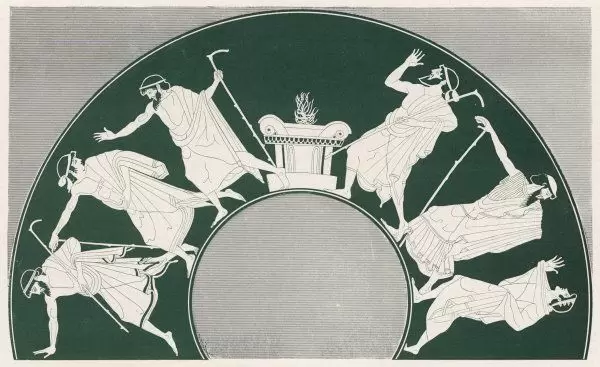
The Plot of Antigone in Ancient Greek Theater
Antigone is famed in Greek mythology for her unwavering beliefs. Her father, King Oedipus of Thebes, married his own mother Jocasta. Thus Antigone was both sister and daughter to Oedipus, and both daughter and grandchild to Jocasta. Her name, Antigone, translates to “in place of one’s parents.”
The myth of Antigone relates her endeavors to bury her brother, Polynices, in a respectable fashion. Before his death, Polynices shared the throne of Thebes with his brother Eteocles. After a falling-out, Polynices was banished from the kingdom by Eteocles, eventually returning with an army to attack Thebes. Both brothers died in the conflict.
Following their deaths, King Creon took the throne and decreed that Polynices remain unburied and unmourned: “Unwept, unsepulchered, a treasure to feast on for birds looking out for a dainty meal.”
Antigone’s refusal to obey Creon’s law sets off the tragedy of state defiance, kinship, and public grief that continues to inspire modern dramatic poetry.
Related Reading
- Theater of War Productions – Antigone in Ferguson
- Poetry Foundation: Antigone
- PUTINOIKA by Giannina Braschi
- Postdramatic Theater
- Contemporary Bacchae
Editorial Note: The introductory framing on this post was prepared independently by the site’s editorial team and does not constitute writing by Giannina Braschi. The poem “Antigone” appears in its original form as published in Poetry Magazine (2022). The poem also appears in PUTINOIKA (2024).
Last reviewed and updated on August 25, 2026.