

Ilan Stavans on Giannina Braschi’s Spanglish Poetry
Spanglish poetry moves between Spanish and English to express life across languages, cultures, and identities. Rooted in bilingual communities and especially vital in Puerto Rican and Nuyorican literature, it can involve code-switching, translation, linguistic collision, humor, and resistance. Giannina Braschi does more than introduce Spanglish words or phrases into an otherwise monolingual text. She wrote the full-length Yo-Yo Boing! across Spanish, Spanglish, and English, making the movement among languages the structure and subject of the work. In Braschi’s writing, Spanglish becomes a poetic method for breaking open inherited forms and writing a new American language into being.
Boing!
I have always visto a Giannina Braschi as my heroine. And I’m an adicto . . . There is something mágico in her juego de palabras, her exploration of tenses, her anxious, uncompromising bilingüismo that ni es de aquí ni es de aquí ni es de allá, ni tiene age ni porvenir, and ser feliz is her color, her identity. Braschi creates a lexicography that is and isn’t atrapada in the presente.
¿Could she be anything but Latinéxica?
My favorite among her work is her ode—¿una oda, really?—a la ambigüedad:
El bilingüismo is an aesthetic bound to double business. O, ’tis most sweet when in one line two crafts directly meet. To be and not to be. Habla con la boca llena and from both sides of its mouth. Está con Dios y con el diablo. Con el punto y con la coma. It is a purgatorio, an intermediate grammatical sign, between heaven and earth, a semicolon between independencia and estadidad, an estado libre asociado, a multicultural mamarracho. It has no clauses or subterfuges, no anda con gríngolas ni con muletas, no es artrítico, no se queja—it howls like a dog to infinity and asks for manna from heaven to fall like rain—no se ahoga en un vaso de agua, no deja que le doren la píldora—it doesn’t walk in a cast, jumping like a güimo with crutches from here to there—it isn’t the canary swinging on the swing inside the cage eating pistachios—it has left and keeps leaving all cages como Pedro por su casa and hasn’t looked back. It has no 10 commandments because no tiene pelos en la lengua, but it has huevos—I have been laying them throughout my entire work which is one—and I call it the manifesto of poetic huevos—it is made by showing huevos, putting your foot in it, pisseando here and pisseando there. It is born from popular fire, from bread, from the earth, and from freedom. It is a stray dog crossing a bridge between north and south, between the 20th and 21st centuries, between Segismundo and Hamlet, between Neruda and Whitman, between Dickinson and Sor Juana, between Darío and Stein, between Sarmiento and Melville—between the two clashing yo’s is the Yo-Yo Boing!
Giannina Braschi
I love the strategic diéresis. Braschi sings like the rain. I love her expressions “Pedro por su casa,” “no tener huevos,” and also hacer una obra with “huevos poéticos.” She talks the talk like Sor Juana and Emily and Rubén and Gertrude and Domingo and Herman. The map que Braschi construye is ideal for me: it has the size of my self.
Mostly, Braschi habla of having “pelos en la lengua.” Now, how on earth can you traducir such an expression? It means to speak frankly, but she does más que eso. She bounces de ida y de regreso, without hindrance, sin remordimiento. Como le da la gana.
She destruye la lengua only to rebuild it in a game of echoes and re-echoes. Nada is what it sounds. She laughs at la Real Academia Española. Se orina en el casticismo.
Hats off, Giannina. You are a semicolon—¿o un semi-Colón?—between independencia and estadidad. You’re el pan y la tierra y la libertad. Particularly la libertad. Language is freedom. You make el pasado un relajo and the future un regalo.
Ambiguity is also mi nombre. (Or else, my nömbre.) I’m bound to double talk. Spanish and English = Spanglish. El yo-yo que sube y baja.
I love to know y not to know. I love to ser y no ser. To estar and no estar.
Gracias a ti, admired nuyorriqueña, mi lengua también está llena de pelos y pelotas.
Boing! Boing!
— Ilan Stavans (Foreword to Poets Philosophers Lovers: On the Writings of Giannina Braschi)
About Ilan Stavans and Spanglish: The Making of a New American Language
Stavans, the Lewis-Sebring Professor of Humanities and Latin American and Latino Culture at Amherst, is quoted, along with many other scholars and media personalities, about the growing phenomenon of Spanglish, a blend of Spanish and English dating back to the 19th century and now spoken across the United States, especially by Latinx immigrants and their children and grandchildren. Spanglish appears today in popular music, in advertising campaigns and on television news programs.
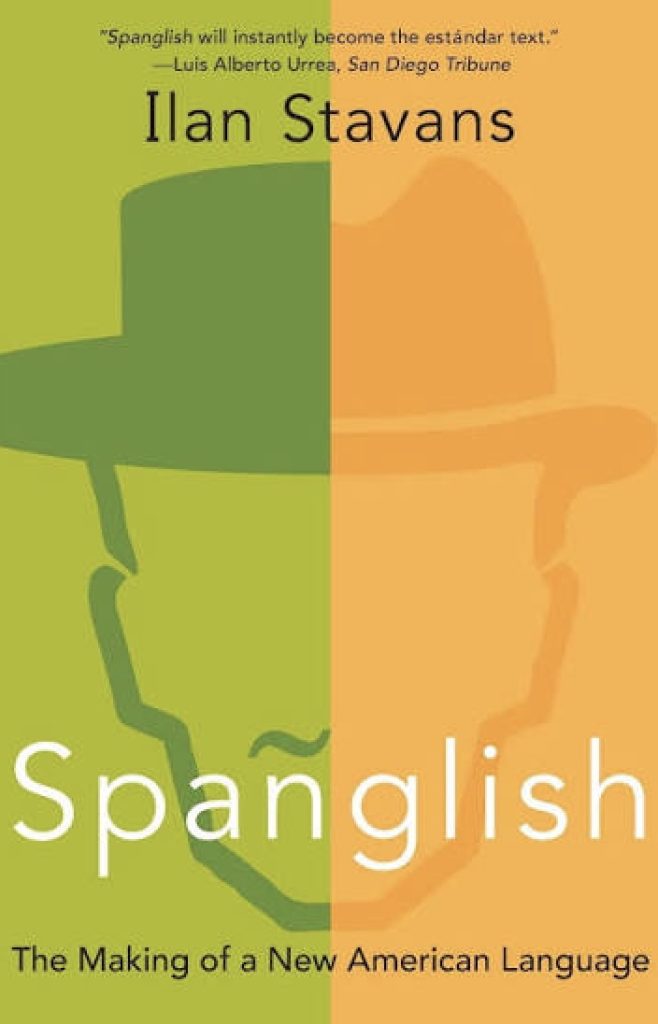
Stavans is the author of the 2003 landmark book Spanglish: The Making of a New American Language and has taught a course on Spanglish—making Amherst one of the growing number of colleges and universities that include Spanglish in their curricula.
Watch Giannina Braschi Discuss Yo-Yo Boing! and Spanglish
A Spanglish Philosophy
“Soy boricua. In spite of my family and in spite of my country—I’m writing the process of the Puerto Rican mind—taking it out of context—as a native and a foreigner—expressing it through Spanish, Spanglish, and English—Independencia, Estado Libre Asociado, and Estadidad—from the position of a nation, a colony, and a state—Wishy, Wishy-Washy, and Washy—not as one political party that is parted into piddly parts and partied out. Todos los partidos están partidos y son unos partidos…” Giannina Braschi, United States of Banana
Have you read these Code-Switching poets and writers?
- Miguel Algarín (1941–2020) — Poet and scholar. Co-founder of the Nuyorican Poets Café whose bilingual curation helped institutionalize urban performance verse. Author of Nuyorican Poetry: An Anthology of Puerto Rican Words and Feelings (editor).
- Giannina Braschi (b. 1953) — Writes “radical politics as a high art” in Spanish, English, and Spanglish. Author of the first Spanglish novel Yo-Yo Boing! (1998) and the epic poem El imperio de los sueños / Empire of Dreams (1988).
- Caridad de la Luz (“La Bruja”) (b. 1977) — The Executive Director of the Nuyorican Poets Café, poet, and actor. Author of The Poetic Art of La Bruja (2010) and For Sale (2013).
- Sandra María Esteves (b. 1948) — Early leader of the Nuyorican poetry movement and visual artist. Author of Bluestown Mockingbird Mambo (1990).
- Mariposa (b. 1971) — Centers on Afro-Puerto Rican identity, diaspora memory, and social justice through performance poetry rooted in the South Bronx. Author of Born Bronx (2001).
- Tato Laviera (1950–2013) — Known for Spanglish verse, focusing on Afro-Latino identity and migration. Author of AmeRícan (1985).
- Jesús Papoleto Meléndez (b. 1950) — A veteran street poet of the Lower East Side whose gritty, urban-realist verses map community struggles and resilience. Author of Street Poetry & Other Poems (1972).
- Willie Perdomo (b. 1967) — Former NYS Poet Laureate whose writing tracks the generational pulse and musical memory of East Harlem. Author of Where a Nickel Costs a Dime (1996), Smoking Lovely (2003), The Essential Hits of Shorty Bon Bon (2014), and The Crazy Bunch (2019).
- Pedro Pietri (1944–2004) — The deadpan iconoclast of Nuyorican literature whose absurdist, fiercely anti-colonial satire redefined diaspora dissent. Author of the classic poem Puerto Rican Obituary (1973), Traffic Violations (1983), The Masses Are Asses (1984), and Selected Poetry (2015).
- Miguel Piñero (1946–1988) — Known for raw, defiant depictions of street survival; his prison-forged writing helped birth the Nuyorican aesthetic. Author of La Bodega Sold Dreams (1980) and Outlaw: The Collected Works of Miguel Piñero (2010).
- Piri Thomas (1928–2011) — A foundational autobiographer and prose stylist whose unflinching explorations of race, crime, and identity in Spanish Harlem set an ideological groundwork for the movement. Author of Down These Mean Streets (1967), Savior, Savior, Hold My Hand (1972), Seven Long Times (1974), and Stories from El Barrio (1978).
- Edwin Torres (b. 1958) — A sound artist who treats poetry as a physical, multi-lingual acoustic playground. Author of The All-Sulu Everything (2013).
Essential Sources on Spanglish Literature
- Aldama, Frederick Luis, and Tess O’Dwyer, editors. Poets Philosophers Lovers: On the Writings of Giannina Braschi. University of Pittsburgh Press, 2020. (Includes a Foreword by Ilan Stavans)
- Algarín, Miguel, and Miguel Piñero, editors. Nuyorican Poetry: An Anthology of Puerto Rican Words and Feelings. Morrow, 1975.
- Betti, Silvia. El espanglish: ¿mito o realidad? Instituto de Estudios Riojanos, 2008.
- Betti, Silvia, and Renata Enghels, editors. Spanglish: Current Issues, Future Perspectives, and Linguistic Insights. Oxford University Press, 2023.
- David, Gabrielle, and Kevin E. Tobar-Pesántez, editors. Hey Yo! Yo Soy! 40 Years of Nuyorican Street Poetry. Red Sugarcane Press, 2012.
- Guitart, Jorge. “Spanglish as an Anglicized Spanish Dialect: Structural and Psycholinguistic Considerations.” Issues in Applied Linguistics, vol. 8, no. 2, 1997, pp. 115-30.
- Moreno-Fernández, Francisco. La lengua española en Estados Unidos. Instituto Cervantes / Real Academia Española, 2020.
- O’Dwyer, Tess. “Giannina Braschi.” The Literary Encyclopedia, 19 Mar. 2026
- Stanchich, Maritza. “Giannina Braschi.” The Encyclopedia of Twentieth-Century American Fiction, edited by David Watson et al., Wiley-Blackwell, 2011.
- Stavans, Ilan. Spanglish: The Making of a New American Language. Rayo/HarperCollins, 2003.
- Zentella, Ana Celia. Growing Up Bilingual: Puerto Rican Children in New York. Blackwell, 1997.
Related Posts
- Yo-Yo Boing!
- El futuro del Espanglish
- Puerto Rican Poetry
- Rethinking the Latin American Canon
- Puerto Rican Thought
Editorial note: This article was independently prepared by the site’s editorial team; it does not constitute writing by Giannina Braschi. Reviewed and updated August 26, 2026.