
Latinx Graphic Novel Teaches History and Pop Culture
Teaching Latinx Comics with United States of Banana
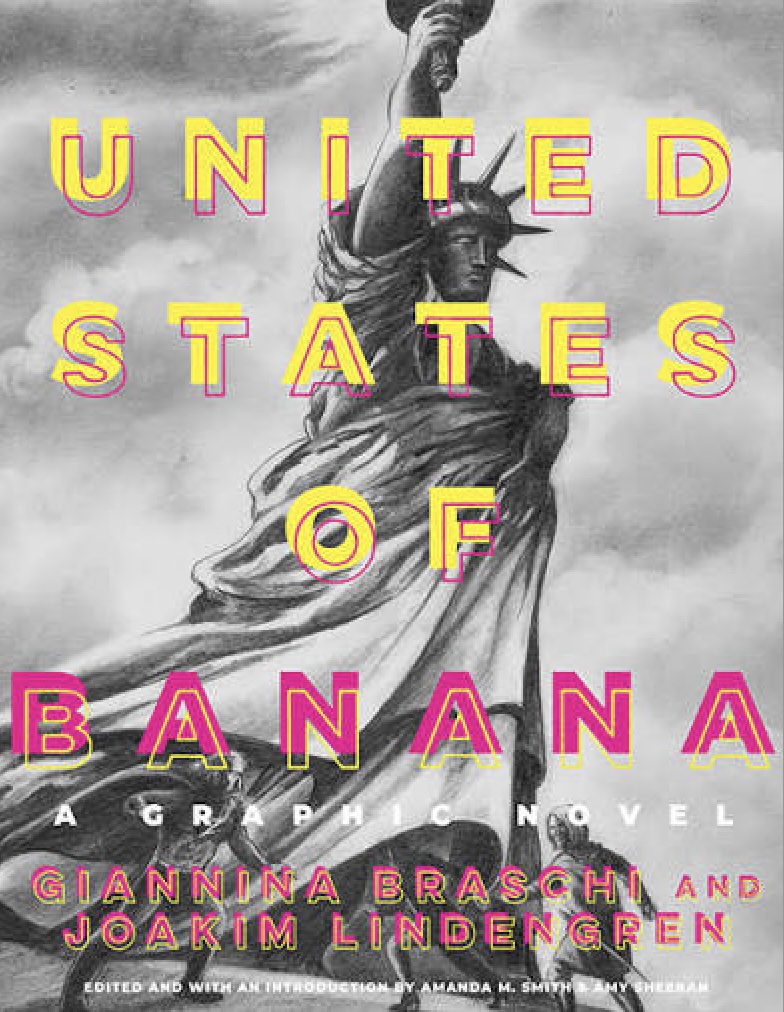
How can one graphic novel open a classroom conversation about colonialism and decolonization, political philosophy, literature, art, and popular culture? United States of Banana: A Graphic Novel gives teachers and students an imaginative point of entry through vivid characters, visual satire, political humor, and references that can be explored at many different levels.
About United States of Banana: A Graphic Novel
United States of Banana: A Graphic Novel was created by Puerto Rican author Giannina Braschi and Swedish cartoonist Joakim Lindengren. Edited and introduced by Amanda M. Smith and Amy Sheeran, it was published in English in 2021 by Mad Creek Books, an imprint of the Ohio State University Press.
The graphic novel adapts a section of Braschi’s 2011 epic tragicomedy United States of Banana, which moves among prose poetry, fiction, theater, manifesto, satire, and political philosophy.
The story follows Hamlet, Zarathustra, and a character named Giannina beneath the Statue of Liberty, where they attempt to free Segismundo—the imprisoned prince from Calderón de la Barca’s Life Is a Dream and, in Braschi’s allegory, Puerto Rico’s political prisoner.
Their journey becomes a debate about US empire, Puerto Rican independence, citizenship, immigration, incarceration, terrorism, revolution, friendship, art, and love.
Multiple Points of Entry for Students
Students do not need to arrive having read Hamlet, Life Is a Dream, or Nietzsche. They may begin with a cartoon, a familiar saying, the Statue of Liberty, a political figure, or an image they recognize. From there, they can investigate the histories and literary traditions with which the graphic novel is in conversation.
As coeditor Amy Sheeran observed in an Otterbein University feature, “there is an entry point for everyone.”
The graphic novel invites students to consider questions such as:
- How does adaptation create new meanings?
- How do images make historical and political arguments?
- What happens when different genres and traditions occupy the same page?
- How can literature expose contradictions within national symbols?
- What can satire and popular culture contribute to political thought?
Popular culture is not a distraction from history. It is one of the forms through which history is transmitted, remembered, contested, and reimagined.
Puerto Rican History, Colonialism, and Decolonization
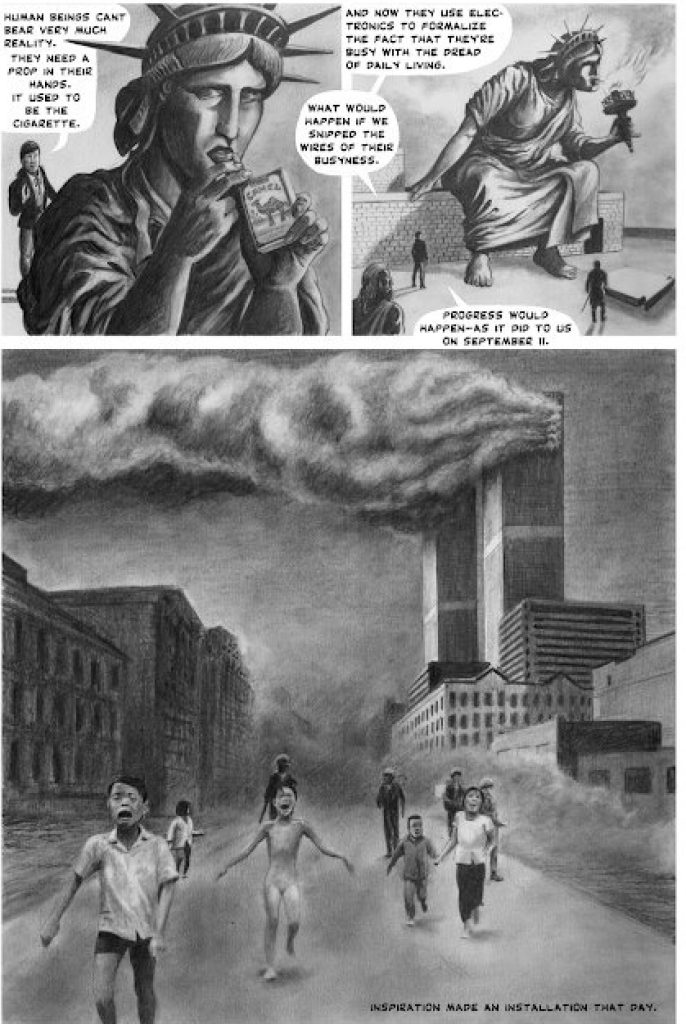
Beneath the graphic novel’s comedy lies an allegory of US imperialism and Puerto Rican independence. Segismundo’s imprisonment transforms the Statue of Liberty into a contested space: liberty is celebrated above ground while colonial captivity remains concealed below.
This setting allows students to examine Puerto Rico’s relationship with the United States, including citizenship, sovereignty, colonialism, migration, independence, and cultural exchange. These subjects are placed in conversation with September 11, border control, mass incarceration, debt, financial power, and the meaning of freedom.
Segismundo also connects Spanish Golden Age theater with Puerto Rico’s colonial status. A seventeenth-century imprisoned prince becomes a contemporary political prisoner, demonstrating how adaptation can move a literary character across historical periods and national traditions.
For a lesson centered on September 11, see Latinx Graphic Novel About 9/11: A Teaching Guide.
Visual Satire, Art, and Popular Culture
Joakim Lindengren carries Braschi’s literary and political collisions into visual form. Philosophers, writers, politicians, cartoons, advertisements, and art-historical references appear beside one another.
His images draw upon classical and modern art, political caricature, photojournalism, film, advertising, popular comics, and underground visual culture. A commercial jingle can lead to a discussion of capitalism. The Statue of Liberty can open questions about immigration. A cartoon can illuminate a philosophical argument.
The graphic novel’s collage-like form demonstrates how culture is assembled from inherited stories, political symbols, languages, memories, and images. Instead of merely identifying these references, students can ask what becomes possible when they collide.
Teaching the Graphic Novel
The volume concludes with classroom questions supporting conversations about history, politics, literature, adaptation, and visual form.
United States of Banana: A Graphic Novel can be taught in courses on:
- Latinx literature and Puerto Rican studies
- Comics and graphic narrative
- Comparative and American literature
- Spanish Golden Age theater
- Postcolonial and decolonial studies
- Political philosophy
- Visual and popular culture
- Adaptation
- Post-9/11 literature
Instructors can teach the complete work or select sequences involving Ground Zero, the Statue of Liberty, Segismundo, Puerto Rico, immigration, imprisonment, or popular culture.
The book’s range does not require every subject to be taught at once. Its strength lies in allowing each class to begin with the images, characters, historical questions, or literary traditions most relevant to the course.
Complimentary copies for instructors: Ohio State University Press provides a free desk copy to instructors who adopt the book for a course with a minimum enrollment of ten students. See the publisher’s desk-copy requirements and request instructions.
United States of Banana in Latinx Comics Studies
The open-access anthology Latinx Comics Studies: Critical and Creative Crossings, edited by Fernanda Díaz-Basteris and Maite Urcaregui, brings together scholarship, pedagogy, and original comics addressing national memory, migration, multilingual identities, colonial violence, and Latinx futurities.
Frederick Luis Aldama’s chapter places United States of Banana: A Graphic Novel within conversations about decolonization, identity, movement, adaptation, and verbal and visual narration.
For course pairings and assignments, see Latinx Comics Studies: Teaching United States of Banana.
Book Details
Title: United States of Banana: A Graphic Novel
Creators: Giannina Braschi and Joakim Lindengren
Editors: Amanda M. Smith and Amy Sheeran
Introduction: “United States of Banana: A Graphic Revolution”
Publisher: Mad Creek Books, an imprint of the Ohio State University Press
Series: Latinographix
Publication year: 2021
ISBN: 978-0-8142-5786-9
Information and ordering: Ohio State University Press
Continue Exploring
- Latinx Graphic Novel About 9/11: A Teaching Guide
- Latinx Comics Studies: Teaching United States of Banana
- About United States of Banana
Source note: This page draws in part upon Madelyn Nelson’s 2021 Otterbein University feature about the graphic novel’s use in interdisciplinary teaching.
Editorial note: This educational page was revised and expanded in 2026 by the editorial team of the Giannina Braschi website. The contextual material should not be attributed to Giannina Braschi.