
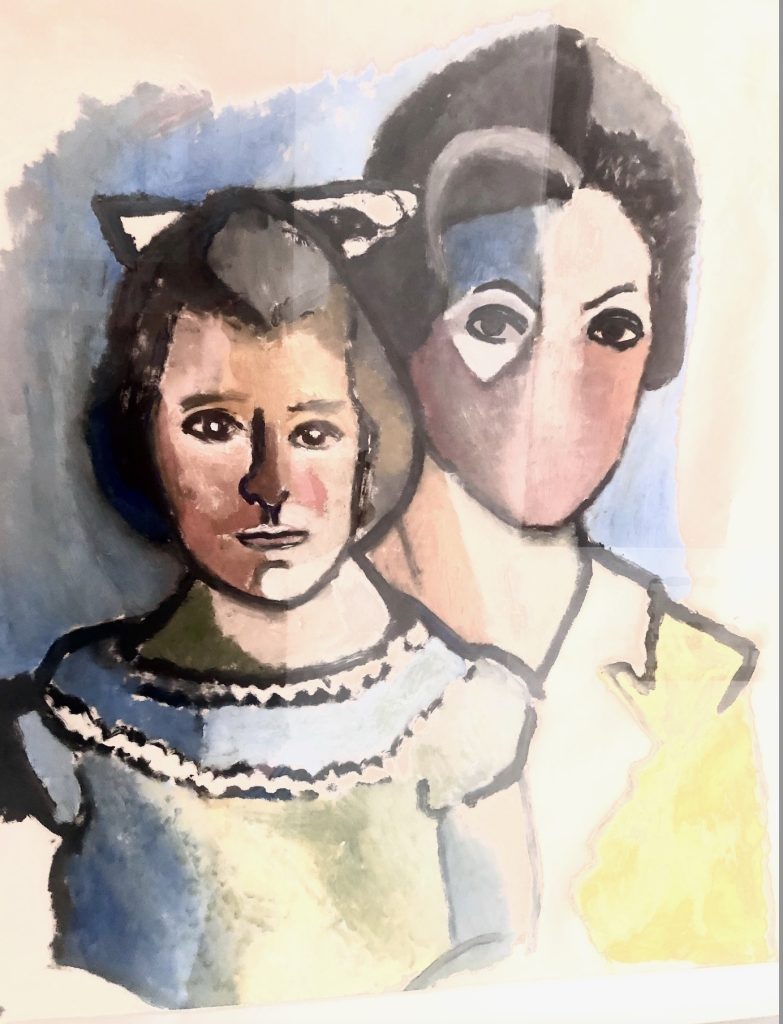
Francisco Rodón, one of the defining Puerto Rican painters of the twentieth century, portrayed Giannina Braschi as a child beside her mother, Edmée Firpi de Braschi. The large mother-and-daughter double portrait belongs to Rodón’s distinguished body of portraiture while occupying an unusual place within it: unlike his celebrated representations of established writers, political leaders, and performers, this painting records a private relationship before one of its sitters entered public cultural life.
Francisco Rodón’s double portrait of Giannina Braschi and her mother
A Mother-and-Daughter Double Portrait
A double portrait depicts two people within a single composition, often using their physical proximity to convey a familial, social, or historical relationship. Rodón’s painting is therefore both a double portrait and, more specifically, a mother-and-daughter portrait.
Braschi appears not as the poet and novelist she would become, but as a child seated beside her mother. The painting does not predict her later literary career or attempt to locate the adult writer within the young sitter. Its importance lies in the moment it preserves: Giannina Braschi and Edmée Firpi de Braschi presented together, before Braschi’s emergence as an internationally studied author.
Viewed retrospectively, the work brings a private family history into the larger record of Puerto Rican art and literature. Its two sitters remain inseparable from its meaning.
Francisco Rodón: A Major Puerto Rican Painter
Francisco Rodón (1934–2023) was born in San Sebastián, Puerto Rico. His artistic formation extended across several countries and institutions. He studied at the Académie Julian in Paris, the Real Academia de Bellas Artes de San Fernando in Madrid, Mexico’s National Institute of Fine Arts, and the Art Students League of New York.
After returning to Puerto Rico in 1959, Rodón studied graphic arts with Lorenzo Homar at the Taller de Gráfica of the Instituto de Cultura Puertorriqueña. The International Center for the Arts of the Americas at the Museum of Fine Arts, Houston describes him as an artist known for outstanding portraits who received numerous prizes and international recognition.
Rodón’s position in Puerto Rican art was formally recognized at Expo 92 in Seville, where he was named Puerto Rico’s most important painter of the twentieth century. The designation placed him in a historical sequence with José Campeche, representing the eighteenth century, and Francisco Oller, representing the nineteenth.
The Museo de Arte de Ponce holds works by Rodón in its collection and identifies him as a major painter of portraits, landscapes, and still lifes.
Theatricality, Color, and the Art of Portraiture
In a 1975 essay preserved by the ICAA Documents Project, the Argentine art critic Rafael Squirru placed Rodón within the Romantic tradition. He emphasized the importance of form, light, and especially color in the painter’s work, while observing a theatrical quality across Rodón’s practice.
That theatricality is particularly relevant to his portraiture. Rodón did more than document the appearance of recognizable people. His portraits presented public figures as individual presences, bringing the authority of the sitter into tension with the expressive possibilities of painting.
His subjects included the Argentine writer Jorge Luis Borges, Puerto Rican governor Luis Muñoz Marín, Cuban prima ballerina Alicia Alonso, and Peruvian novelist and Nobel laureate Mario Vargas Llosa.
Rodón’s 1982 portrait Yo, Borges belongs to the collection of the Museo de Arte de Ponce. His portrait of Alonso, La legendaria Alicia Alonso—Canto del Cisne, was painted in 2005. Christie’s records the work as an oil on paper laid on canvas.
His monumental portrait of Luis Muñoz Marín, completed in 1977 after several years of work, became one of the best-known representations of the first democratically elected governor of Puerto Rico.
A Landmark Auction Record for Puerto Rican Painting
Rodón’s standing was also reflected in the international art market. In November 2009, Puedo Retornar al Crepúsculo y la Noche sold at Sotheby’s New York for $302,500, exceeding its estimate of $175,000 to $225,000.
The Museo de Arte de Ponce identifies the result as the highest price paid up to that time for a Puerto Rican painting. The $302,500 result remains Rodón’s auction record.
The Sotheby’s catalogue entry describes the 2005 work as oil on heavy paper laid on canvas, measuring 44¼ by 31 inches.
The sale established an important benchmark for Puerto Rican art at international auction. Although later Puerto Rican artists have recorded higher individual sales, Rodón’s result remains a landmark in the market history of Puerto Rican painting.
A Private Portrait Within a Public Career
The portrait of Braschi and her mother differs from the public commissions and portraits most often associated with Rodón. Borges, Muñoz Marín, Alonso, and Vargas Llosa came to the painter with established cultural or political identities. The Braschi portrait precedes the public identity for which one of its sitters would later be known.
This chronological distinction matters. Rodón was not painting “the author Giannina Braschi” as a literary figure. He was painting a child in relation to her mother. The child is fully painted; her mother’s face is articulated only through the eyes.
The work’s significance consequently resides in both biography and form. It belongs to the history of Braschi’s visual representation, but it also stands as an example of Rodón’s ability to approach portraiture through human relation rather than public office, professional achievement, or celebrity.
Giannina Braschi in Puerto Rican Portraiture
Rodón’s painting is part of a wider visual archive surrounding Braschi. Dorian Lugo Bertrán discusses that archive in “Leaping Off the Page: Giannina Braschi’s Intermedialities,” his contribution to Poets, Philosophers, Lovers: On the Writings of Giannina Braschi, edited by Frederick Luis Aldama and Tess O’Dwyer and published by the University of Pittsburgh Press.
Lugo Bertrán places Braschi’s portraits within his larger examination of intermediality: the movement of her literary presence across media and artistic disciplines. He identifies portraits by the Puerto Rican artists Francisco Rodón, Jorge Zeno, Víctor Vázquez, John Betancourt, and Eduardo Firpi.
The archive extends beyond painting. Lugo Bertrán also names New York photographers Michael Somoroff, John Clifford, Beowolf Sheehan, John Stuart, and Michael Zansky; Catalan photographer Gabriel Suau; Italian painter Vita Giorgi; and Swedish photographer Cato Lein. He further considers Ian Stell’s kinetic “Giannina Chair,” a functional sculpture that transforms from a chair into a lamp.
The range of Braschi’s crossings into other media is explored further in Tess O’Dwyer’s essay “Popping Up in Pop Culture and Other Unlikely Spaces: Latinx Author Giannina Braschi Crosses Over”, published in World Literature Today. The essay traces the movement of Braschi’s writing into television comedy, chamber music, comics, film, industrial design, and ecological urban planning.
Together, these studies establish that Rodón’s portrait is not an isolated biographical curiosity. It belongs to a continuing exchange between Braschi’s literature and other artistic forms.
An Early Image in an Expanding Cultural Archive
Braschi would later write in Spanish, Spanglish, and English across poetry, fiction, theater, satire, manifesto, and philosophical dialogue. Her major works include El imperio de los sueños (Empire of Dreams), Yo-Yo Boing!, United States of Banana, and Putinoika.
Her writing has generated responses in scholarship, performance, photography, graphic narrative, music, film, painting, sculpture, architecture, and design. Most of those interpretations engage with an established body of work and a recognizable public figure.
Rodón’s mother-and-daughter double portrait occupies an earlier and more intimate position. Its importance comes not from imposing the adult author upon the child, but from the relationship it preserves: Giannina Braschi and Edmée Firpi de Braschi sharing the same pictorial space.
About the Double Portrait
- Artist: Francisco Rodón
- Sitters: Giannina Braschi and Carmen Edmée Firpi de Braschi
- Descriptive title: Double Portrait of Giannina Braschi and Her Mother
- Date: Not yet confirmed
- Medium: Not yet confirmed
- Approximate dimensions: Four by four feet; measurement to be confirmed
- Present location: Collection of Giannina Braschi, New York City.
The title used here is descriptive. It should not be presented as Rodón’s official title unless confirmed through an inscription, inventory, exhibition catalogue, or other documentary source.