
Puerto Rican poetry has never belonged to a single language, geography, style, or generation. It speaks from the archipelago and across its diaspora, in Spanish, English, Spanglish, and artforms that move among them. Its poets have taken up colonial history and political status, migration and memory, work and love, the sounds of city streets and the natural world.
Few texts gather these questions as compactly as “Soy Boricua.” It is not a standalone poem but a passage from Giannina Braschi’s United States of Banana (2011), a Puerto Rican epic of mixed genres in which poems of many forms and styles move through drama, philosophy, and prose. The speaker sets out to express the Puerto Rican mind as both native and foreigner, in Spanish, Spanglish, and English. The passage holds the island’s three political options, independence, commonwealth, and statehood, in a single breath, refusing to let any one party claim the whole. Its wordplay turns the question of status into a question of language itself.
Soy boricua. In spite of my family and in spite of my country—I’m writing
the process of the Puerto Rican mind—taking it out of context—as a native
and a foreigner—expressing it through Spanish, Spanglish, and
English—Independencia, Estado Libre Asociado, and Estadidad—from the
position of a nation, a colony, and a state—Wishy, Wishy-Washy, and
Washy—not as one political party that is parted into piddly parts and
partied out. Todos los partidos están partidos y son unos partidos.Giannina Braschi, from United States of Banana
Other Puerto Rican poems to read alongside “Soy Boricua”
The poems below, arranged by generation, offer other ways into the same conversation. They are a point of departure, not a canon.
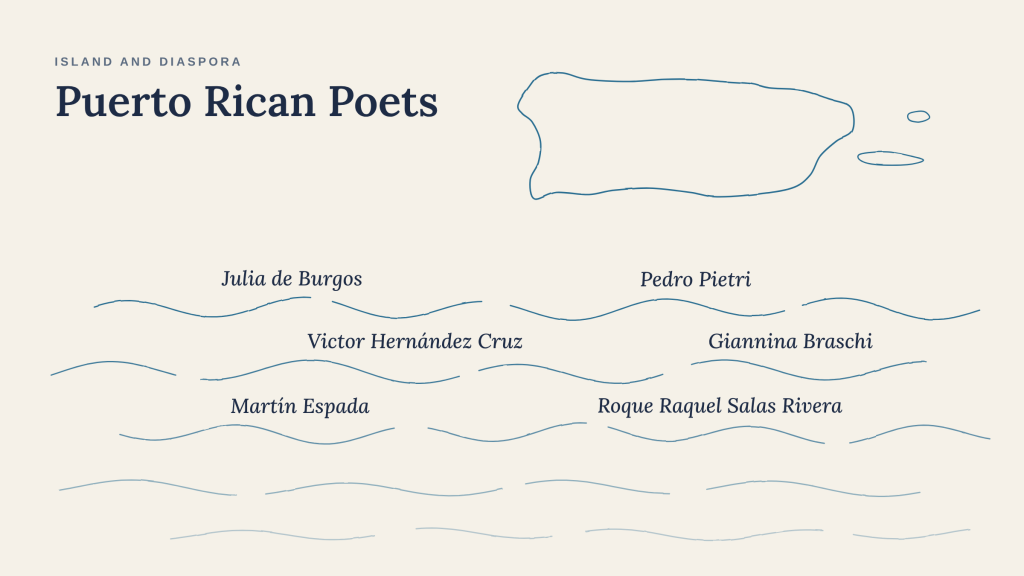
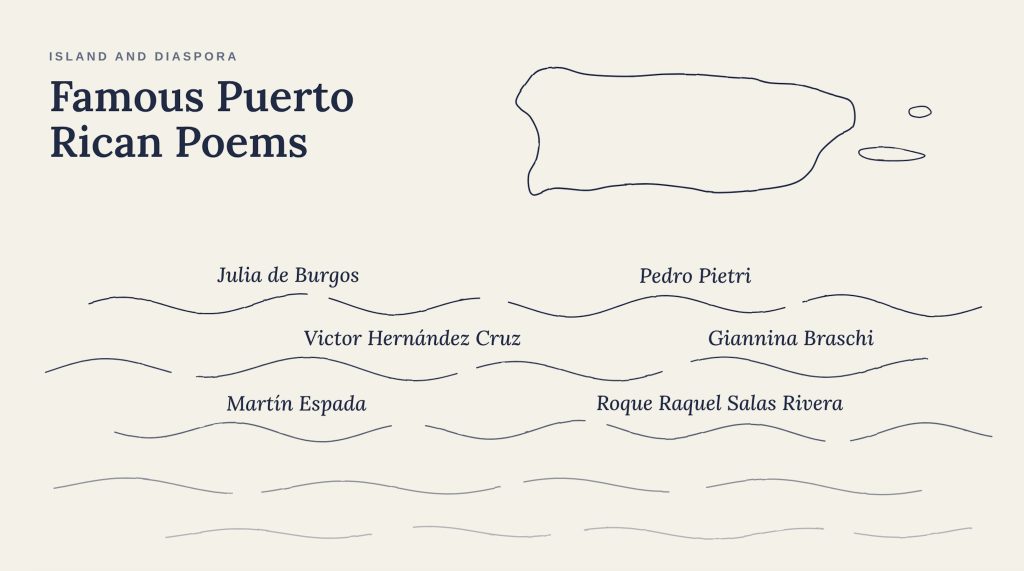
- Julia de Burgos: “A Julia de Burgos,” “Yo misma fui mi ruta,” “Río Grande de Loíza,” and “El mar y tú.” Explore the poems and translations through this guide to Julia de Burgos.
- Pedro Pietri: “Puerto Rican Obituary,” a landmark of Nuyorican poetry that confronts labor, migration, and the costs of the American dream.
- Victor Hernández Cruz: “Puerto Rico,” a poem that moves through the island’s landscape, history, and diasporic memory.
- Giannina Braschi: “El imperio de los sueños/ Empire of Dreams,” a collection of six books of poetry, including beloved poems such as “Behind the word is silence,” “I love hiccups and” or “Pastoral.”
- Martín Espada: “Flowers and Bullets,” which brings Puerto Rican history and the flag into a poem of inheritance and belonging.
- Roque Raquel Salas Rivera: “to approach / la aproximación,” presented in English and Spanish, which considers water, intimacy, land, and the relationships that bind people to an island.
Continue exploring Puerto Rican literature
Poetry is one path into a literary tradition that also moves through fiction, theater, criticism, and public conversation. Explore the site’s Puerto Rican poetry guide for contemporary poets and anthologies; continue with 23 essential Puerto Rican novels, tracing fiction across generations and languages; and read Puerto Rican Writers on PBS: Literature Across Island and Diaspora for a broader literary journey through the island and its diaspora.
Related reading
Poetry is one path into a literary tradition that also moves through fiction, theater, criticism, and public conversation.
- Famous Puerto Rican writers: a wider view of the authors who have shaped the literature across island and diaspora.
- Puerto Rican poetry guide: contemporary poets and anthologies.
- Puerto Rican novels: fiction across generations and languages.
- Puerto Rican playwrights: the theater tradition, from the island’s stages to Nuyorican drama.
- Puerto Rico | American Stories: A Reading Road Trip with the Library of Congress and PBS Books

Editorial note: The post is designed to be an entry point into Puerto Rican poetry; it was independently produced by the editorial team of the site. Last updated October 2026.