
Puerto Rican Playwrights
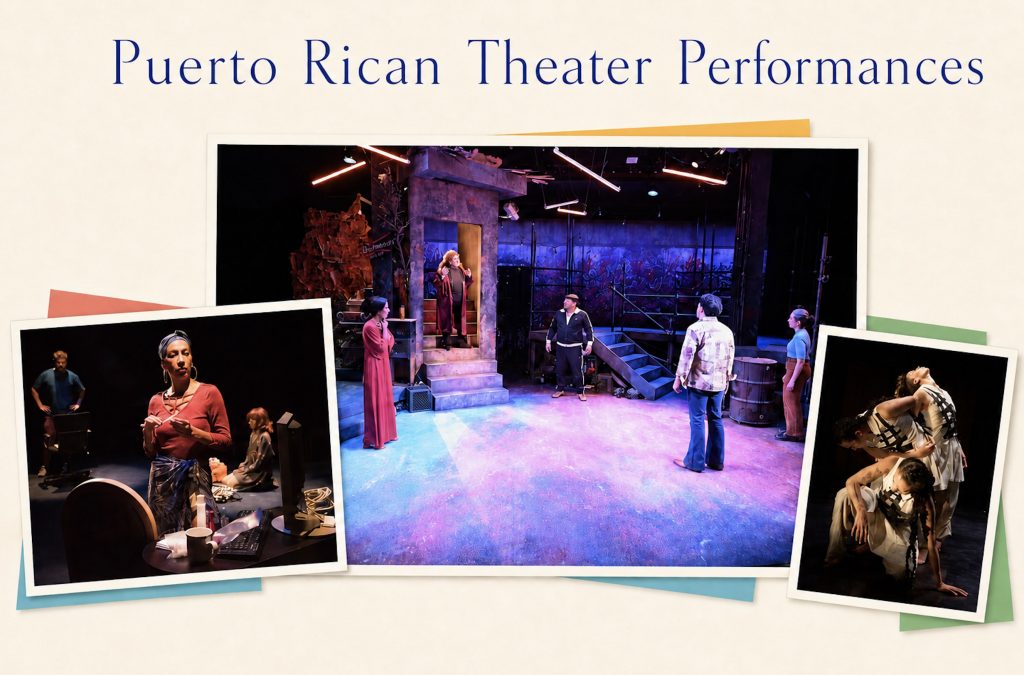
Puerto Rican playwrights have created a vast theatrical world on the island and across the diaspora. Puerto Rican theater stretches from nineteenth-century historical drama and radical revisions of Greek tragedy to Nuyorican absurdism, prison theater, Broadway musicals, and cross-genre epics of revolution.
Across these stages, migration, colonialism, race, language, family, gender, and national identity become voice, conflict, character, rhythm, music, humor, and spectacle. These works do more than dramatize ideas: they make history, power, and human transformation live before an audience.
“Truth is what evolves in theater—the changing of the heart of a person—how it thought it was one person before—and how it evolves—and changes into another thing. The transformation of that truth is the movement of the work—and the episode is the visualization of that transformation.”
—Giannina Braschi, PUTINOIKA
Foundations, National Drama, and Classics Remade
Alejandro Tapia y Rivera — La cuarterona (1867)
A foundational Puerto Rican drama about slavery, racial prejudice, forbidden love, and class. Tapia y Rivera brought the social conflicts of the nineteenth-century Caribbean onto the emerging national stage.
Also read: Roberto D’Evreux (1856), a romantic historical drama about the Earl of Essex and Queen Elizabeth I.
René Marqués — La carreta (1953)
A midcentury classic. A rural Puerto Rican family moves from the countryside to San Juan and then the Bronx in search of progress. The journey becomes a tragic study of migration, industrialization, displacement, and the price of leaving home.
Puerto Rico’s midcentury national theater also includes Francisco Arriví, whose Vejigantes examines race, gender, and Afro-Puerto Rican identity across three generations, and Manuel Méndez Ballester, a central dramatist of working-class life and social transformation.
Also read: Los soles truncos (1958), a gothic drama about three sisters clinging to a vanishing aristocratic world.
Luis Rafael Sánchez — La pasión según Antígona Pérez (1968)
Sánchez relocates Sophocles’ Antigone to a fictional Latin American dictatorship. Antigone’s burial of two insurgents becomes a dangerous public act—and classical tragedy becomes an attack on tyranny, propaganda, and official truth.
Also read: Quíntuples (1984), in which two actors perform multiple members of one family. Identity becomes confession, masquerade, and theatrical spectacle.
Myrna Casas — El gran circo Ucraniano (1988)
A wild political circus of grotesque humor, national identity, and staged authority. Casas uses absurdism to expose the performances through which societies and governments maintain power. The play received Puerto Rico’s National Dramaturgy Award.
José Rivera — Marisol (1992)
A young Puerto Rican woman crosses an apocalyptic New York while angels wage war against a dying God. Surreal, violent, funny, and visionary, Marisol turns the city into a cosmic battlefield. Rivera received an Obie Award for the play.
Also read: Sueño (1998), his contemporary reinvention of Calderón de la Barca’s Life Is a Dream.
Nuyorican and Avant-Garde Theater
Pedro Pietri — The Masses Are Asses (1974)
A masterpiece of Nuyorican absurdist theater. Pietri turns class aspiration, respectability, and the performance of success into radical comedy. Repetition and contradiction trap his characters inside the social mythology they are trying to escape.
Read further: Pedro Pietri: Selected Poetry, edited by Juan Flores and Pedro López Adorno, reveals the theatrical voices, surreal humor, and political performance behind The Masses Are Asses.
Miguel Piñero — Short Eyes (1974)
Written from Piñero’s experience of incarceration, Short Eyes brought prison language, racial hierarchy, violence, and moral terror to the American stage. Its explosive success carried the work from the Public Theater to Broadway and later to film.
Also read: The Sun Always Shines for the Cool (1976), a rhythmic drama of hustlers, players, street life, and survival.
Read further: Outlaw: The Collected Works of Miguel Piñero gathers ten plays with his poetry and previously unpublished writing. Karen Jaime’s The Queer Nuyorican places Piñero within the performance culture of Loisaida and the Nuyorican Poets Café.
Migdalia Cruz — Miriam’s Flowers (1990)
A Puerto Rican family in the Bronx fractures after a child is killed by a train. Memory interrupts time, religious images fill the stage, and grief takes physical form. Cruz’s poetic structure refuses the consolations of an orderly family tragedy.
Also read: El Grito del Bronx (2009), in which a woman confronts her brother’s impending execution and the family history that binds them.
“When theater is done well, it is magical because it’s making alive things that aren’t alive.”
—Migdalia Cruz, NEA
Nation, Migration, and Independence
Carmen Rivera — La Gringa (1996)
María Elena García, raised in New York, travels to Puerto Rico expecting to recover an uncomplicated homeland. Instead, she discovers that she is considered American on the island and Puerto Rican on the mainland. Funny and poignant, La Gringa received an Obie Award and became a landmark of Spanish-language Off-Broadway theater.
Giannina Braschi — United States of Banana (2011)
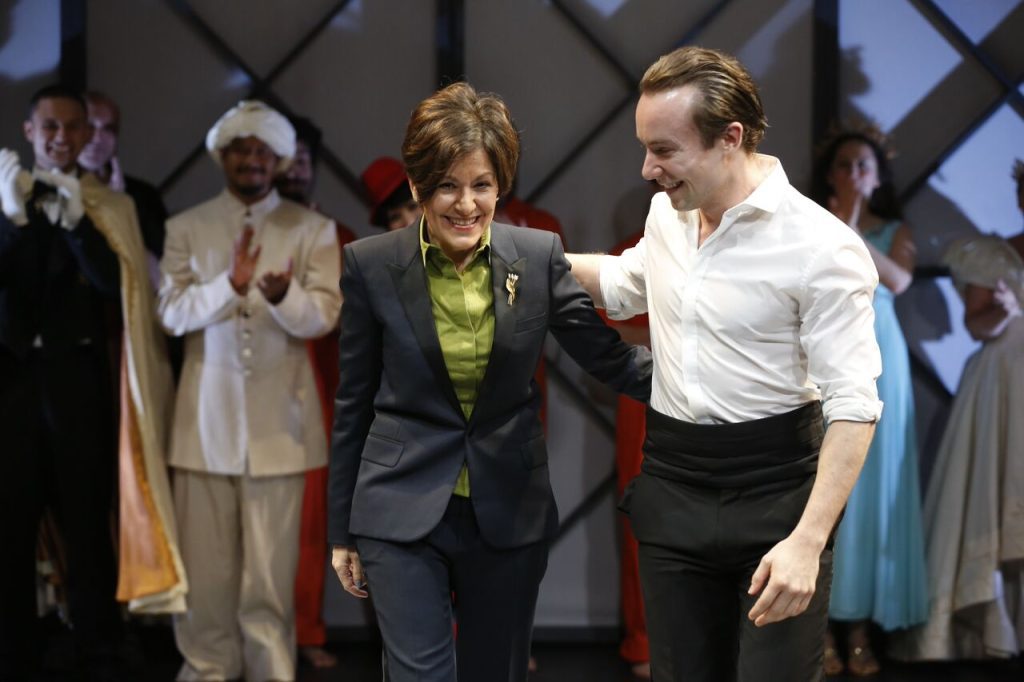
A cross-genre epic of political theater about the collapse of the American empire and the liberation of Puerto Rico. Hamlet, Segismundo, Zarathustra, and Giannina enter the Statue of Liberty to free Segismundo. Poetry, philosophical dialogue, manifesto, satire, and revolutionary action culminate in Puerto Rico’s declaration of independence.
Also read: PUTINOIKA (2024), a tragicomic contemporary Bacchae populated by political figures, doubles, choruses, maenads, artists, and dictators in the era of Trump and Putin.
United States of Banana Across Forms
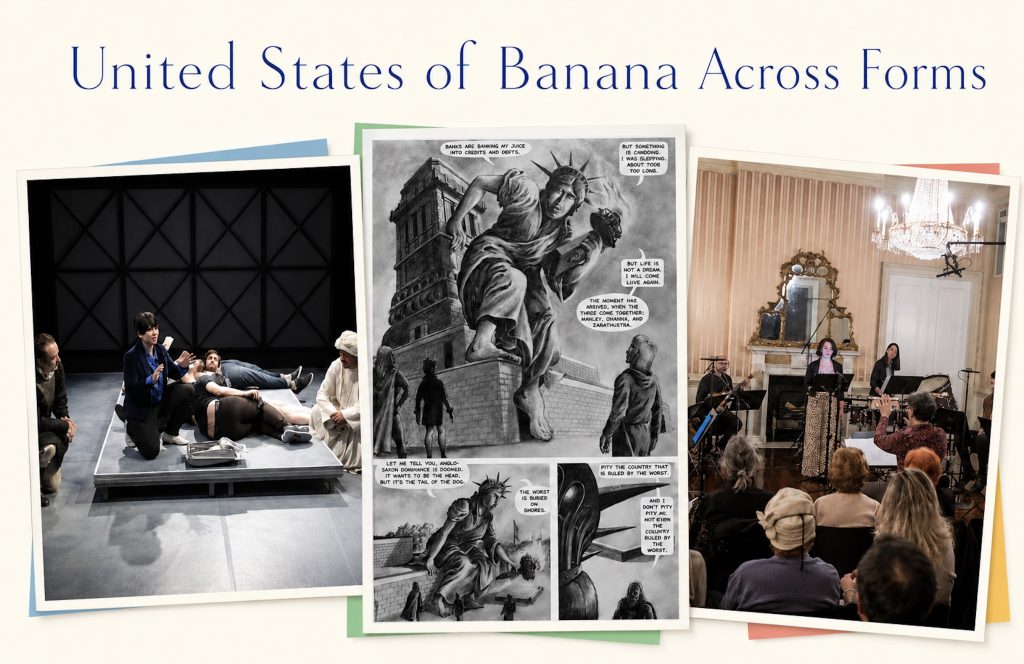
The theatrical life of United States of Banana extends beyond the page. Its characters, dialogue, music, satire, and revolutionary action have generated interpretations across several art forms:
- Listen: The Workers’ Lit episode “United States of Banana”, featuring Karlo Yeager Rodríguez (2026), follows Hamlet, Zarathustra, Giannina, and Segismundo through the Statue of Liberty and toward Puerto Rican independence.
- Read about its staging: Director Juan Pablo Félix staged scenes as postdramatic theater in a 2015 Columbia Stages production. His dissertation, United States of Banana: A Postcolonial Dramatic Fiction, documents the project and its political and theatrical framework.
- See the graphic adaptation: Swedish artist Joakim Lindengren transformed the work into a graphic novel, translated into Swedish by Helena Eriksson. His images give Braschi’s philosophical characters and collapsing empire a brash visual life.
- Hear its music: Puerto Rican composer Gabriel Bouche Caro drew upon Braschi’s Wishy, Wishy-Washy, and Washy formulation for Ni Fú, Ni Fa: Los cuentos de siempre. The three-part chamber work imagines statehood, colonial status, and independence through musical languages. Listen to the composer discuss the work and hear the Victory Players perform it.
- Explore its criticism: Poets, Philosophers, Lovers: On the Writings of Giannina Braschi approaches the work through theater, philosophy, political theory, translation, visual art, and performance.
Matthew Barbot — the beautiful land i seek (la linda tierra que busco yo) (2024)
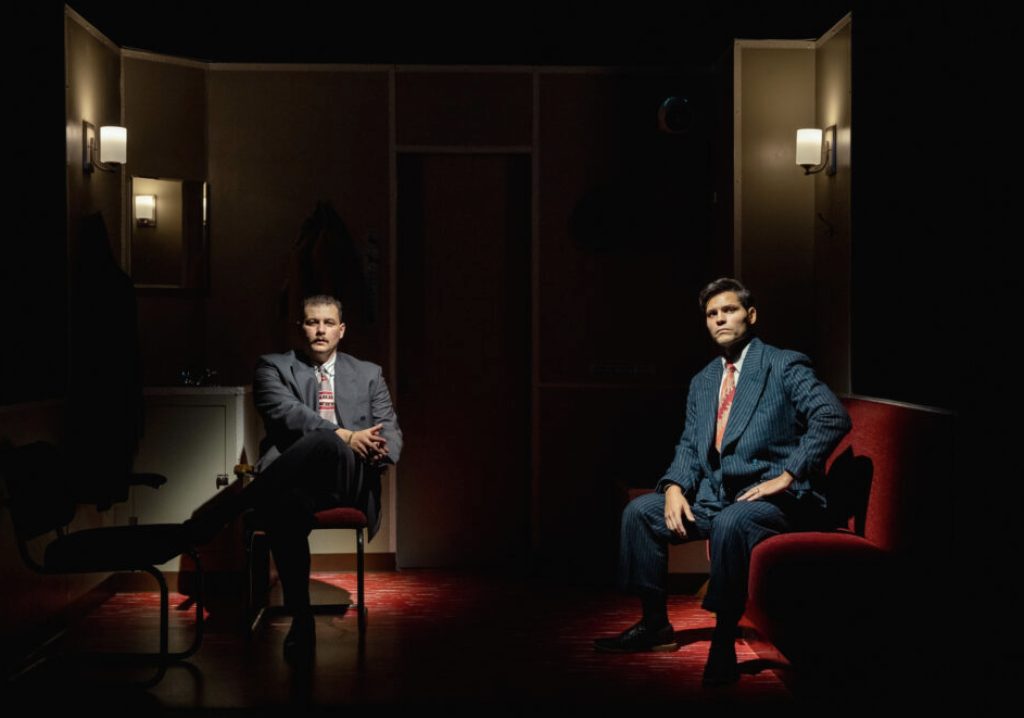
Two men board a train to Washington, D.C., in 1950 with a plan to strike in the name of Puerto Rican independence. Their compartment door refuses to stay closed, and figures from Puerto Rican art and history repeatedly interrupt their mission. The result is a funny, gripping drama about revolution, sacrifice, and historical memory.
José Zayas directed its 2024 world premiere at the Puerto Rican Traveling Theater.
Broadway and Musical Theater
Lin-Manuel Miranda — In the Heights (2005)
Washington Heights becomes the center of a musical about migration, family memory, ambition, romance, economic pressure, and neighborhood change. Miranda’s breakthrough musical reached Broadway in 2008 and won four Tony Awards, including Best Musical.
Lin-Manuel Miranda — Hamilton (2015)
A theatrical phenomenon, Hamilton retells the founding of the United States through hip-hop, R&B, musical theater, and a predominantly Black and Latino cast. Cabinet debates become rap battles, constitutional history becomes popular spectacle, and an immigrant emerges as the architect of the national financial system.
Hamilton won the Pulitzer Prize for Drama and eleven Tony Awards. It transformed Broadway’s sound, casting imagination, audience, and relationship to American history.
Read further: Dueling Grounds: Revolution and Revelation in the Musical Hamilton examines the musical’s writing, staging, choreography, music, politics, race, gender, and class. Historians on Hamilton considers how the musical represents—and reshapes—American history.
“Musical storytelling has no limits.”
—Lin-Manuel Miranda, PBS NewsHour
Rosalba Rolón with Pregones Theater — The Red Rose (2005)
Music and political history converge in this theatrical portrait of Afro-Puerto Rican writer and activist Jesús Colón. His migration to New York, labor politics, government surveillance, and confrontation with the House Un-American Activities Committee become the material of a musical, with music by Desmar Guevara.
The production received a 2024 Talía Award for Best Contemporary Hispanic Performing Arts Production in New York.
Carmen Rivera and Cándido Tirado — Celia (2007)
A musical biography of Celia Cruz told partly through the voice of her husband, Pedro Knight. Rivera and Tirado build the story around the force of Cruz’s music, transforming migration, exile, love, and international fame into a popular theatrical celebration.
Contemporary Families and Communities
Quiara Alegría Hudes — Elliot, A Soldier’s Fugue (2006)
Military service and war echo across three generations of a Puerto Rican family. Hudes gives each generation its own rhythm while revealing the injuries, silences, and inherited obligations connecting them.
Also read: Water by the Spoonful (2012), the Pulitzer Prize-winning second play in the Elliot trilogy, about an Iraq War veteran and a community formed through an online addiction-recovery group.
Read further: Hudes’s memoir My Broken Language traces the Philadelphia family, language, music, and memory from which much of her theater emerged. Anne García-Romero’s The Fornés Frame includes a chapter on Hudes’s theatrical experimentation.
Cándido Tirado — Fish Men (2012)
A high-stakes chess game in Washington Square Park becomes a drama of memory, migration, obsession, and economic survival. Tirado finds theatrical tension in the rituals and psychological warfare of street chess.
Also read: Momma’s Boyz (2006), about three young men confronting the socioeconomic traps surrounding them.
Paola Lázaro — Tell Hector I Miss Him (2017)
Old San Juan appears as a crowded emotional community rather than a picturesque backdrop. Twelve characters pursue love, drugs, companionship, escape, and reconciliation beneath the walls of a Spanish fort. The play unfolds like a collection of interlocking short stories.
Christin Eve Cato — Sancocho (2023)
Two estranged Puerto Rican sisters prepare sancocho while confronting their father’s declining health and the wounds separating them. The pot on the stove becomes memory, cultural inheritance, argument, and a possible path toward reconciliation.
Stages That Built Puerto Rican Theater
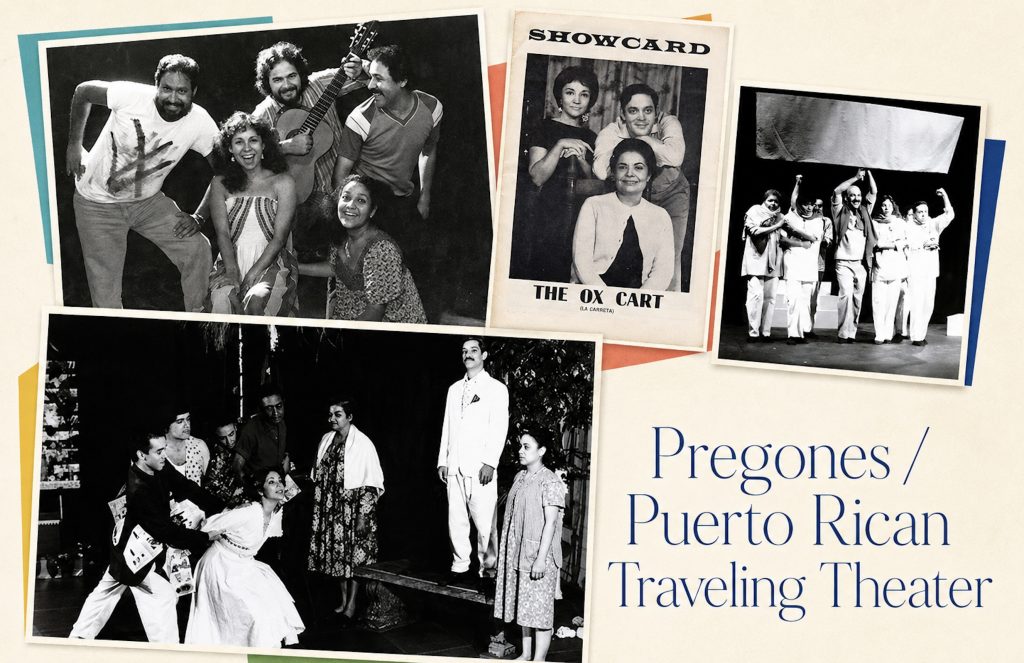
Puerto Rican theater has also been shaped by the institutions and artists that trained performers, developed new work, and carried productions to audiences. On the island, the University of Puerto Rico, the Instituto de Cultura Puertorriqueña, Teatro Tapia, and directors including Victoria Espinosa helped establish a modern national theater. In New York, the Puerto Rican Traveling Theater, founded by Miriam Colón in 1967, brought Puerto Rican drama into neighborhoods across the city; Pregones Theater, the Nuyorican Poets Café, and other companies expanded the field through ensemble work, poetry, music, experimental performance, and bilingual theater.
Scholarship on Puerto Rican Theater and Performance
- Pragmatic Liberation and the Politics of Puerto Rican Diasporic Drama, by Jon D. Rossini — political action, colonial citizenship, and liberation in Puerto Rican diasporic drama. The complete book is available open access.
- The Theater of Revisions in the Hispanic Caribbean, by Katherine Ford — classical rewriting and theatrical adaptation across Puerto Rico, Cuba, and the Dominican Republic.
- Nuyorican Feminist Performance: From the Café to Hip Hop Theater, by Patricia Herrera — women’s performance, poetry, drama, and hip-hop at the Nuyorican Poets Café.
- The Queer Nuyorican: Racialized Sexualities and Aesthetics in Loisaida, by Karen Jaime — Nuyorican performance aesthetics, including attention to Miguel Piñero and the Café.
- Poets, Philosophers, Lovers: On the Writings of Giannina Braschi, edited by Frederick Luis Aldama and Tess O’Dwyer — cross-genre scholarship on Braschi’s poetry, fiction, theater, philosophy, and artistic adaptations.
- Pregones Theatre: A Theatre for Social Change in the South Bronx, by Eva Cristina Vásquez — a focused history of Pregones and its place in mainland Puerto Rican theater.
Anthologies and Companion Volumes
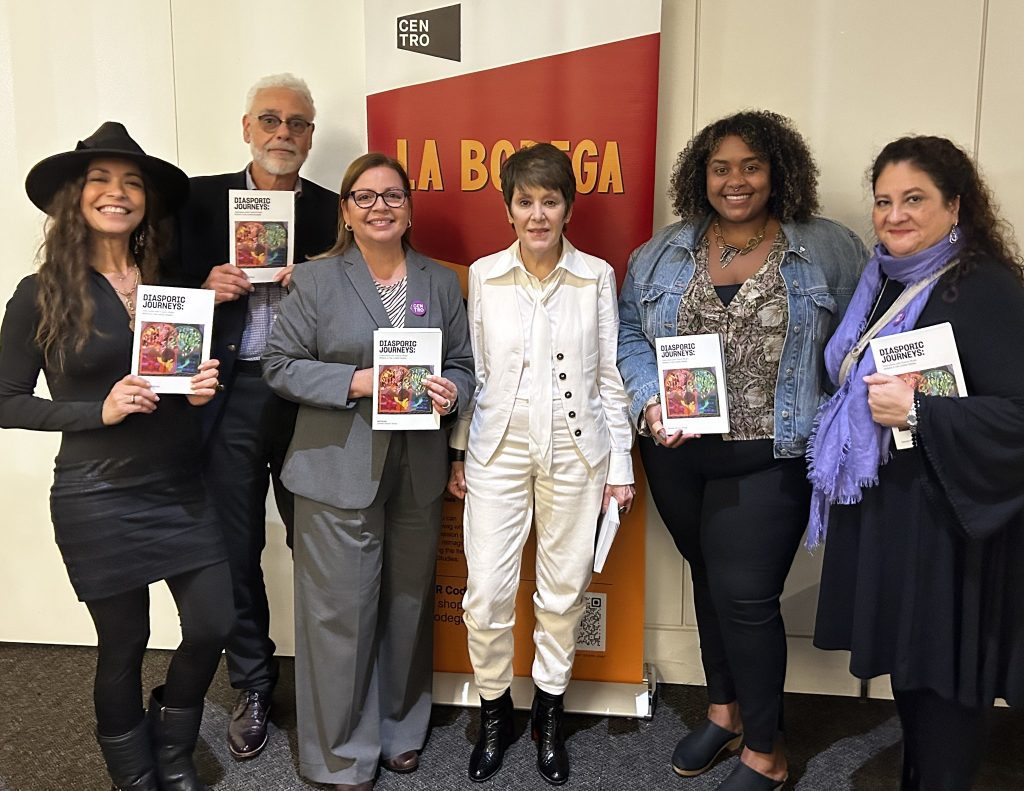
- Diasporic Journeys: Interviews with Puerto Rican Writers in the United States, edited by Carmen Haydée Rivera
- Nuestro New York: An Anthology of Puerto Rican Plays, edited by John V. Antush
- Recent Puerto Rican Theater: Five Plays from New York, edited by John V. Antush
- Puro Teatro: A Latina Anthology, edited by Alberto Sandoval-Sánchez and Nancy Saporta Sternbach
- Writing Off the Hyphen: New Critical Perspectives on the Literature of the Puerto Rican Diaspora, edited by José L. Torres-Padilla and Carmen Haydée Rivera
Related Reading
Editorial note: This introductory guide was posted by the editors of GianninaBraschi.com. It is not intended as a comprehensive history of Puerto Rican theater and was not written by Giannina Braschi. Last reviewed August 2026.