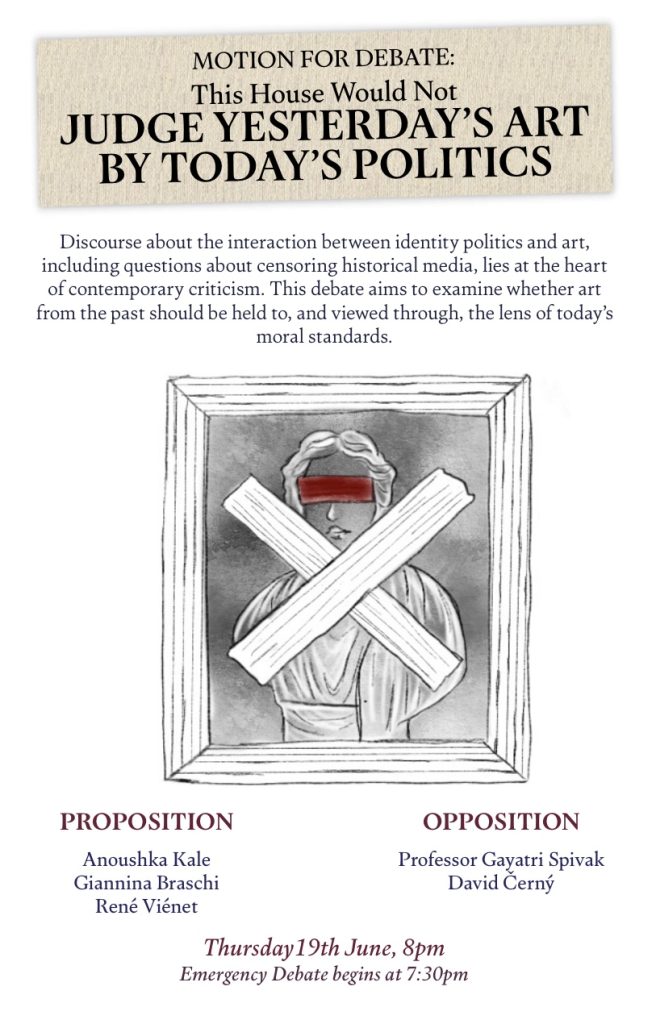
Cambridge Union Art Politics Debate
This House Would Not Judge Yesterday’s Art by Today’s Politics
On June 19, 2025, Puerto Rican poet-philosopher Giannina Braschi spoke for the proposition in the Cambridge Union debate “This House Would Not Judge Yesterday’s Art by Today’s Politics.” Her speech addressed artistic freedom, historical change, and the authority of contemporary politics to judge works created under different moral and political conditions.
Braschi on Art and Political Judgment
In her defense of the motion, Braschi turns political judgment back upon politics itself:
“Don’t judge yesterday’s art by the moral standards of today’s politics. Judge today’s politics by the moral standards of today’s politics. Genocide, mass incarceration, mass deportation, oligarchy, pollution, collusion, and delusion are the moral standards of today’s politics. Art is about truth and beauty—and politics compromises truth for power. But when it comes to truth and beauty, negotiations by warmongers count for nothing. What counts are dialogues of love.”
The debate extends questions central to Braschi’s writing: Who has the authority to judge art? Can political power determine artistic value? How can literature resist the ideological demands imposed upon it?
Watch Giannina Braschi’s Cambridge Union Speech
Giannina Braschi | This House Would Not Judge Yesterday’s Art by Today’s Politics | Cambridge Union
Braschi delivered a speech for the proposition in the Cambridge Union Debating Chamber. Her appearance offers a rare public demonstration of the political and aesthetic thought developed throughout Empire of Dreams, Yo-Yo Boing!, United States of Banana, and PUTINOIKA.
The motion brought writers, artists, and theorists into debate over whether art from the past should be judged according to contemporary political values.
The debate took place during Easter Term under outgoing Cambridge Union president Anoushka Kale. The original announcement and term schedule appear in the Cambridge Union Easter Term 2025 program.
Cambridge Union debate on whether today’s politics should judge yesterday’s art

Cambridge Union debate: “This House Would Not Judge Yesterday’s Art by Today’s Politics,” June 19, 2025.
Why the Cambridge Union Matters
Founded in 1815, the Cambridge Union is one of the world’s oldest debating societies. Its chamber has brought writers, political leaders, artists, and activists into public confrontation over race, gender, democracy, empire, and freedom of expression. Speakers have included the Dalai Lama, Stephen Hawking, Ronald Reagan, Nancy Pelosi, Salman Rushdie, and Sam Altman.
The Union’s most consequential debate took place in 1965, when James Baldwin and William F. Buckley Jr. confronted the motion “The American Dream Is at the Expense of the American Negro.” Baldwin’s argument about racial injustice and the contradictions of American democracy prevailed by 544 votes to 164 and became a landmark in the intellectual history of the civil rights movement. Watch the Baldwin–Buckley debate.
The Union’s history also reflects changes in women’s participation in public life. Women gained full membership in the 1960s, Ann Mallalieu became its first female president in 1967, and Germaine Greer debated William F. Buckley Jr. on women’s liberation in 1973.
Braschi’s appearance enters this history from a Puerto Rican and postcolonial perspective. Her defense of artistic freedom brings questions of colonialism, language, historical power, and the independence of the imagination into a debating tradition largely shaped by British and North American public life.
Art, Politics, and Postcolonial Philosophy
Braschi does not separate artistic form from political thought. Through satire, multilingualism, philosophical dialogue, and radical experiments in genre, her literature questions inherited definitions of freedom, sovereignty, citizenship, democracy, and empire.
Her Cambridge Union speech carries these ideas beyond the page and into public debate. For a fuller account of Braschi’s work as a political thinker, read Postcolonial Political Philosophy: Freedom, Sovereignty, and Coloniality.