
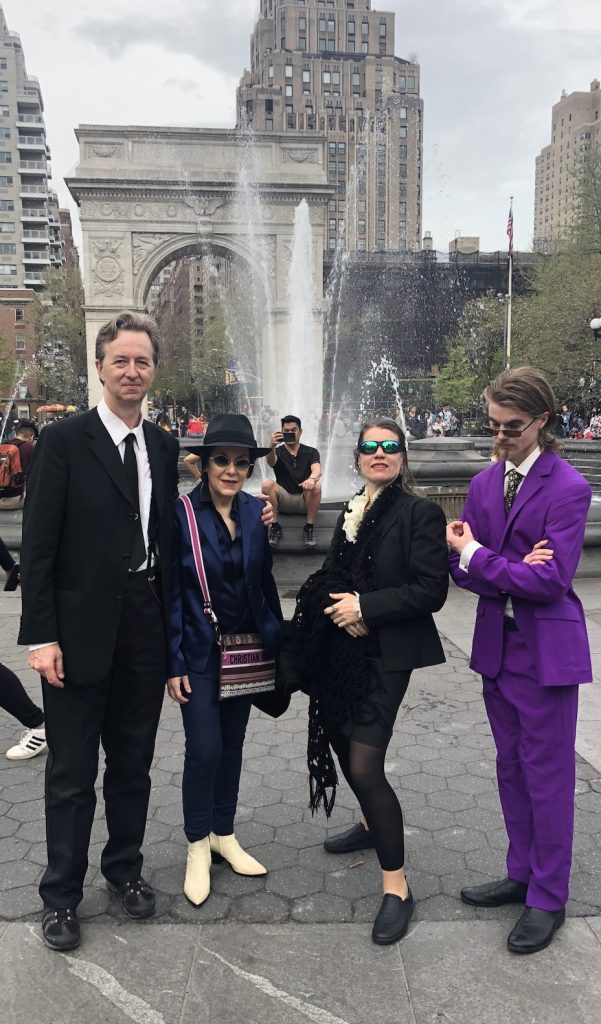
First published in Swedish by Prokrastinatorn on June 16, 2017, this archival review reads Joakim Lindengren’s comic book United States of Banana as a meeting of political fury, absurdist comedy, and an exuberantly crowded visual imagination. The English translation follows the review’s argument and its reservations about the ending. Its discussion of Puerto Rico’s political status reflects the date of the original.
The original headline called the work a “graphic novel”; this post uses “comic book,” the term Lindengren prefers.
Lindengren’s comic book and Calderón’s Life Is a Dream
“The prince dreams he rules / a victim of his illusion / reigning from his throne. / But our power is only borrowed / no more than writing in the wind.”
—From Life Is a Dream by Pedro Calderón de la Barca, 1635
So speaks the Polish prince Sigismund, imprisoned by his father after a brief but disastrous turn on the throne and then made to believe that he had dreamed the whole thing, in the play Life Is a Dream (La vida es sueño) by the seventeenth-century Spanish dramatist Pedro Calderón de la Barca. The verse drama is best known for its metaphysical reflections on the dreamlike nature of existence, but it is just as much a meditation on power and responsibility—and on the ability to take command of one’s own fate rather than surrender to defeatism and simply live up to the low expectations of the surrounding world.
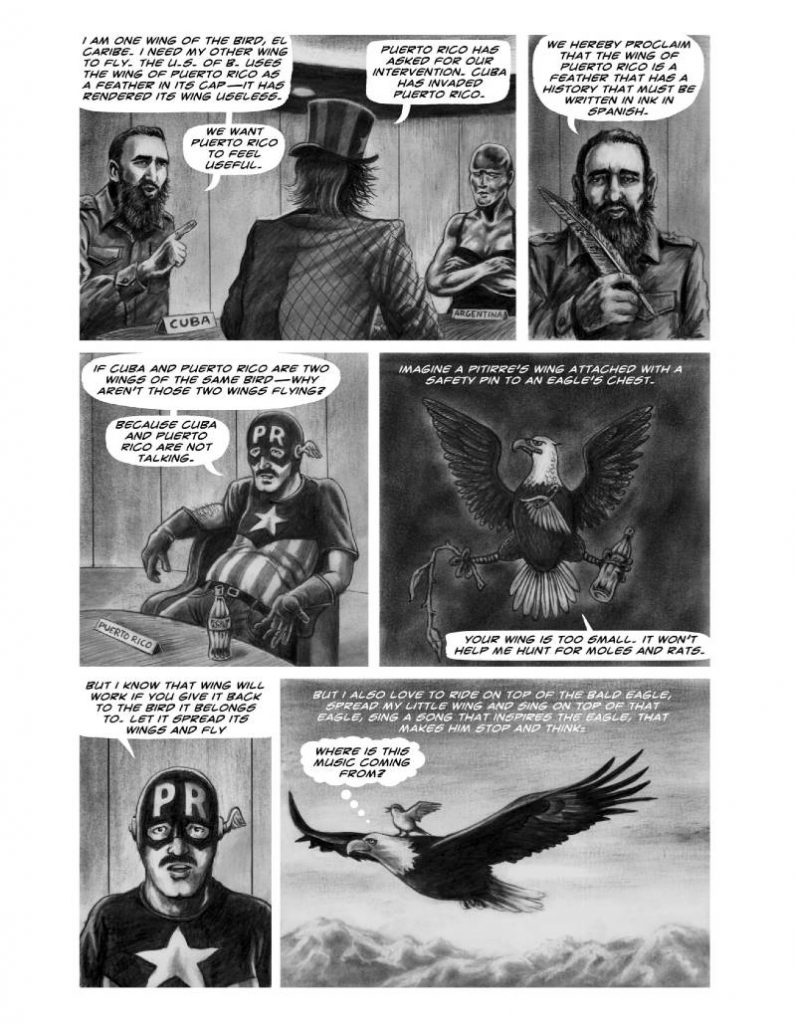
These are timeless themes. Some 375 years later, Sigismund reappears under his Spanish name, Segismundo, in Puerto Rican author Giannina Braschi’s 2011 postmodern, postcolonial, punk-poetic novel United States of Banana. Here he is an analogue for Puerto Rico, imprisoned not in a tower but beneath the skirts of the Statue of Liberty—a striking image of a country caught in political limbo as a U.S. dependency. Braschi’s literary alter ego, Giannina, searches for him alongside the superman-priest Zarathustra and Hamlet, another heir to the throne with severely dysfunctional family relationships. Along the way, they argue about crumbling empires, the nature of freedom, and the poet’s role in society after the September 11 attacks. It is a breathtaking mix of personal poetic manifesto and political commentary: Braschi castigates the United States’ relations with Latin America generally and Puerto Rico particularly, while issuing a battle cry for creativity in a hyper-commercialized consumer culture.
Braschi’s unruly prose is colorful enough on its own, but perhaps United States of Banana finds its definitive interpretation in the recently published comic-book version, brilliantly illustrated by veteran Swedish comics artist Joakim Lindengren. What looks on paper like an unlikely pairing—what do Braschi’s anarchic agitation and Lindengren’s nostalgic affection have in common?—proves unexpectedly successful. It is as if Braschi’s combination of righteous anger and absurdist farce inspired Lindengren to find a new expressive mode, beyond the anti-authoritarian rebelliousness and scatological humor of early works such as Krystmarodören and Brun utan tvål, and the reactionary-tinged reference humor of Kapten Stofil.
Here he has traded ink for charcoal. His richly saturated, atmospheric pencil drawings brim with detail without sacrificing his gift for physical comedy. He has never drawn better. Lindengren’s ambition, however, goes beyond making an illustrated translation of the book. He gives Braschi’s critique of Western cultural imperialism depth and vitality by conjuring an inferno of pop-cultural and art-historical figures to fill the panels. David Bowie and the Marx Brothers appear alongside Socker-Conny and Pablo Picasso, while Han Solo, Mr. T, and Toshiro Mifune fight over the gate money. And so on. It is a dizzying fireworks display of images, full of startling associations and combinations.
Lindengren’s art history, pop culture, and visual satire
A playground for characters from our collective subconscious could easily have become a superficially satisfying postmodern meta-fest. But Lindengren often makes clever, unexpected connections that give Braschi’s themes new dimensions. The result is a fiercely vital reading experience—furious, wildly funny, and relevant.
“It is as if Braschi’s combination of righteous anger and absurdist farce inspired Lindengren to find a new expressive mode, beyond the anti-authoritarian rebelliousness and scatological humor of early works such as Krystmarodören and Brun utan tvål, and the reactionary-tinged reference humor of Kapten Stofil. […] He has never drawn better.”
“I was a monument to immigration. Now I am a border patrol agent,” laments the Statue of Liberty, a gift from France to mark the centennial of U.S. independence. “They turned me into a mausoleum of freedom,” she adds later. Among many other things, United States of Banana reflects on how ideals erode, warp, and harden into building blocks for empire. Braschi contrasts freedom with “freedom”: unbridled creativity with beautiful but empty concepts that can be packaged, trademarked, and marketed around the world. No wonder the statue sees her reflection distorted into Munch’s The Scream on the curved surface of a Coca-Cola bottle. One could despair over less.
Consumer society does not hesitate to make money from national trauma. In a chilling visual joke, Lindengren transforms 7-Eleven into 9-Eleven, showing how the attack on the World Trade Center has been absorbed into national mythmaking. When Braschi laments how people are kept placid by a barrage of mass-media sedatives, Lindengren puts Alex from A Clockwork Orange behind the wheel of a taxi, his eyes forced open by metal clamps and his rebellious streak subdued.
The Statue of Liberty is not blameless either. Her sympathies shift; as Giannina explains, she is sustained by an “axis of evil” that discriminates by status, race, and gender. At times, the statue becomes a surrogate mouthpiece for American ideology.
“How did I impede your spiritual development?” she asks Giannina, who replies, “By making me long for what I don’t want or need.” Capitalism’s principles could hardly be stated more clearly. It persuades us that spiritual growth comes from material accumulation. Giannina stubbornly insists on the opposite. Consumer frenzy can itself become a form of captivity. Freedom also means being free from desire.
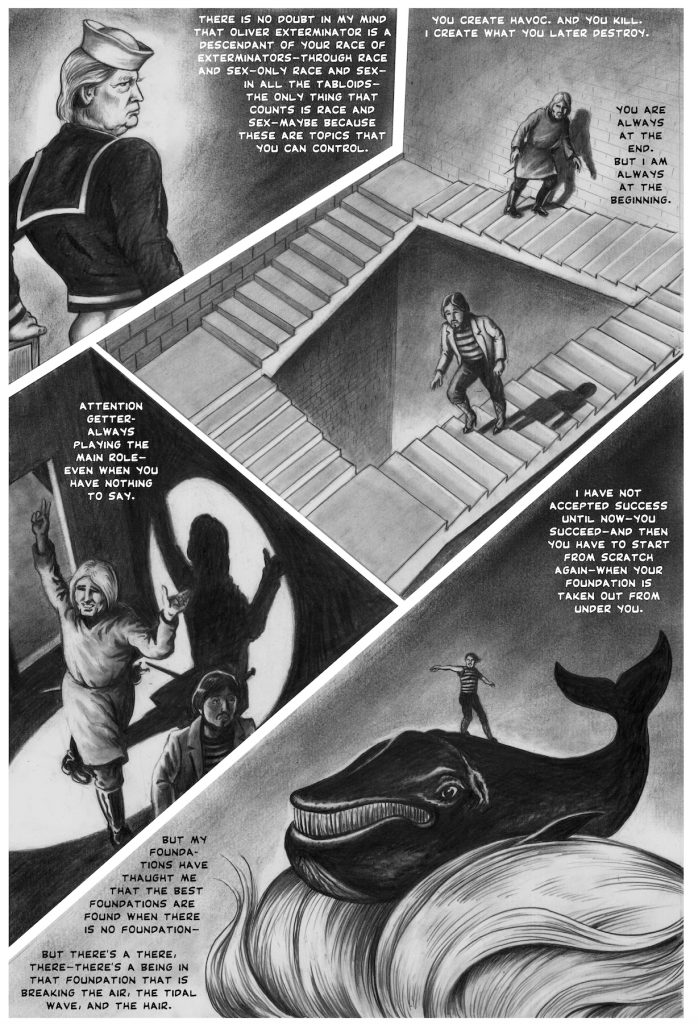
But all empires crack sooner or later. “Anglo-Saxon dominance is doomed,” the statue says resignedly, and the comic is full of ominous signs to support her verdict. Lindengren draws Barack Obama mopping a floor, oblivious to the Niagara Falls flooding the room. He makes an inspired connection between Donald “quack quack” Duck and Donald “tweet tweet” Trump: both are querulous figures with poor impulse control and an unusual talent for self-sabotage. Uncle Sam becomes Two-Face, the Batman villain, a two-faced liar. “Something is rotten in America,” as Hamlet might say. His presence in the drama, incidentally, bodes no happy ending.
“He makes an inspired connection between Donald ‘quack quack’ Duck and Donald ‘tweet tweet’ Trump: both are querulous figures with poor impulse control and an unusual talent for self-sabotage.”
Giannina Braschi’s declaration of Puerto Rican Independence
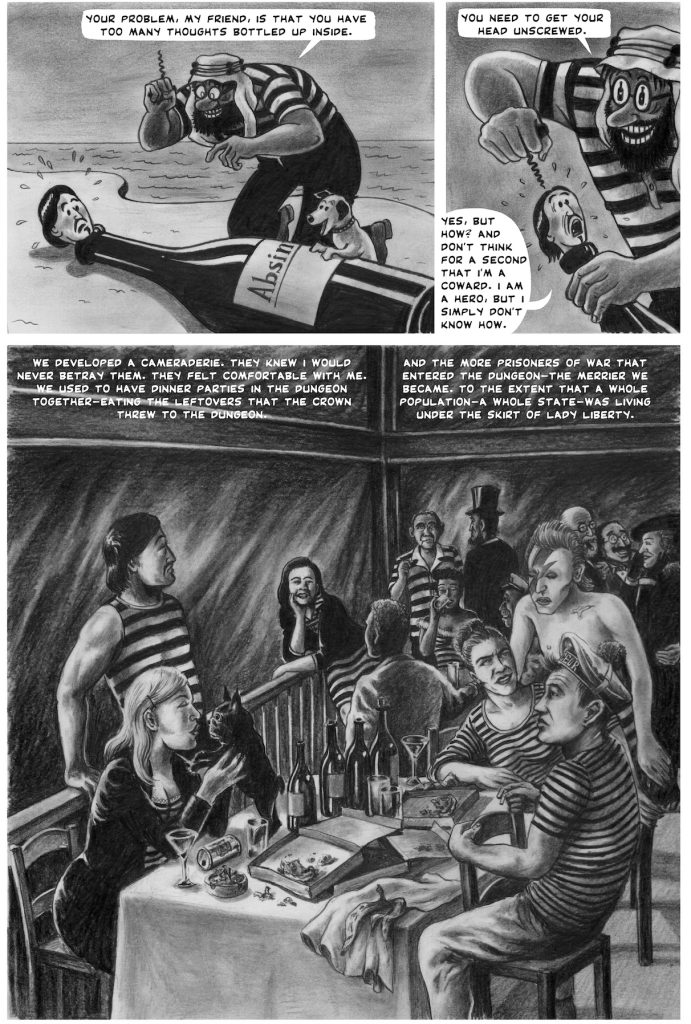
The instability is not confined to the top. Beneath the Statue of Liberty’s skirts, discontent simmers among the motley crowds winding through Escher-like labyrinths and stage sets worthy of a Busby Berkeley dance number. There is no need to list all of Lindengren’s references here, but seeing pin-up icon Bettie Page share a panel with a Tom of Finland hunk and the Swedish porn-parody agent James Fjong gave this reviewer particular pleasure.
Here sits Segismundo, Prince of Poland and Puerto Rico’s analogue, despairing over his ability to make free choices. In 2017, Puerto Rico was divided among those who wanted it to remain a U.S. territory, become a full-fledged 51st state, or become an independent nation. For Segismundo, however, these do not amount to much of a choice: “Dither, dither-dather, and dather,” he sighs, as domestic political bickering takes physical form in Huey, Dewey, and Louie running headless around his cell.
Segismundo also refuses to become a screen for other people’s dreams. Zarathustra sees a superman, Giannina a slave to freedom, and hotheaded Hamlet a conqueror. Segismundo himself dreams of dissolving borders between nations, races, and genders.
His loyalty is tested in the book’s final third, when a wedding becomes the setting for a final showdown. Segismundo’s father, Basilio, is to marry Hamlet’s mother, Gertrude, and offers Segismundo full statehood for Puerto Rico as a wedding gift. Unfortunately, this is where the literary allusions begin to wobble. The marriage is meant as a metaphorical alliance between South and North America, but it is never entirely clear what Gertrude has to do with American imperialism—especially since Lindengren draws her with Wagnerian, Teutonic majesty. Mostly, the episode seems designed to bring the analogies back to Hamlet, but it rings a little false.
Even as the external plot grows fuzzy around the edges, the critique of the system and the call for freedom never lose their edge. The book ends with a triumphant act of defiance, a personal declaration of independence that Lindengren bathes in hopeful dawn light. It is hard to find fault with that image. For a comic drawn in black and white, United States of Banana is remarkably colorful—a spirited defense of freedom.
Further reading
For more on Lindengren’s comic book, see Latinx Comics Studies: Teaching United States of Banana, Teaching Puerto Rican Graphic Novels: United States of Banana, and the site’s review of the comic book. The original Swedish review appeared at Prokrastinatorn on June 16, 2017. For a broader account of Lindengren’s comic book references, read “Popping Pop Culture and Other Unlikely Spaces” in World Literature Today.