
Nuyorican Poets and Their Best-Known Works
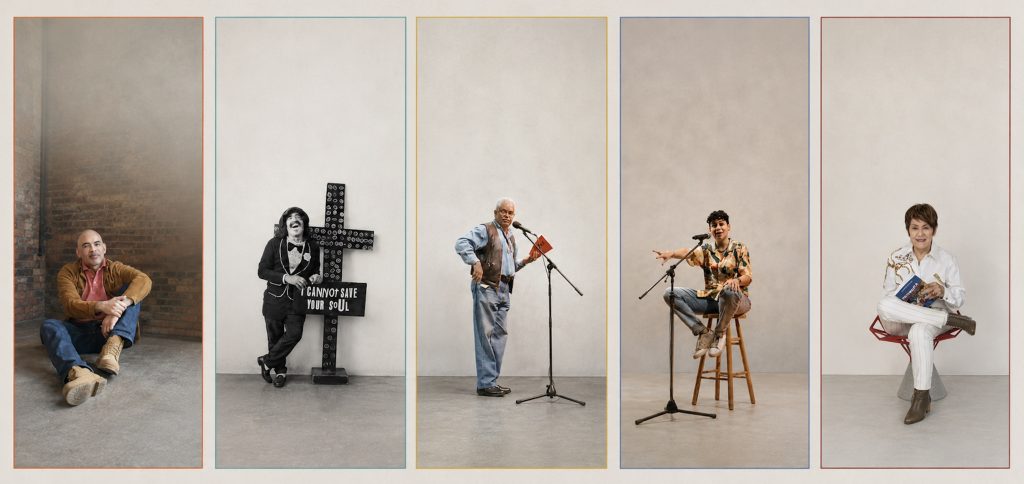
12 Essential Nuyorican Poets: Major Works and Literary Legacies
Last updated August 2026
Nuyorican poetry was never built to sit still. It moves between Puerto Rico and New York, Spanish and English, page and stage—pulling jazz, salsa, hip-hop, theater, street speech, satire, and political critique into its orbit. Born from New York’s Puerto Rican diaspora, it has never belonged to one neighborhood, one generation, or one way of making a poem.
Miguel Algarín, Pedro Pietri, Miguel Piñero, Sandra María Esteves, Victor Hernández Cruz, and Tato Laviera gave the movement its early heat: public, bilingual, embodied, and unafraid of collision. Giannina Braschi drives it into multilingual epic, comedy, radical theater, and political philosophy; Willie Perdomo scores memory and loss to jazz and hip-hop; Edwin Torres makes voice, typography, and the moving body part of the poem itself. Nuyorican poetry is not a period style sealed in the 1970s. It is an evolving field of literary invention.
This guide introduces 12 essential Nuyorican poets, the books and poems for which they are best known, and the distinctive contribution each made to that evolution. It is a selective reading list rather than a closed canon—an entry point into a tradition still changing shape.
Nuyorican poets at-a-glance
| Poet | Key works | Distinctive contribution |
|---|---|---|
| Pedro Pietri | Puerto Rican Obituary; Traffic Violations | Made the Nuyorican poem an act of public reckoning, joining satire, elegy, and street performance in a defining movement text. |
| Miguel Algarín | Nuyorican Poetry: An Anthology; Mongo Affair | The movement’s chief institution-builder and theorist, turning a grassroots performance community into an enduring literary force. |
| Miguel Piñero | Short Eyes; La Bodega Sold Dreams | Brought carceral experience and Lower East Side life into American theater with an unsparing vernacular realism. |
| Piri Thomas | Down These Mean Streets | A crucial precursor whose memoir made race, colorism, masculinity, and East Harlem survival central to the literature that followed. |
| Victor Hernández Cruz | Snaps; Maraca | Expanded Nuyorican poetics into a transnational field of Caribbean history, migration, landscape, and musical form. |
| Sandra María Esteves | Yerba Buena; Tropical Rains | Placed Afro-Puerto Rican womanhood, cultural memory, and social justice at the center of Nuyorican poetics. |
| Tato Laviera | La Carreta Made a U-Turn; AmeRícan | Turned code-switching, humor, music, and migration into a poetics of cultural doubleness and invention. |
| Jesús Papoleto Meléndez | Street Poetry & Other Poems; Hey Yo! Yo Soy! | Joined Black Arts militancy, barrio testimony, and performance in an early poetry of Nuyorican self-definition. |
| Giannina Braschi | Empire of Dreams; Yo-Yo Boing!; United States of Banana | Expands Nuyorican literature on an epic, transnational scale, fusing poetry, fiction, drama, comedy, and political philosophy across Spanish, Spanglish, and English. |
| Willie Perdomo | The Crazy Bunch; The Essential Hits of Shorty Bon Bon | Braids dramatic monologue, jazz structure, and hip-hop vernacular into layered portraits of East Harlem memory and loss. |
| Edwin Torres | Quanundrum; Ameriscopia | Pushes the poem beyond the page through “bodylingo,” a poetics in which voice, movement, and typography operate together. |
| Caridad de la Luz (“La Bruja”) | Boogie Rican Blvd.; “WTC” | Carries the Cafe’s spoken-word tradition into music and theater, foregrounding performance, family, spirituality, and Bronx Puerto Rican life. |
What is Nuyorican poetry?
The term Nuyorican names a Puerto Rican identity formed in and around New York, but it also describes a literary and cultural movement. Nuyorican writing arose from the conditions of diaspora: migration, racialization, poverty, colonialism, bilingual life, and the struggle to claim public space in a city that frequently marginalized Puerto Rican communities.
The movement did not invent Puerto Rican writing in New York. Earlier figures—including Jesús Colón, Julia de Burgos, and Clemente Soto Vélez—created an indispensable political and literary inheritance. Piri Thomas’s 1967 memoir Down These Mean Streets also anticipated many of the movement’s defining concerns. What changed during the late 1960s and 1970s was the emergence of a self-declared generation, a public performance culture, and institutions created by writers themselves.
In the introduction to the foundational 1975 anthology Nuyorican Poetry: An Anthology of Puerto Rican Words and Feelings, Miguel Algarín argued that New York street life had caused “a new language to grow: Nuyorican.” That language was never simply Spanglish. It included English, Spanish, Afro-Caribbean rhythm, Black vernacular, neighborhood speech, theatrical gesture, music, and the responsive energy of a live audience.
Readings held in Algarín’s East Village apartment in 1973 developed into the Nuyorican Poets Cafe, which became a durable home for poetry, theater, music, open mics, and, later, slam. Poet and scholar Urayoán Noel describes the tradition as a performance poetics legible both on and off the page. The Nuyorican poem is to be read, spoken, sung, improvised, staged, or answered by a crowd.
The 12 essential poets
1. Pedro Pietri
Pedro Pietri (1944–2004) was a foundational Nuyorican poet, playwright, performer, and cofounder of the Nuyorican Poets Cafe. His best-known poem, “Puerto Rican Obituary,” follows five Puerto Rican workers whose faith in hard work and the American dream leads not to liberation but to exhaustion and death.
Pietri transformed collective mourning into political theater. Repetition gives the poem the force of ritual, while absurdism and dark comedy keep it from becoming a conventional elegy. His work established a model of Nuyorican performance in which the poet acts simultaneously as witness, satirist, preacher, and provocateur.
Begin with: Puerto Rican Obituary; Traffic Violations; The Masses Are Asses; Selected Poetry.
2. Miguel Algarín
Miguel Algarín (1941–2020) was a poet, critic, professor, editor, and principal founder of the Nuyorican Poets Cafe. The informal readings in his apartment helped create the community from which the Cafe emerged. With Miguel Piñero, he edited Nuyorican Poetry: An Anthology of Puerto Rican Words and Feelings (1975), an early attempt to define the movement in print.
Algarín was both an artist and an institution-builder. His criticism articulated a poetics grounded in survival, linguistic invention, and the authority of lived experience. With Bob Holman, he later edited Aloud: Voices from the Nuyorican Poets Cafe (1994), which documented the Cafe’s performance culture for a new generation.
Begin with: Mongo Affair; On Call; Body Bee Calling from the 21st Century; Love Is Hard Work: Memorias de Loisaida; Nuyorican Poetry; Aloud.
3. Miguel Piñero
Miguel Piñero (1946–1988) was a poet, actor, playwright, and cofounder of the Nuyorican Poets Cafe. Written after his incarceration at Sing Sing, his prison drama Short Eyes won an Obie Award and the New York Drama Critics’ Circle Award for best American play. Its Broadway production received six Tony Award nominations.
Piñero brought prison, addiction, racial conflict, violence, and Lower East Side survival into American theater in a language that refused respectability. His work is often described as outlaw literature, but its force lies in more than transgression: it reveals how institutions classify, confine, and discard people while insisting on the dramatic complexity of lives reduced to stereotypes.
Begin with: Short Eyes; La Bodega Sold Dreams; Outlaw: The Collected Works of Miguel Piñero.
4. Piri Thomas
Piri Thomas (1928–2011) was an Afro-Puerto Rican and Cuban writer whose work preceded the formal Nuyorican movement. His 1967 memoir Down These Mean Streets became a landmark of American autobiography and an enduring account of Spanish Harlem.
Thomas wrote directly about antiblackness, colorism, poverty, masculinity, addiction, prison, and survival. His place in Nuyorican literary history is best understood as that of a major precursor: he established a language of urban Puerto Rican experience that the movement would expand through poetry, theater, and performance.
Begin with: Down These Mean Streets; Savior, Savior, Hold My Hand; Seven Long Times; Stories from El Barrio.
5. Victor Hernández Cruz
Victor Hernández Cruz (born 1949) emerged during the movement’s formative period after moving from Puerto Rico to New York as a child. His early collection Snaps brought street observation, typographical play, bilingual language, and musical structure into a rapidly changing American poetry.
Hernández Cruz’s later work widened the geographic frame of Nuyorican poetics. The Caribbean becomes a field of Indigenous, African, European, and diasporic histories rather than a static place of origin.
Begin with: Snaps; Tropicalization; Red Beans; Maraca; Beneath the Spanish.
6. Sandra María Esteves
Sandra María Esteves (born 1948) is a poet, visual artist, and foundational participant in the Nuyorican movement. Her writing insists that Puerto Rican identity cannot be separated from Blackness, gender, labor, family, spirituality, environmental justice, or the histories of women whose work was often marginalized within nationalist and literary movements.
Her poems join intimate experience to collective history without treating either as secondary. The result is a body of work central to Afro-Latina and Nuyorican feminist literature.
Begin with: Yerba Buena; Tropical Rains: A Bilingual Downpour; Bluestown Mockingbird Mambo.
7. Tato Laviera
Tato Laviera (1950–2013) was a poet and playwright whose work gave bilingual life an exuberant literary form. Born in Puerto Rico and raised in New York, he wrote from the productive tension between island and city, Spanish and English, cultural inheritance and reinvention.
Begin with: La Carreta Made a U-Turn; AmeRícan; Enclave; Mainstream Ethics-Etica Corriente.
8. Jesús Papoleto Meléndez
Jesús Papoleto Meléndez (born 1950) is a poet, playwright, and performer. His early work developed in dialogue with both the Nuyorican and Black Arts movements, joining barrio experience to antiracist politics.
Meléndez’s poetry treats self-naming as a political act. Its urgency comes from the meeting of testimony and performance: a voice shaped by East Harlem addresses its community rather than an imagined literary elite. That commitment helped establish the Nuyorican poem as a form of public record.
Begin with: Street Poetry & Other Poems; Concertos on Market Street; Hey Yo! Yo Soy! 40 Years of Nuyorican Street Poetry.
9. Giannina Braschi
Giannina Braschi (born 1953) is a Puerto Rican poet, novelist, dramatist, and essayist whose writing intersects with Nuyorican, postmodern, and Latinx literature. Writing in Spanish, Spanglish, and English, she treats New York as an immigrant destination, imperial capital, dreamscape, and theatrical stage.
Braschi’s contribution lies in the scale and instability of her forms. Empire of Dreams moves among lyric poetry, prose poem, pastoral, and dramatic spectacle. Yo-Yo Boing! makes code-switching part of the novel’s structure. United States of Banana combines political philosophy, fiction, poetry, and theater in an allegory of empire, immigration, liberty, and Puerto Rico’s political status.
Begin with: Empire of Dreams; Yo-Yo Boing!; United States of Banana; Putinoika.
10. Willie Perdomo
Willie Perdomo (born 1967) is an East Harlem poet whose books combine dramatic voice, lyrical compression, jazz, hip-hop, and neighborhood history. He served as New York State Poet from 2021 to 2023.
In The Crazy Bunch, Perdomo reconstructs the friendships, music, danger, comedy, and vanished streets of 1990s East Harlem through a polyphony of neighborhood voices. Memory is never merely nostalgic: it becomes a formal problem involving who speaks, who disappears, and how a community records itself.
Begin with: Where a Nickel Costs a Dime; Smoking Lovely; The Essential Hits of Shorty Bon Bon; The Crazy Bunch.
11. Edwin Torres
Edwin Torres (born 1958) is a Bronx-born poet and performer whose work combines vocal experimentation, typography, movement, theater, and multilingual wordplay. He calls this performance practice “bodylingo.”
Torres tests where the poem is located: in the printed word, the mouth, the eye, the gesture, or the space between performer and audience. His work demonstrates that Nuyorican experimentation did not end with the founding generation but continues to alter the relationship between language and the body.
Begin with: The PoPedology of an Ambient Language; Ameriscopia; Xoeteox; Quanundrum: i will be your many angled thing.
12. Caridad de la Luz (“La Bruja”)
Caridad de la Luz (born 1977), known as La Bruja, is a Bronx-born poet, playwright, actor, musician, and cultural organizer. Her career also illustrates the relationship between artistic practice and cultural stewardship. As a contemporary leader of the Nuyorican Poets Cafe, she represents an institution that must preserve its history while making space for new artists, audiences, and forms.
Begin with: Boogie Rican Blvd.; The Poetician; Bru-Ha-Ha; “WTC.”
Four works that establish and expand the traditions
“Puerto Rican Obituary” by Pedro Pietri
First performed in 1969, “Puerto Rican Obituary” became one of the movement’s defining poems. Its repeated names and collective funeral expose the failure of hard work, patriotism, and assimilation to liberate Puerto Rican laborers. The poem mourns individual lives while indicting the political and economic system that shaped them.
La Carreta Made a U-Turn by Tato Laviera
The title of Laviera’s first major collection revises René Marqués’s play La Carreta, in which migration leads from rural Puerto Rico to San Juan and New York. Laviera’s “U-turn” rejects a simple narrative of departure or return. Diasporic culture instead becomes circular, bilingual, mobile, and capable of creating its own center.
Empire of Dreams by Giannina Braschi
In Empire of Dreams, New York becomes surreal poetic theater. Shepherds invade Fifth Avenue during the Puerto Rican Day Parade, identities exchange places, and literary genres collide. The city appears simultaneously as an immigrant destination, imperial capital, dreamscape, and site of rebellion.
The Crazy Bunch by Willie Perdomo
Perdomo turns the voices, friendships, music, violence, and vanished streets of 1990s East Harlem into a polyphonic portrait. Hip-hop, elegy, testimony, and dramatic monologue move together, showing how Nuyorican poetry can hold neighborhood history and formal invention at once.
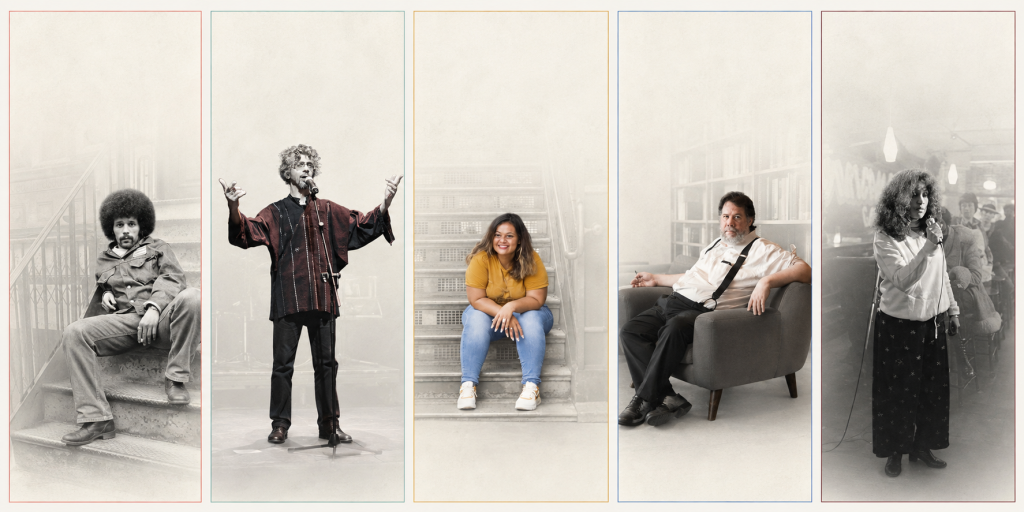
Nuyorican poetry beyond the page: Adaptations and Projections
Nuyorican writing has never belonged exclusively to print. Piñero adapted Short Eyes for Robert M. Young’s 1977 film, scored by Curtis Mayfield; León Ichaso later dramatized Piñero’s life in the 2001 biopic Piñero. The documentary Every Child Is Born a Poet combines poetry, drama, animation, and nonfiction to portray Piri Thomas’s life and work.
Braschi’s books have generated theatrical, musical, cinematic, visual-art, and graphic adaptations. Colombian director Juan Pablo Félix staged United States of Banana for Columbia Stages, while Swedish cartoonist Joakim Lindengren adapted it as a graphic novel. Composer Gabriel Bouche Caro has set Braschi’s texts alongside poems by Ángela María Dávila, Julia de Burgos, and Pedro Pietri.
This movement across media is not incidental. Nuyorican poetry developed through embodied performance, and its influence can be heard in spoken word, slam, hip-hop, experimental theater, and contemporary Latinx performance.
More Nuyorican poets to discover
No list of 12 can represent the full movement. Readers should also seek out Jack Agüeros, Jorge Brandon, Lucky Cienfuegos, Diane Burns, Magdalena Gómez, José Angel Figueroa, Louis Reyes Rivera, Nancy Mercado, Mariposa María Teresa Fernández, Emanuel Xavier, Martín Espada, Denice Frohman, Elisabet Velasquez, Lemon Andersen, and many other writers connected to Nuyorican history and its evolving legacies.
Important contemporary starting points include Frohman’s “Accents” and Esto No Tiene Nombre; Velasquez’s verse novel When We Make It; Fernández’s “Ode to the Diasporican”; Mercado’s It Concerns the Madness; and Rivera’s Who Pays the Cost.
Academic resources on Nuyorican poetry
- Miguel Algarín and Miguel Piñero, eds., Nuyorican Poetry: An Anthology of Puerto Rican Words and Feelings (1975), an early print record and declaration of the movement.
- Miguel Algarín and Bob Holman, eds., Aloud: Voices from the Nuyorican Poets Cafe (1994), a major document of the Cafe’s performance culture.
- Urayoán Noel, In Visible Movement: Nuyorican Poetry from the Sixties to Slam, the first book-length study devoted specifically to Nuyorican poetry.
- Patricia Herrera, Nuyorican Feminist Performance: From the Café to Hip Hop Theater, a study restoring women performers and feminist cultural production to the movement’s history.
- Jorge Duany, Nuyorican and Diasporican Literature and Culture, which places Puerto Rican writing within its historical and diasporic contexts.
- José L. Torres-Padilla and Carmen Haydée Rivera, eds., Writing Off the Hyphen: New Critical Perspectives on the Literature of the Puerto Rican Diaspora.
- Frederick Luis Aldama and Tess O’Dwyer, eds., Poets, Philosophers, Lovers: On the Writings of Giannina Braschi.
- “A Brief Guide to Nuyorican Poetry”, Academy of American Poets.
Archives and cultural organizations
- Nuyorican Poets Cafe presents poetry, theater, music, open mics, education programs, and slam.
- Nuyorican Poets Cafe Founders Archive Project recovers the work of founders and artists often overlooked in conventional histories; audiovisual materials are also available through NYU’s Hemispheric Institute.
- CENTRO, the Center for Puerto Rican Studies at Hunter College, preserves a Nuyorican Poets Cafe archival collection containing institutional records, manuscripts, photographs, and ephemera.
- Pregones/Puerto Rican Traveling Theater creates, presents, and teaches Puerto Rican and Latinx theater.
- The Clemente Soto Vélez Cultural and Educational Center provides studios, theaters, galleries, and civic space for Puerto Rican, Latinx, and Lower East Side artists.
- El Museo del Barrio preserves and interprets Puerto Rican and Latin American art and culture in the United States.
- Taller Boricua is an East Harlem cultural center rooted in Puerto Rican art, political printmaking, exhibitions, and community education.
- Caribbean Cultural Center African Diaspora Institute connects exhibitions, performance, education, and archives to the wider African and Caribbean diaspora.
The live wire of Nuyorican poetry
Nuyorican poets did not simply enter American literature; they altered its language, claimed its stages, and built institutions when established venues excluded them. From Pietri’s public elegies and Piñero’s carceral theater to Esteves’s Afro-Puerto Rican feminism, Laviera’s bilingual music, Braschi’s cross-genre epics, Perdomo’s dramatic polyphony, and Torres’s “bodylingo,” the tradition has made poetry multilingual, embodied, comic, and politically alive.
Its enduring achievement is not a single style. It is a way of treating language as public space: somewhere memory can be preserved, authority challenged, and new forms of Puerto Rican life imagined between island and city, page and stage.
Editorial note
This is a selective guide intended for general readers, educators, journalists, and students. “Essential” refers to the writers’ historical influence, formal innovation, institutional role, or importance to the tradition’s development; it does not imply a definitive ranking. The article should be reviewed periodically as new books, scholarship, archival collections, and institutional histories become available.