
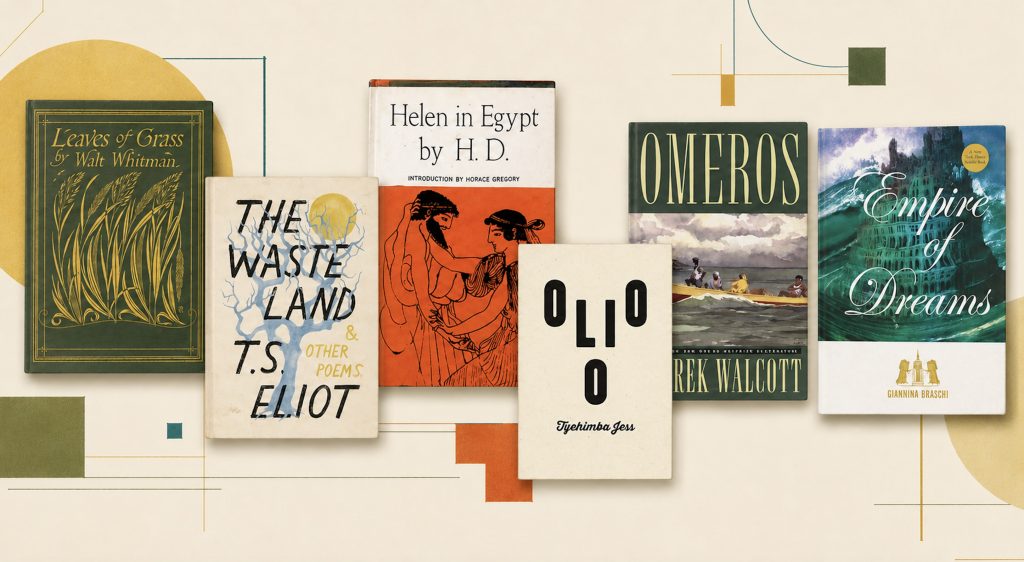
American epic poems extend the traditional epic beyond heroic warfare and national origins. From Walt Whitman’s democratic self to the fractured voices of T. S. Eliot, H.D., Ezra Pound, and Charles Olson, poets have repeatedly reinvented the form to confront the scale and contradictions of American experience.
These works transform cities, bridges, wars, migrations, economic systems, spiritual journeys, and national myths into poetry. Some are book-length narratives; others are modernist sequences, documentary journeys, counter-epics, serial compositions, or multilingual experiments that resist a single story or form.
In contemporary poetry, the American epic has grown more hemispheric, diasporic, feminist, ecological, Black, Indigenous, and queer. Poets including Giannina Braschi, Derek Walcott, Gary Snyder, Alice Notley, Nathaniel Mackey, Anne Waldman, Tyehimba Jess, and Tommy Pico use epic scale and structures to challenge inherited ideas of nation, history, language, identity, and cultural authority.
What Makes a Poem an American Epic?
The classical epic recounts the deeds of heroes and the destinies of nations. The modern American epic often questions those very ideas. Its protagonist may be a city, a people, a landscape, a language, or a divided consciousness. Its subject is not necessarily the founding of a nation, but the struggle over who belongs to it, whose histories it carries, and how it imagines itself.
As the Library of Congress observes, epic poetry can be understood as history seen through the eyes of a poet. The works below enlarge that history by introducing competing voices, suppressed memories, migrations, cultural collisions, and radically different visions of America.
I heard that you ask’d for something to prove this puzzle the New World,
And to define America, her athletic Democracy,
Therefore I send you my poems that you behold in them what you wanted.—WALT WHITMAN, “TO FOREIGN LANDS”
Empire of Dreams: A Postmodern American Epic
Giannina Braschi’s Empire of Dreams is a postmodern American epic set in New York City. First published in Spanish as El imperio de los sueños in 1988 and translated into English by Tess O’Dwyer in 1994, the work is organized into three parts comprising six books. “Assault on Time” forms the first; “Profane Comedy” contains four—“Book of Clowns and Buffoons,” “Poems of the World; or, The Book of Wisdom,” “Pastoral; or, The Inquisition of Memories,” and “Song of Nothingness”—and “The Intimate Diary of Solitude” forms the sixth.
Across its six books, Empire of Dreams turns genre into performance: poetry cross-dresses as pastoral, commercial, diary, tabloid, gossip, confession, autobiography, musical, and manifesto. A vast cast of immigrant characters transform into other characters as clowns, buffoons, shepherds, soldiers, magicians, witches, fortune-tellers, madmen, and artists perform their fantasies in the streets. An antinovel satirizes the writer’s role and calls for a poetic revolution. New York City becomes a theater of liberation where the marginal move toward the center—of political power, meaning, feeling, and identity.
“Though Braschi’s tone can be playful, her work has deep roots in the subversive side of classical literature. The scale is epic.”
—D. NURKSE, POET AND FORMER BROOKLYN POET LAUREATE
The work’s epic ambition becomes most visible in “Pastoral; or, The Inquisition of Memories,” where the conquest narrative is reversed: shepherds invade New York, poetry overtakes commerce, and immigrant artistry remakes the imperial city.
On the top floor of the Empire State a shepherd has stood up to sing and dance. What a wonderful thing. That New York City has been invaded by so many shepherds. That work has stopped and there is only singing and dancing. And that the newspapers—The New York Times, in headlines, and The Daily News—call out: New York. New York. New York. Listen to it. Hear it on the radio. And on television. Listen to the loudspeakers. Listen to it. The buffoons have died. And the little lead soldier. Shepherds have invaded New York. They have conquered New York. They have colonized New York. The special of the day in New York’s most expensive restaurant is golden acorn. It’s an egg. It’s an apple. It’s a bird. Fish. Melody. Poetry. And epigram. Now there is only song. Now there is only dance. Now we do whatever we please. Whatever we please. Whatever we damn well please.
—GIANNINA BRASCHI, “PASTORAL; OR, THE INQUISITION OF MEMORIES,” EMPIRE OF DREAMS
American Epic Poems in Chronological Order
- 1855: Song of Myself — Walt Whitman
An expansive celebration of the individual, democracy, the body, and the interconnectedness of life. - 1855: The Song of Hiawatha — Henry Wadsworth Longfellow
A rhythmic construction of Indigenous American myth based largely on Ojibwe narratives transmitted to Longfellow through Henry Rowe Schoolcraft. - 1917–1969: The Cantos — Ezra Pound
A fragmented, polyglot exploration of global history, economics, politics, and cultural inheritance. - 1922: The Waste Land — T. S. Eliot
A foundational modernist poem that assembles fractured voices, languages, myths, and memories into a portrait of spiritual and cultural crisis after World War I. - 1930: The Bridge — Hart Crane
An attempt to create a unifying American myth through the history and symbolism of the Brooklyn Bridge. - 1946–1958: Paterson — William Carlos Williams
An industrial city reimagined as a man and a man as a city, composed from poetry, letters, documents, local history, and everyday speech. - 1953–1975: The Maximus Poems — Charles Olson
A sprawling investigation of history, geography, civic life, and the meaning of place centered on Gloucester, Massachusetts. - 1956: “Howl” — Allen Ginsberg
A long, incantatory protest against conformity, materialism, psychiatric repression, and social destruction in postwar America. - 1961: Helen in Egypt — H.D.
A feminist reimagining of Helen of Troy inspired by a surviving fragment attributed to the Greek poet Stesichorus. - 1972: The Fall of America — Allen Ginsberg
A documentary road epic confronting war, media, technology, environmental damage, and the political fractures of the United States. - 1982: The Changing Light at Sandover — James Merrill
A supernatural epic constructed from communications received through a Ouija board, encompassing human history, the afterlife, and the structure of the universe. - 1988: Empire of Dreams — Giannina Braschi
A postmodern poetry epic in six books that transforms immigration and New York City into a multilingual theater of artistic revolution. - 1990: Omeros — Derek Walcott
A Caribbean reimagining of Homeric epic centered on colonial history, memory, labor, identity, and the sea. - 1996: Mountains and Rivers Without End — Gary Snyder
An ecological epic connecting geology, prehistory, Zen Buddhism, Asian art, Indigenous storytelling, and the landscapes of North America and the Pacific Rim. - 1996: The Descent of Alette — Alice Notley
A feminist underworld epic in which a woman descends beneath a contemporary city to confront a tyrant and heal a damaged world. - 2006: Splay Anthem — Nathaniel Mackey
A jazz-inflected serial poem exploring exile, migration, African cosmology, fractured community, and collective song. - 2011: The Iovis Trilogy — Anne Waldman
A monumental feminist epic traversing mythology, war, patriarchy, motherhood, politics, Buddhism, and global history. - 2016: Olio — Tyehimba Jess
A polyphonic work of epic scale that recovers the lives and voices of Black performers from the Civil War through blues, gospel, ragtime, and vaudeville. - 2016–2019: The Teebs Cycle — Tommy Pico
A four-book queer Indigenous cycle—IRL, Nature Poem, Junk, and Feed—bringing colonial history, desire, technology, popular culture, and contemporary urban life into poetry of epic scale.
Giannina Braschi Reads T. S. Eliot’s The Waste Land
In this short film, Giannina Braschi reads the Madame Sosostris passage from T. S. Eliot’s The Waste Land. Eliot’s clairvoyante surveys civilization through fragmented symbols of drowning, blindness, crowds, fortune, and fear—an apt bridge between modernist and contemporary epic, in which prophecy survives but certainty has collapsed.
Watch Giannina Braschi read T. S. Eliot’s “The Waste Land.”
Madame Sosostris, famous clairvoyante,
Had a bad cold, nevertheless
Is known to be the wisest woman in Europe,
With a wicked pack of cards. Here, said she,
Is your card, the drowned Phoenician Sailor,
(Those are pearls that were his eyes. Look!)
Here is Belladonna, the Lady of the Rocks,
The lady of situations.
Here is the man with three staves, and here the Wheel,
And here is the one-eyed merchant, and this card,
Which is blank, is something he carries on his back,
Which I am forbidden to see. I do not find
The Hanged Man. Fear death by water.
I see crowds of people, walking round in a ring.
Thank you. If you see dear Mrs. Equitone,
Tell her I bring the horoscope myself:
One must be so careful these days.
—T. S. ELIOT, THE WASTE LAND
The American Epic Continues
Across this chronology, the American epic evolves from a declaration of national possibility into a form for questioning the nation itself. Whitman locates America in the expansive poetic self; Crane and Williams seek collective meaning in a bridge and an industrial city. Later poets redirect that ambition through migration, Caribbean history, ecology, feminism, Black culture, Indigenous experience, queer desire, and digital life.
Not every work on this list is an epic in the strict classical sense. Some are long poems, modernist sequences, serial compositions, counter-epics, or hybrid books that deliberately stretch the form beyond heroic narrative. What unites them is their scale of ambition—the attempt to make poetry bear the weight of history, collective identity, political crisis, and cultural transformation.
The American epic survives not by preserving a settled national myth, but by reopening the question of America: who may name it, whose histories it carries, and what futures its language can imagine.
American Epic Poetry Resources
- Library of Congress: American Poetry Resources
- Academy of American Poets: The Epic
- Poetry Foundation: Epic
- The Walt Whitman Archive
- Yale University Press: Empire of Dreams
Related Reading
- Poetry Foundation: Interview about Empire of Dreams
- Puerto Rican Epic Poem
- Spanish Caribbean Poets
- Empire of Dreams: Epic Poetry
- American Feminist Epics
Editorial note: This selective guide was prepared by the editors of GianninaBraschi.com and was not written by Giannina Braschi. It is intended as a starting point for readers, students, and teachers exploring American epic poetry rather than as an exhaustive canon.