
How a Cambridge Union Debate Works: Art, Politics, and Moral Standards
On June 19, 2025, Puerto Rican poet-philosopher Giannina Braschi spoke as the third proposition in the Cambridge Union debate “This House Would Not Judge Yesterday’s Art by Today’s Politics.”
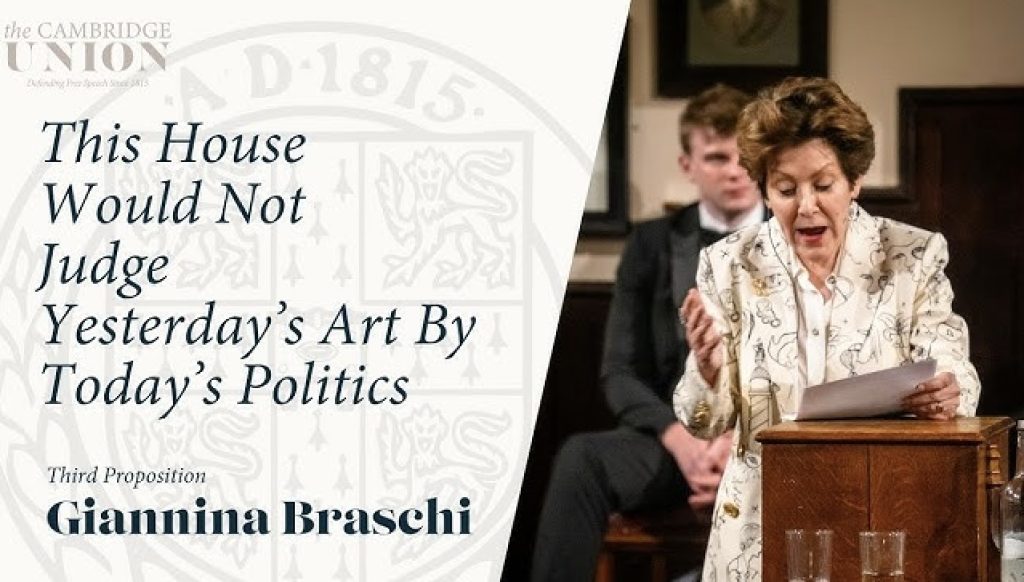
This archival note records the debate’s formal structure, Braschi’s role, and her argument that art must create values rather than submit to the prevailing moral standards of political power.
To watch the speech and explore the complete event, visit Who Judges Art? A Postcolonial Poet-Philosopher at the Cambridge Union.
Cambridge Union Debate Record
- Taking the minutes: Roberta Rennie
- Motion: This House Would Not Judge Yesterday’s Art by Today’s Politics
- Date: June 19, 2025
- Location: Cambridge Union Debating Chamber
- Braschi’s position: Third proposition
- In the chair: Anoushka Kale
The motion placed art in tension with contemporary political judgment: Should works from the past be measured by the moral standards of the present, or should art remain free to challenge the political values imposed upon it?
“Art Is Not Created to Fit Politics”
Giannina Braschi argued that political engagement does not require art to submit to the prevailing standards of political authority:
“Art is not created to fit the moral standards of today’s politics but rather to destroy them. To create new values—new noises, new genres. And this does not mean that we are not political beings. We are political beings. We are public figures. But we can’t allow today’s moral standards to take over our standards of expectations.”
Her position distinguishes the political force of art from obedience to politics. Art intervenes in public life by inventing new forms, values, and ways of thinking—not by serving as an instrument of existing authority.
How a Cambridge Union Debate Works
Cambridge Union debates follow a formal parliamentary structure. The motion is introduced with the traditional phrase “This House Would” or “This House Believes.” Speakers then alternate between the proposition and the opposition.
For this debate, the format included:
- Six ten-minute speeches alternating between proposition and opposition
- A chair responsible for time limits, interjections, and debate procedure
- Points of Information offered by audience members and accepted or declined by the speaker
- No Points of Information during the first or final minute of a speech
- Floor speeches supporting the proposition, opposition, or abstention
- A final vote by speakers and audience members
At the conclusion, participants leave the chamber through doors marked Ayes or Noes; the central exit represents abstention. The chair announces the result after the votes are counted.
The Cambridge Union’s parliamentary debate format culminates in a vote through the Ayes, Noes, or abstention doors.
Watch a Poet-Philosopher in the Debating Chamber
Giannina Braschi is a Puerto Rican poet, novelist, dramatist, and political philosopher who writes in Spanish, Spanglish, and English. Her mixed-genre works include Empire of Dreams, Yo-Yo Boing!, United States of Banana, and PUTINOIKA.
Across poetry, fiction, theater, manifesto, satire, and philosophical dialogue, Braschi examines freedom, colonialism, democracy, capitalism, migration, artistic creation, and the power of language. The American Studies Association awarded her the 2024 Angela Y. Davis Award for an outstanding public contribution to American Studies.
Her Cambridge Union debate brought this literary and philosophical project into the public arena, defending art as a force that does not merely reflect political values but creates new values.
Explore the Debate and Its Ideas
- Cambridge Union art and politics debate
- Postcolonial political philosophy
- Puerto Rican philosophy books
- Giannina Braschi’ s Biography
This archival note preserves information about The Cambridge Union debate format, Giannina Braschi’s participation, and the text of her speech. Interpretive commentary is editorial unless expressly presented as a quotation. This post does not constitute writing by Giannina Braschi.
Last reviewed and updated: August 26, 2026.