
American Experimental Literature: How Writers Remake the Page
What happens when a novel breaks apart, a poem borrows from the essay, or the printed page becomes part of the story? Experimental American literature makes form do more than carry a narrative. Through fractured plots, shifting voices, multilingual wordplay, unusual syntax, and inventive page design, writers change how readers encounter language and experience.
There is no single experimental style or unbroken canon. The work ranges from Melville’s encyclopedic novel to modernist reinventions of syntax, postwar experiments with narrative, and contemporary writing across genres and languages. The writers below share a willingness to test literary conventions, though they do so in distinct ways.
How Experimental Writing Works
Experimental writing can:
- Break open genre and narrative. Poetry, prose, drama, and criticism may converge in one work. Plots can unfold through fragments, repetition, multiple voices, or recursive structures instead of a straight line.
- Make language strange again. Shifts in syntax, diction, register, or language draw attention to words as sounds and materials, not just vehicles for plot.
- Use the page as part of the work. Typography, spacing, and visual arrangement can shape a text’s pace, meaning, and structure.
- Take formal risks. A work’s structure can help it face subjects such as history, empire, ecology, and the body without smoothing away their contradictions.
A Lineage of Formal Experiment
Early Roots and Modernist Breaks
Herman Melville’s Moby-Dick remains an early touchstone for its dramatic scenes, shifting voices, and encyclopedic digressions. Gertrude Stein challenged familiar syntax and repetition; Djuna Barnes reshaped the novel through compressed, allusive prose.
Postwar and Postmodern Experiments
In the decades that followed, William S. Burroughs used cut-up techniques; Kathy Acker remixed and appropriated texts; Ishmael Reed brought satire and myth into collision; and Thomas Pynchon built sprawling, encyclopedic narratives. William H. Gass, John Barth, Donald Barthelme, and Robert Coover each tested the limits of voice, plot, and fiction’s relationship to its own artifice. Jonathan Bayliss’s formally inventive novels belong in this conversation as well.
The lineage also runs through the work of Samuel R. Delany, Theresa Hak Kyung Cha, and David Foster Wallace, alongside writers who continue to experiment today.
Contemporary Writers Pushing Form
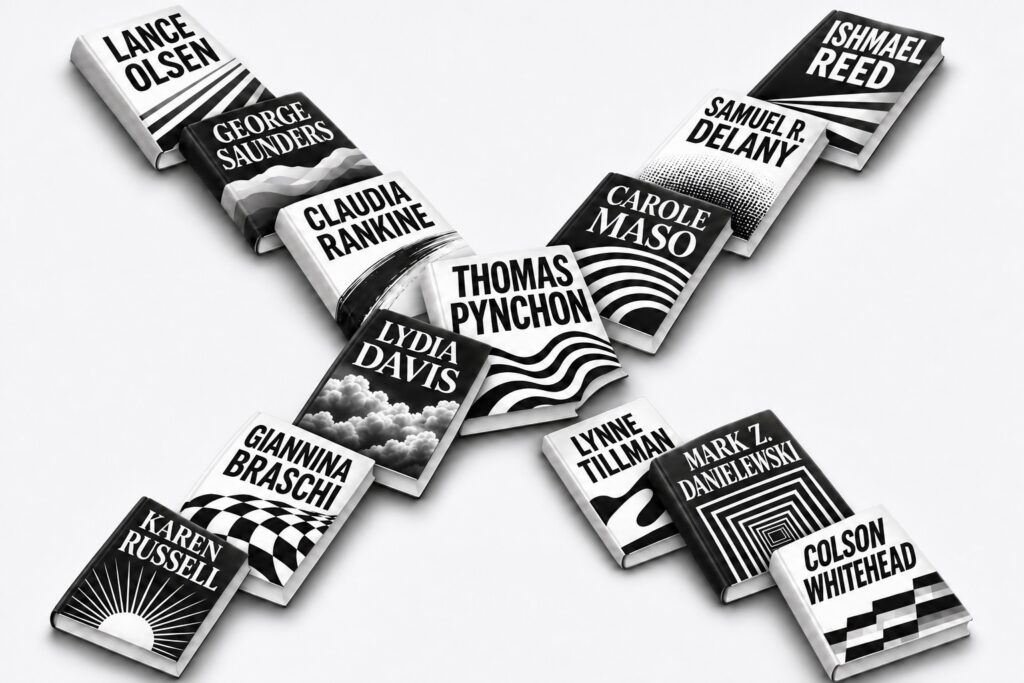
Among the living writers working across experimental, hybrid, or otherwise formally adventurous forms are Ishmael Reed, Thomas Pynchon, Samuel R. Delany, Claudia Rankine, Giannina Braschi, Lynne Tillman, Carole Maso, Lydia Davis, George Saunders, Lance Olsen, Mark Z. Danielewski, Karen Russell, and Colson Whitehead.
Their approaches differ: some work across poetry and prose, languages and genres; others reshape the novel through structure, voice, speculative framing, or shifts in perspective. Together, their work shows how open-ended the category of experimental writing remains.
These questions came into focus at the 36th Annual Conference of the American Literature Association, held May 21–24, 2025, at the Westin Copley Place in Boston. Olivia Carr Edenfield of Georgia Southern University served as Conference Director. americanliteratureassociation.org
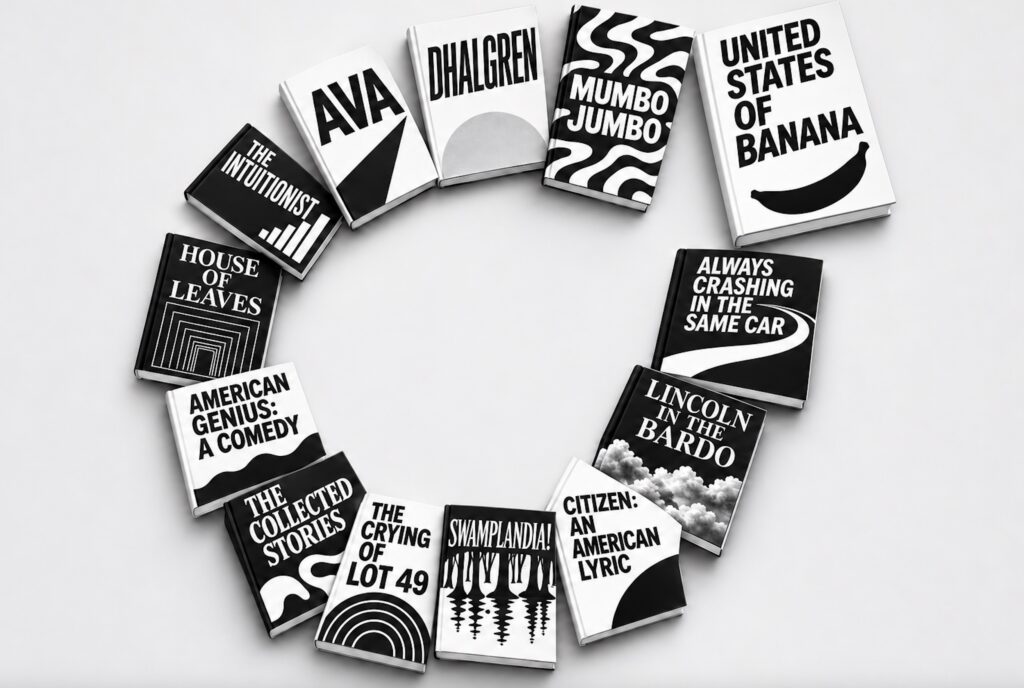
13 Books That Push Literary Form
These selections show different approaches to experimentation, from multilingual and hybrid writing to fragmented narration and visual design.
- Thomas Pynchon, The Crying of Lot 49 (1966) — A search for a hidden postal system becomes a puzzle about whether patterns reveal a conspiracy or merely the searcher’s need for one.
- Ishmael Reed, Mumbo Jumbo (1972) — Rewrites American history as a struggle over culture and power, using satire, invented documents, and the mythology of the novel’s “Jes Grew.”
- Samuel R. Delany, Dhalgren (1975) — Gives readers a city whose geography, chronology, and even the book’s beginning and ending refuse to settle into a single account.
- Carole Maso, Ava (1993) — Follows a dying woman’s last day through lyrical fragments that let memory, rather than plot, shape the novel.
- Colson Whitehead, The Intuitionist (1999) — Makes elevator inspection the unlikely terrain for a detective story about race, technology, and rival theories of progress.
- Mark Z. Danielewski, House of Leaves (2000) — Makes a haunted house story a physical maze of nested manuscripts, footnotes, and pages that change shape.
- Lynne Tillman, American Genius: A Comedy (2006) — Turns an unnamed narrator’s obsessive monologue into the novel’s engine, circling through health, memory, art, and everyday life.
- Lydia Davis, The Collected Stories (2009) — Finds whole stories in tiny disturbances: a repeated phrase, a misapprehension, or a thought that changes direction mid-sentence.
- Giannina Braschi, United States of Banana (2011) —Turns late-stage American empire into tragicomic theater: Hamlet, Zarathustra, and Giannina descend beneath Lady Liberty’s skirt to free Segismundo, linking his escape to Puerto Rico’s liberation.
- Karen Russell, Swamplandia! (2011) — Sets a family’s unraveling in an alligator-wrestling theme park, shifting between a teenager’s mythic vision and her brother’s starkly different account.
- Claudia Rankine, Citizen: An American Lyric (2014) — Addresses the reader as “you” through scenes of racial injury, placing lyric, essay, and visual art in conversation.
- George Saunders, Lincoln in the Bardo (2017) — Reimagines the night Abraham Lincoln visits his son’s grave as a chorus of the dead, each voice shaping—and disputing—the story.
- Lance Olsen, Always Crashing in the Same Car: A Novel After David Bowie (2023) — Makes the telling of Bowie’s final months part of the story, shifting among the musician, a scholar writing about him, and other voices.
Archive: American Literature Association Panels and Session Highlights
Experimental American Fiction Program, 2025
- “American Experimental Fiction: A Roundtable Discussion” — Organized by the Jonathan Bayliss Society
- “Charles Olson, Vincent Ferrini, and Jonathan Bayliss in Gloucester” — Co-hosted by the Charles Olson Society and the Jonathan Bayliss Society
Form and Function I
Chair: Michaela Smith, Georgia Southern University
- “The Defamiliarization of English in 20th-Century American Poetry” — Malek J. Zuraikat, Yarmouk University, Jordan
- “‘You Can’t Kill Time With Your Heart’: David Foster Wallace and the Time of Embodiment” — Cory Alix, Roger Williams University, and Britt Zeldenrust, Indiana University Northwest
- “Considering Giannina Braschi’s United States of Banana” — Adriana M. Fischetti, CCNY
For broader conference archives and annual program details, visit the American Literature Association Annual Conference page.
Related Reading
Scholarly Books and Anthologies on Experimental Literature
- American Studies After Postmodernism, edited by Theodora Tsimpouki, Konstantinos Blatanis, and Angeliki Tseti (Palgrave Macmillan, December 2023). Examines critical directions, formal shifts, and interdisciplinary frameworks in American literary studies after postmodernism.
- The Routledge Companion to Experimental Literature, edited by Joe Bray, Alison Gibbons, and Brian McHale (Routledge, 2012). A reference volume on experimental movements and formal innovation across fiction, poetry, and digital media.
- Experimental Fiction: An Introduction for Readers and Writers, by Julie Armstrong (Bloomsbury Academic, 2014). Introduces the history, aesthetic strategies, and critical frameworks of experimental prose.
- Hyperglossia and the Novel: The Production of (Non) Space, by Elidio La Torre Lagares (Taylor & Francis, 2025). Examines multilingualism, spatial poetics, and cross-genre experimentation in the contemporary novel.
- Poets, Philosophers, Lovers: On the Writings of Giannina Braschi, edited by Frederick Luis Aldama and Tess O’Dwyer (University of Pittsburgh Press, 2020). Essays on Braschi’s cross-genre experimentation, political philosophy, multilingual poetics, and place in contemporary American and Latinx literature.
- The Norton Anthology of Postmodern American Fiction, edited by Paula Geyh, Fred G. Leebron, and Andrew Levy (W. W. Norton, 1998). Collects postwar and late-20th-century American experimental prose, including work by Burroughs, Pynchon, Barthelme, Acker, and Reed.
- Against Expression: An Anthology of Conceptual Writing, edited by Craig Dworkin and Kenneth Goldsmith (Northwestern University Press, 2011). A collection of radical, procedural, and constraint-based writing.
Related Posts
- American Epic Poems: Explore monumental American verse and hybrid epics, from Walt Whitman and Charles Olson to contemporary writers.
- American Feminist Epics: Read essays and scholarship on how feminist writers reshape epic scale, voice, and political critique.
- United States of Banana: Learn about Giannina Braschi’s genre-defying dramatic novel on liberty, empire, and post-9/11 America, and explore the United States of Banana Study Guide and Summary.
- Nuyorican Poets and Experimental Poetics: Explore how multilingual wordplay, code-switching, and urban geography transform American poetry.
Editorial note: This post was independently developed by the site’s editorial team. Last updated November 22, 2026.