
Women Authors and Artists as Temporary Tattoos
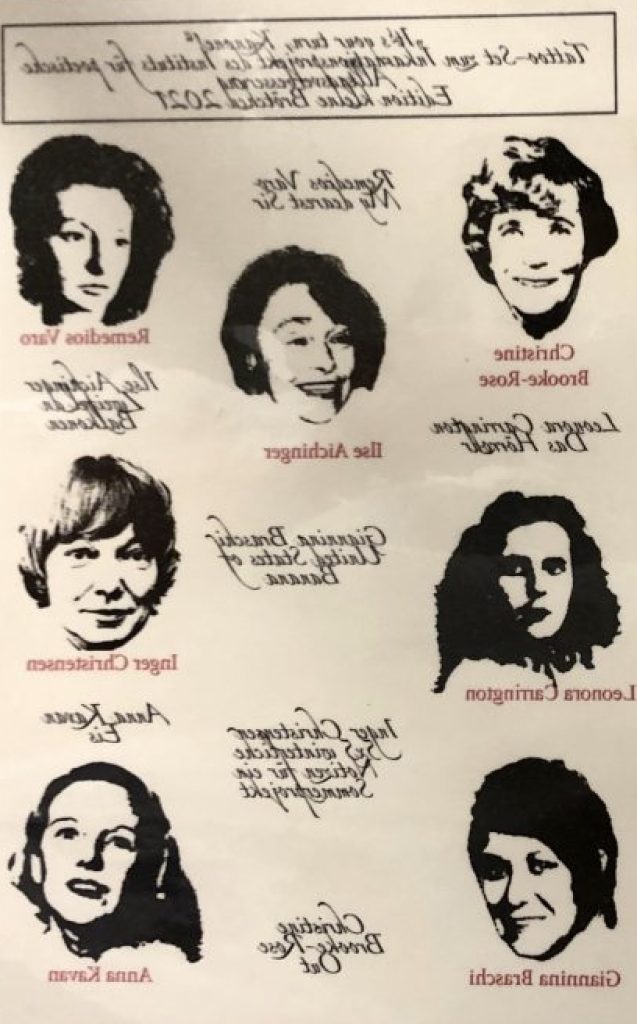
Christine Brooke-Rose, Ilse Aichinger, Giannina Braschi
Lisa Spalt’s Inkarnationsprojekt transforms an international constellation of experimental women into wearable art.
What would it mean to carry a writer or artist on your skin—not permanently, but long enough to inhabit her imaginative world?
Austrian writer, translator, and interdisciplinary artist Lisa Spalt takes that question literally in the Inkarnationsprojekt, created through the Institut für poetische Alltagsverbesserung—the Institute for the Poetic Improvement of Everyday Life.
The project’s water-transfer temporary tattoos feature women who crossed borders between countries, languages, artistic disciplines, and literary forms. Applying one of their images becomes a small act of incarnation: artistic influence is not merely read, viewed, or remembered. It is worn.
Lisa Spalt’s Inkarnationsprojekt
The Inkarnationsprojekt is not conventional literary merchandise. It belongs to Spalt’s larger artistic practice of transforming ordinary objects and activities through language, collaboration, humor, and conceptual play.
The Institut für poetische Alltagsverbesserung describes itself as a changing collective devoted to the “poetic improvement of everyday life.” Its projects have included edible money, altered dreams and memories, oracles made from rubbish, and a revolution that can be rubbed into one’s hair.
Within this imaginative world, a temporary tattoo is both playful object and artistic proposition. The IPA invites participants to “incarnate” a chosen writer or artist by carrying her image on the body.
Women Writers and Artists in the Tattoo Series
The 2021 water-tattoo set shown here features seven vanguard writers and artists:
- Leonora Carrington, the British-born Mexican surrealist writer and painter
- Remedios Varo, the Spanish-Mexican surrealist artist
- Anna Kavan, the British experimental novelist and short-story writer
- Inger Christensen, the Danish poet known for formally inventive works
- Christine Brooke-Rose, the British experimental novelist and literary critic
- Ilse Aichinger, the Austrian writer whose work confronted war, persecution, and the instability of language
- Giannina Braschi, the Puerto Rican poet and novelist who crosses languages, genres, and literary traditions
The selection of temporary tattoos of women authors and writers creates an unconventional, transnational canon of women who resisted stable classifications. Carrington and Varo moved between surrealist literature and visual art. Kavan, Christensen, Brooke-Rose, and Aichinger transformed the structures of fiction and poetry. Braschi moves among poetry, theater, fiction, philosophy, and political satire in Spanish, Spanglish, and English.
Together, these figures suggest that the avant-garde is not a single movement, country, or historical period. It is a continuing practice of crossing boundaries and creating forms that did not previously exist.
Experimental Literature, Body Art, and Cultural Adaptation
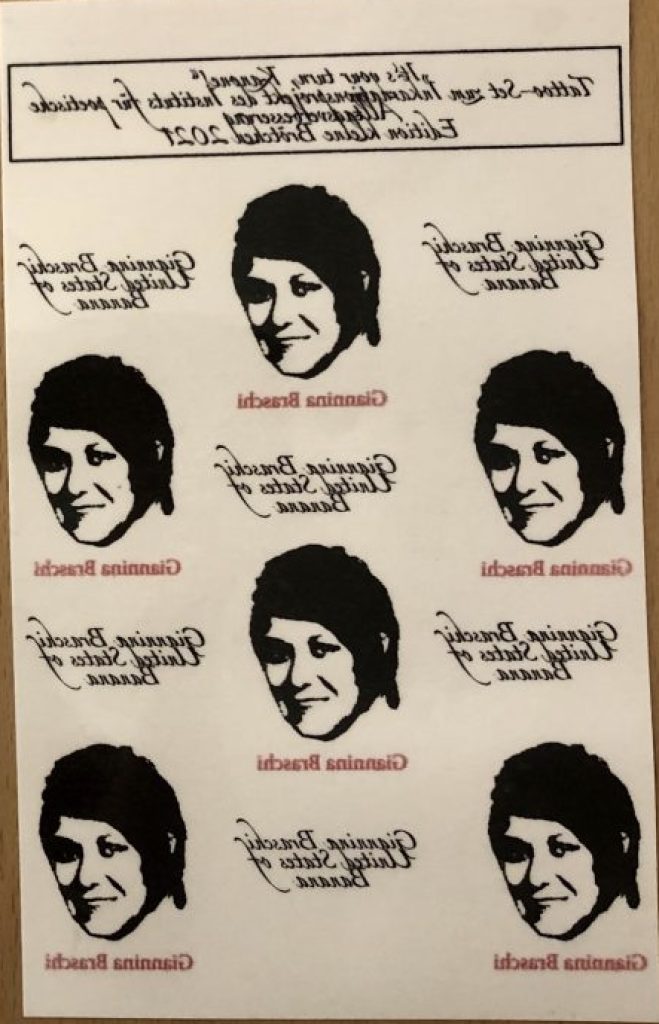
Spalt’s tattoos turn literary and artistic inheritance into something physical, portable, and temporary. They also belong to a broader history of literature migrating into other media.
Giannina Braschi’s writing, for example, has inspired works in theater, chamber music, film, comics, painting, sculpture, industrial design, fashion, and ecological urban planning. Tess O’Dwyer examines these transformations in the World Literature Today essay “Popping Up in Pop Culture and Other Unlikely Spaces: Latinx Author Giannina Braschi Crosses Over”.
The temporary tattoo set offers another, unusually intimate form of cultural adaptation. Instead of translating a literary work into music, theater, or visual narrative, the Inkarnationsprojekt translates artistic affinity into an image carried directly on the body.
Braschi’s inclusion also places her within a larger genealogy of avant-garde poets, philosophers, and artists who challenge inherited categories. Like the other women in Spalt’s series, she crosses borders between artistic forms and creates new literary genres that resist a single linguistic, national, or disciplinary identity.
Lisa Spalt and Giannina Braschi in Vienna: Willkommene Kontaminationen
Spalt’s engagement with Braschi did not end with the 2021 tattoo project. Years later, Spalt and writer Julius Handl presented Willkommene Kontaminationen—“Welcome Contaminations”—at Vienna’s Alte Schmiede.
The literary and philosophy program brought Braschi into conversation with Brazilian modernist Mário de Andrade and French-Egyptian surrealist Joyce Mansour. Spalt and Handl examined how these writers cross languages, unsettle expressions of authority, and employ subversive literary strategies. Braschi participated through two video interventions, which formed part of Spalt’s continuing inquiry into experimental literature, cultural crossings, and resistance to established forms.
Read about Willkommene Kontaminationen at Vienna’s Alte Schmiede or watch the complete event on Youtube.
About Lisa Spalt
Born in Hohenems and based in Linz and Vienna, Lisa Spalt is an Austrian writer, translator, and interdisciplinary artist. Her cutting-edge books include Grüne Hydra von Calembour and Das verwirrte Tier. She has also translated experimental French-language writers into German and created collaborative projects involving literature, audio, film, music, drawing, and performance.
Her work combines formal experimentation with biting humor, conceptual invention, and social critique. The Inkarnationsprojekt exemplifies that practice on an intimate scale: a temporary image placed on the skin becomes an encounter with an artistic lineage.
The tattoo eventually disappears. The affiliation it declares need not.
The Wasser-Tattoo-Set was created for the Inkarnationsprojekt of the Institut für poetische Alltagsverbesserung and published by Edition kleine Brötchen in 2021.
Related Reading
- Latin American Philosophers and Poets
- Latinx Philosophy and the Creation of New Literary Genres
- Fashion and Poetry Quotes
Editorial note: This independent post about Lisa Spalt’s artistic project was not written by Giannina Braschi.
Last reviewed and updated: September 2, 2026