
Spanish Caribbean Poems
Across Puerto Rico, Cuba, and the Dominican Republic, poetry has been a language of revolt, remembrance, migration, and reinvention. José Martí joined lyric intimacy to anticolonial thought; Nicolás Guillén brought Afro-Cuban speech and musical form into the center of Cuban poetry; Julia de Burgos made the river, the female body, and the divided self instruments of liberation. In the Dominican Republic, Pedro Mir transformed sugar, dispossession, and foreign power into national epic, while Aída Cartagena Portalatín joined formal experiment to Black consciousness, feminist resistance, and the revision of Dominican history.
These traditions have never remained within island borders. Spanish Caribbean poetry travels through migration, exile, translation, performance, and encounters with other languages. It continues to be written and transformed in New York, Miami, Madrid, Mexico City, and throughout the Caribbean diaspora.
Poetry from El imperio de los sueños
Puerto Rican poet Giannina Braschi extends this tradition through a vast body of poetry written in Spanish over approximately a decade. The two poems presented here come from El libro de payasos y bufones, the second of the six poetry books gathered in El imperio de los sueños.
Published in Spain in 1988, the collection moves among lyric and prose poetry, dramatic dialogue, comedy, philosophical reflection, anti-novel, and mock diary. Its clowns, buffoons, shepherds, magicians, witches, animals, and dreamers inhabit a world in which literary forms and identities continually change.
CAMILA ESPINOZA VIDEO: El libro de payasos y bufones
“Poesía de un tiburón con dos ballenas”
Poesía de un tiburón con dos ballenas y un fantoche de peluche. Poesía de un cangrejo y una tortuga. Poesía de dos automóviles y un ascensor. Poesía de un gigante y un enano. Poesía del payaso y el borracho. Poesía de la estrella y la muralla. Poesía del verano y la montaña. Poesía del conejo que vuela y del zapato que baila. Y poesía del dolor de la alegría y poesía de la alegría del dolor. Poesía del murciélago y la bruja. Poesía del zapato roto y de las medias descalzas y del horizonte que te busca cuando estás llegando a la montaña. Y poesía de la colina que bajas cuando estás esperando la llamada. Y poesía del número perdido en el sombrero del mago. Y poesía de la pluma de la cotorra y poesía del papagayo y la sombrilla. Y poesía de la sombra y el testigo. Y poesía del accidente y la sorpresa. Y poesía del amor que nunca llega porque se escapa con el sombrero del mago. Y la palabra poesía, y el sonido poesía y la sombra poesía se hacen de veras dos verdaderos números, dos verdaderos payasos, dos enormes aeroplanos, dos aplausos que nadie oye porque estrellados en el aire dejan de sentirse aire y estrellados contra el viento dejan de sentirse viento. Y poesía sin montaña y sin colina. Y poesía sin ausencia y sin vacío. Y poesía de la noche y el testigo en sombra, en polvo, en nada.
A Collective Mexican Performance
More than three decades after the poem above appeared in print, Mexican video artist Camila Espinoza, creator of the audiovisual project sonder.a, made a short film in which a group of Mexican artists and poets perform it in Spanish. Produced during the COVID-19 pandemic, the film gives the poem a collective audiovisual form. The Spanish news and culture magazine Cambio16 featured the project as “El vídeo del poema de Giannina Braschi” in 2021.
Watch “El libro de payasos y bufones”
“Yo he sido adivina”
Yo he sido adivina. En otros tiempos le adiviné el futuro a los bufones y a los locos. Ustedes lo recuerdan. Tenía la voz pequeña como un grano de arena y unas manos inmensas. Los locos caminaban por mis manos. Les dije la verdad. Nunca pude mentirles. Y ahora me arrepiento. En otros tiempos un borracho lleno de quimeras me invitó a bailar. Le adiviné las barajas cuando los tragos del vino fueron haciéndose golpes. Mis golpes en la puerta acabaron con el mar. Nos acabó el recuerdo. Bufones y locos cuentan la arena y nunca le han roto sueños a la noche. Sorben la noche y se levantan llenos de mediodías. Magos fueron y serán mis compañeros. Sin casi adivinar sus trucos les prendí el fuego en la garganta. Pero nadie explota. Al menos uno. Y con el pez se levanta otra quimera.
The Poet Performs “Yo he sido adivina”
In a short film directed by Williams Cole, Braschi performs the poem herself. Her voice, gestures, and silences carry its movement through prophecy, memory, regret, violence, and dream. The film was commissioned by the Adrian Brinkerhoff Poetry Foundation and co-produced by the Academy of American Poets.
El libro de payasos y bufones: Poetry and Visual Art
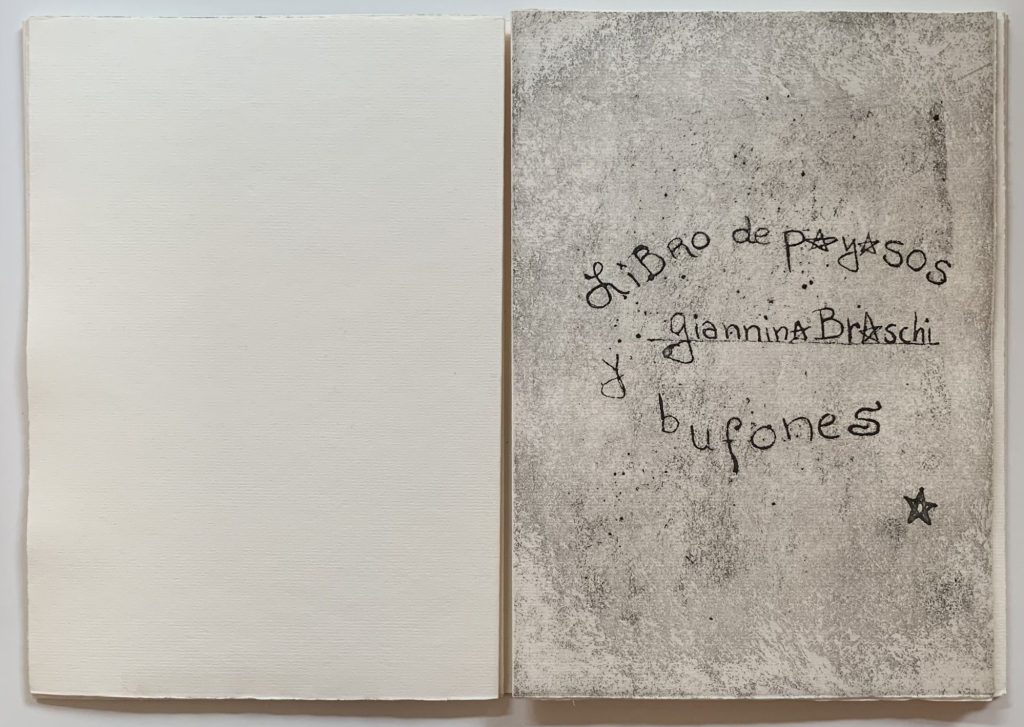
In 1987, El libro de payasos y bufones appeared in Milan as a limited-edition artist’s book printed by master printmaker Giorgio Upiglio at Grafica Uno. It joined fifteen poems by Braschi with five original color aquatints by artist Rita Gallé in 125 numbered and signed copies. Learn more about Giorgio Upiglio, Rita Gallé, and the artist’s book.
Six Books of Spanish Poetry in a Single Postmodern Epic
The six books of poetry gathered in El imperio de los sueños form a postmodern epic poem. This scale is essential to understanding Braschi’s work. Before writing in Spanglish and English, she had created an extensive poetic project in Spanish that crossed literary genres while keeping poetry as its generative force. The collection appeared in English as Empire of Dreams, translated by Tess O’Dwyer and published by Yale University Press in 1994 with an introduction by poet Alicia Ostriker.
Selected Scholarship
- Ostriker, Alicia. “Introduction.” Empire of Dreams. Translated by Tess O’Dwyer, Yale University Press, 1994.
- O’Dwyer, Tess. “Translator’s Note.” Empire of Dreams. Yale University Press, 1994.
- Carrión, María M. “Geography, (M)Other Tongues and the Role of Translation in Giannina Braschi’s El imperio de los sueños.” Studies in 20th & 21st Century Literature 20.1 (1996): 167–192.
- Balboa Echeverría, Miriam. “Mirada y marejada en El imperio de los sueños de Giannina Braschi.” Confluencia (2002): 98–103.
- Horno-Delgado, Asunción. “Imperiosa y anti-imperial: Giannina Braschi o la poética del imperioso desacuerdo nomádico.” Hispanic Poetry Review 4.1 (2004).
- Loustau, Laura R. “The Poetry of Giannina Braschi.” Poets, Philosophers, Lovers: On the Writings of Giannina Braschi. Edited by Frederick Luis Aldama and Tess O’Dwyer, University of Pittsburgh Press, 2020.
Spanish Caribbean Poets and Poetry Books
For a wider introduction to José Martí, Julia de Burgos, Nicolás Guillén, Luis Palés Matos, Nancy Morejón, Pedro Mir, Aída Cartagena Portalatín, José Lezama Lima, Salomé Ureña, and contemporary Caribbean writers, visit Spanish Caribbean Poets: Essential Writers and Poetry Books.
For additional recordings, see Poetry on Film and Audiovisual Poetry Readings.
Editorial note: The introduction and supporting material were prepared by the editors of GianninaBraschi.com. They are not authored by Giannina Braschi.
Last reviewed and updated: September 2, 2026