
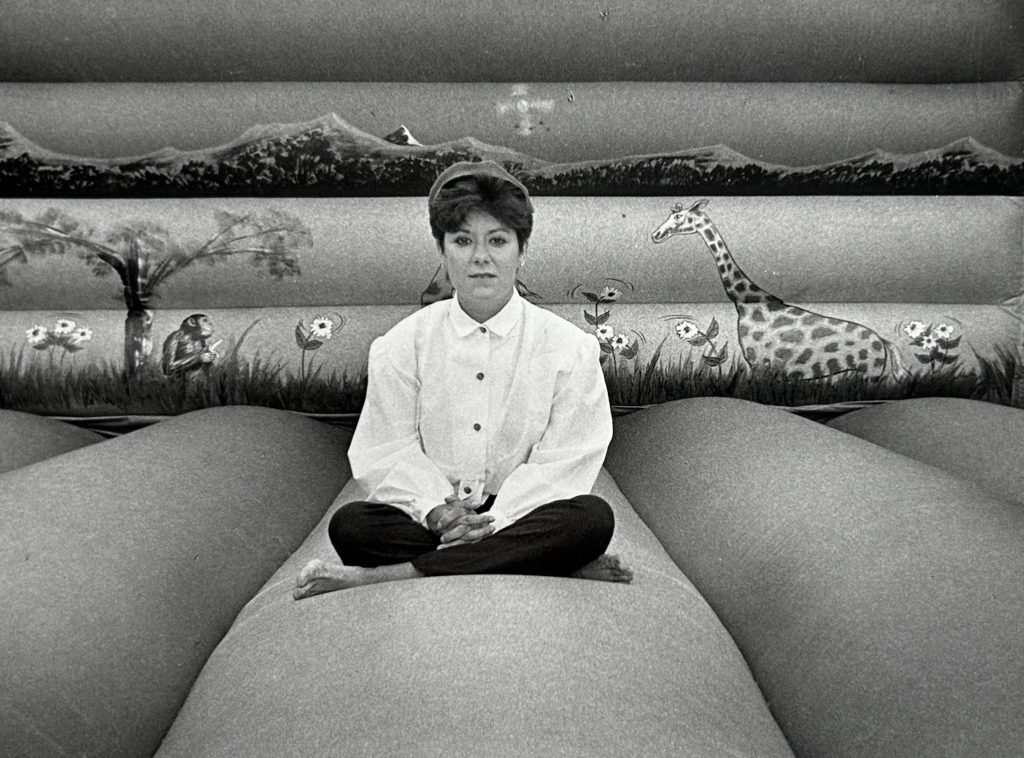
Profane Comedy imagines the day poetry takes over New York: work stops, shepherds occupy the Empire State Building, and song and dance rule Manhattan. Around them, clowns and buffoons perform, little lead soldiers march, wonders multiply, and memories are put on trial and burned.
Across four books, Giannina Braschi creates four radically different worlds. Poetry becomes theater, song, manifesto, philosophy, bacchanal, and inquisition—each charged with its own images, spiritual quest, and emotional energy.
“Braschi is a Spanish Arthur Rimbaud, reinventing surrealism, creating a maze of characters—clowns, shepherds, magicians, madmen, witches and artists who perform their fantasies in the city streets. In substantial ways, Braschi is the brightest new voice in her generation writing in the Spanish language.”
—Willis Barnstone and Tony Barnstone, Literatures of Asia, Africa, and Latin America: From Antiquity to the Present
From La comedia profana to Empire of Dreams
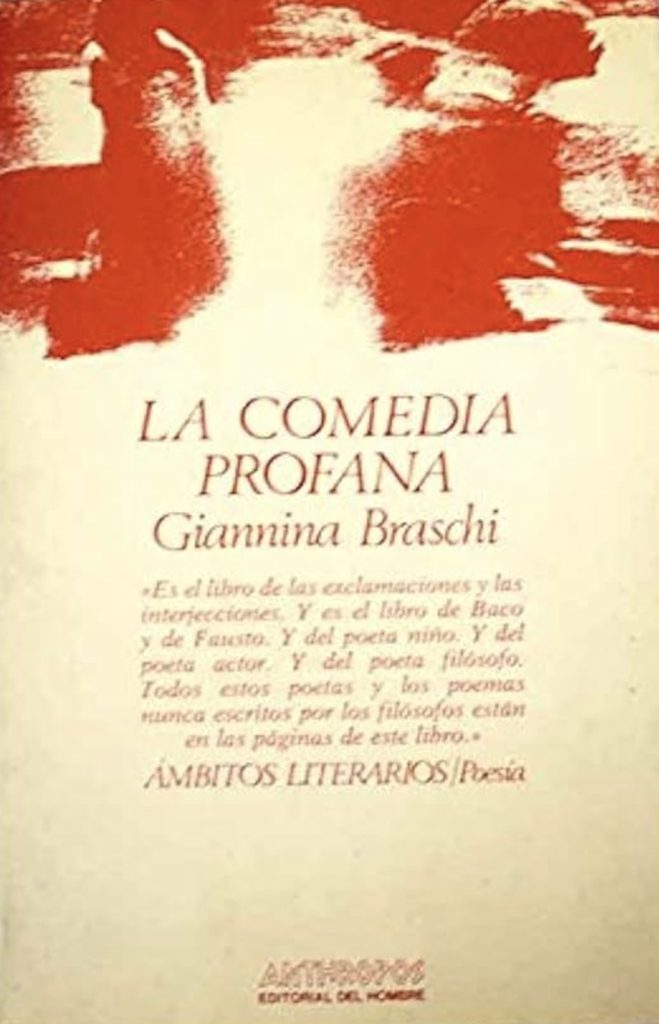
Giannina Braschi began writing Profane Comedy in New York in 1979 and completed it in 1985. First published as La comedia profana by Anthropos Editorial in Barcelona, it later became a central part of Braschi’s postmodern epic El imperio de los sueños (1988), translated by Tess O’Dwyer as Empire of Dreams (1994).
Profane Comedy comprises four books:
- “Book of Clowns and Buffoons”
- “Poems of the World; or, The Book of Wisdom”
- “Pastoral; or, The Inquisition of Memories”
- “Song of Nothingness”
Each book begins a new spiritual and imaginative quest, with its own themes, imagery, and emotional tone.
American Poetry in Spanish: Giannina Braschi in New York
New York is home to an extraordinary and ever-expanding body of poetry written in Spanish—a literature of exile, migration, political struggle, formal experiment, and cultural reinvention. Its distinguished history extends from José Martí and Federico García Lorca’s Poet in New York to Julia de Burgos and the Nuyorican poetry movement. Braschi’s own literary world included Pedro Pietri, Miguel Algarín, and Clemente Soto Vélez.
The breadth of this Spanish-language world is reflected in the work’s vocabulary, phrases, registers, and cultural references, which move across centuries, regions, and diasporas. As Tess O’Dwyer writes in “Giannina Braschi,” The Literary Encyclopedia:
Braschi not only poeticizes the evolution of the Spanish language across historical ages, but also across shifting geographical terrains of the Spanish diaspora. Though the poems are set in New York, there are “allusions to the Quartier Latin, the barrios chinos of Barcelona and Seville, the Borgesian labyrinths of Buenos Aires, San Juan’s colonial architecture, and loci from literatures and societies of the past and present” (Carrión 447). Chilean novelist Carlos Labbé described Braschi’s language as “anti-Spanish colonized by the United States, from the imperial Castilian lexicon of Golden Age poetry that barely conceals the Mozarabic, the Berber, the Saharawi, and the Sephardic, from the Taíno syntax that defiantly survives in street-corner chatter” (Labbé). By recasting New York as a theater of liberation for nomadic characters and writing (Loustau 21), Braschi dissolves the borders between the Golden Age and the digital era, effectively propelling the immigrant from the periphery to the vanguard of a new cultural empire (Cruz-Malavé 801).
Theatrical Poetry and Commedia dell’Arte: “Book of Clowns and Buffoons”
“Book of Clowns and Buffoons” turns poetry into theater. Drawing on the shifting roles of commedia dell’arte, Braschi sends actors, directors, clowns, fortune-tellers, magicians, madmen, and little lead soldiers onto the stage through songs, proclamations, exclamations, and interjections.
My tanks were filled with gasoline and wars. I was a lead soldier. I marched against the smoke of the city… And the world closed its doors—anvils and hammers against the sleeping men—the doors of the heart, cities everywhere and little lead soldiers.
—Giannina Braschi, “Book of Clowns and Buffoons,” translated by Tess O’Dwyer
Voices change roles, images mutate, and the page becomes a site of continuous theatrical performance.
Poetry of Wonder and Excess: “Poems of the World; or, The Book of Wisdom”
“Poems of the World; or, The Book of Wisdom” is driven by abundance. The child-mother of the universe, the chestnut roaster, comets, animals, lovers, orchestras, pleasures, sexes, and wonders multiply across its pages.
Poetry becomes creation myth, proverb, circus, bacchanal, song, and manifesto. Bodies and words reproduce with the same high-voltage energy. Yet the book mistrusts fixed wisdom: “I’ve just turned life into a proverb,” the speaker declares. “I’ve just killed it.”
I want everything to be in my book. So nothing is left unsaid.
I want to say it all. Live it all. See it all. Make everything anew.Let the music begin. Let the singer begin to sing. Let everything begin anew. I want everything. Everything. Everything.
—Giannina Braschi, “Poems of the World; or, The Book of Wisdom”
Spanish Golden Age Pastoral Poetry in New York: “Pastoral; or, The Inquisition of Memories”
“Pastoral; or, The Inquisition of Memories” upends the Spanish Golden Age by unleashing a bucolic invasion of the Big Apple. Pastoral elegies no longer mourn a lost Arcadia; instead, they mobilize a migrant revolution on Fifth Avenue.
The shepherds occupy the Empire State Building and replace work with poetry, song, and dance:
On the top floor of the Empire State a shepherd has stood up to sing and dance. What a wonderful thing. That New York City has been invaded by so many shepherds… Now there is only song. Now there is only dance. Now we do whatever we please. Whatever we please. Whatever we damn well please.
—Giannina Braschi, “Pastoral; or, The Inquisition of Memories”
This radical reclamation of the quintessential American skyline becomes an inquisition—a sermon, palinode, funeral, trial, and ceremonial burning of memory. Braschi’s shepherds reject pastoral nostalgia and declare: “This is the funeral of memories.”
Nietzsche, Innocence, and Forgetting: “Song of Nothingness”
“The child is innocence and forgetting, a new beginning, a game, a self-propelled wheel, a first movement, a sacred ‘Yes.’”
—Friedrich Nietzsche, Thus Spoke Zarathustra
“Song of Nothingness” begins with Nietzsche’s child: innocent, forgetful, playful, and capable of beginning anew. Its world is filled with children, baby teeth, bootblacks, teachers, painters, hunger, and the wheel of fortune.
Its imagery is starker than the exuberant abundance of “Poems of the World,” but the book itself is no less full or theatrical. Songs, games, philosophical arguments, entrances, disappearances, and reversals unfold at high voltage. Fate escapes, a piano plays the pianist’s key, and there is “no distance between the spectacle and the performance.”
“Song of Nothingness” becomes a space of forgetting, play, and first movement—the emptying that makes another beginning possible.
From Profane Comedy to Putinoika: Across 40 years of experimental writing
Profane Comedy is an early work by a poet who would go on to create the first full-length Spanglish novel, Yo-Yo Boing!; the philosophical novel United States of Banana; and the cross-genre tragicomedy Putinoika. Radically different in form, style, and subject, these books capture the energy and obsessions of successive American eras—from Reagan, Clinton-Bush, and Obama to the age of Trump and Putin.
Yet through every transformation, the same essential charge remains. As her editor Jonathan Brent observed, Braschi’s work is “a torrent of voice and imagination that reflect back to us the marvelous feeling of being alive.”
Further Reading
On GianninaBraschi.com
- La comedia profana: reseña de Juan Martínez Capó
- Empire of Dreams: Epic Poetry
- Modern Pastoral Poems and Contemporary Eclogues
External Sources
- La comedia profana: reseña de Juan Martínez Capó
- Emilie L. Bergmann and Edward H. Friedman, “Imitation and Adaptation: A Meeting of Minds,” Bulletin of Spanish Studies 93, nos. 7–8
- Empire of Dreams: Epic Poetry
- Empire of Dreams at Yale University Press
- O’Dwyer, Tess. “Giannina Braschi.” The Literary Encyclopedia, 19 March 2026. Updated August 2026.
Editorial note: This introduction was prepared by the editors of GianninaBraschi.com and was not written by Giannina Braschi.