
Postcolonial nation-states inherited borders that often reflect the histories of empires more closely than the cultural lives of the people divided by them. Religions, languages, philosophies, and works of art continue to move across those boundaries, challenging the idea that nations are culturally self-contained.
Hamid Dabashi on Nations Without Borders
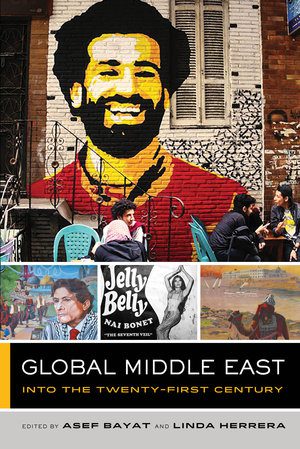
In “On Nations Without Borders,” cultural theorist Hamid Dabashi considers how ideas travel across countries, languages, and centuries. His essay appears in Global Middle East: Into the Twenty-First Century, edited by Asef Bayat and Linda Herrera and published by the University of California Press in 2021.
Written for students and general readers, the collection approaches the Middle East through global movement and exchange. Its contributors examine religion, science, literature, exile, food, film, fashion, music, sports, political movements, and the circulation of people and ideas.
Dabashi is the Hagop Kevorkian Professor of Iranian Studies and Comparative Literature at Columbia University. His scholarship encompasses postcolonialism, world literature, cinema, cultural history, and critiques of national identity.
Dabashi rejects the idea of the nation as a sealed cultural space. Postcolonial nations have shaped the world and been shaped by it, regardless of the political boundaries inherited from empire. Ideas do not move only from Europe outward; non-European histories, religions, and artistic traditions have continually transformed the cultures that claim authority over them.
His central formulation is:
“The question here is not the Iranian provenance of Zoroaster but the manner in which subversive ideas find their way upon the global scene.”
Zoroaster’s Persian origin matters, but it cannot contain the figure’s cultural life. Dabashi uses his transformations across different languages and art forms to show how allegories leave home, acquire new meanings, and reappear in unexpected political settings.
This post highlights one portion of Dabashi’s wider chapter: the continuum he draws from Zarathustra through Mozart and Nietzsche to Giannina Braschi’s United States of Banana.
Zarathustra from The Magic Flute to United States of Banana
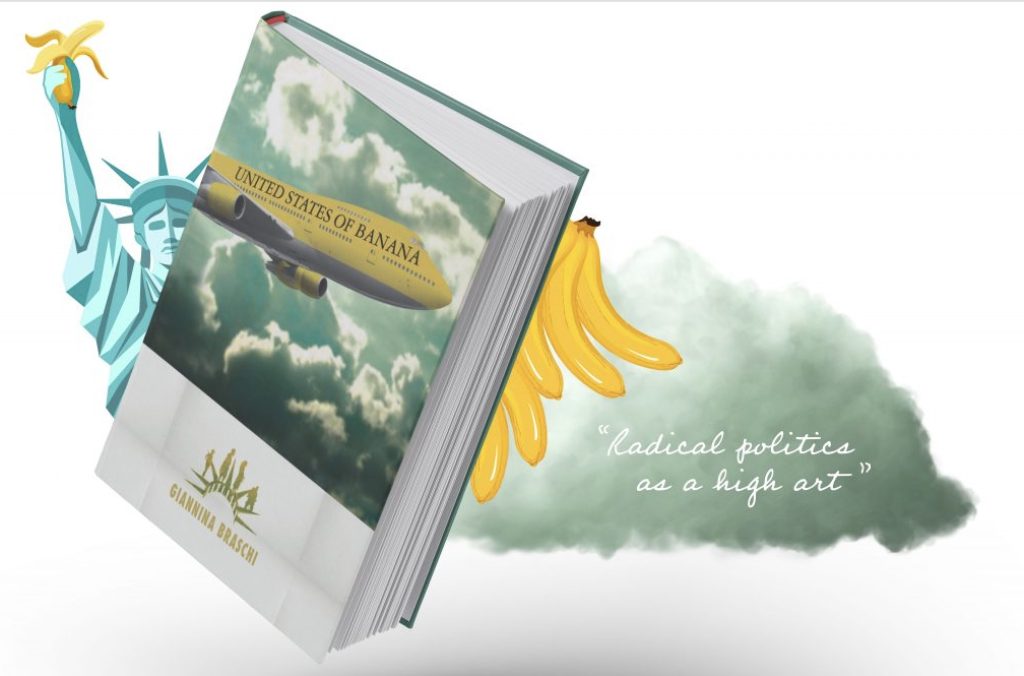
Dabashi traces Zarathustra’s reinvention across more than two hundred years. Mozart and Emanuel Schikaneder invoke the figure through The Magic Flute. Nietzsche transforms Zarathustra into the philosophical speaker of Thus Spoke Zarathustra. Through Walter Kaufmann’s influential English translation, Nietzsche’s prophet travels again, entering North American intellectual and literary culture.
Braschi then brings Zarathustra into a Puerto Rican and Caribbean argument about empire. In United States of Banana, he joins Hamlet and Giannina on a mission to liberate Segismundo, Puerto Rico’s political prisoner, from beneath the Statue of Liberty. Their journey becomes a debate about Puerto Rican independence and statehood, U.S. citizenship, immigration, mass incarceration, capitalism, and freedom.
The three works are connected by more than the recurrence of one character. Each reinvents Zarathustra within a formally subversive project. Mozart and Schikaneder create a German-language opera against the dominance of Italian librettos. Nietzsche overturns inherited philosophical values. Braschi places Zarathustra inside a post-9/11 tragicomedy confronting U.S. empire and Puerto Rico’s colonial condition.
For Dabashi, the global circulation of allegory is inseparable from the movement of labor, materials, capital, languages, and cultural forms. Zarathustra could therefore have been another non-European sage. What matters is the capacity of a figure once associated with a particular place to enter the global imagination and become an instrument of new and subversive thought.
Dabashi ranks United States of Banana among the most brilliant postcolonial works of fiction to emerge after September 11. His reading places Braschi within a transnational history extending from ancient Persia through European opera and philosophy to post-9/11 New York.
The continuum opens productive paths for scholars of Puerto Rican and Latin American literature, American studies, Caribbean thought, comparative literature, and translation. It also helps explain why Braschi’s literary figures—from Hamlet and Segismundo to Zarathustra—are never passive references. They cross linguistic and national traditions to participate in new arguments about sovereignty, citizenship, empire, and liberation.
His account of postcolonial nation-states opens productive paths for scholars of Puerto Rican and Latin American literature, American studies, Caribbean thought, comparative literature, and translation.
Scholarly Discussion of Global Middle East
The following scholarly resources provide broader assessments of Global Middle East and its effort to understand the region through global exchange rather than cultural isolation.
- Asatryan, Georgi. Review of Global Middle East: Into the Twenty-First Century, edited by Asef Bayat and Linda Herrera. Asian Studies Review, vol. 46, no. 3, 2022, pp. 553–54.
- Bayat, Asef, and Linda Herrera. “Asef Bayat and Linda Herrera, Eds., Global Middle East: Into the 21st Century (New Texts Out Now).”Jadaliyya, 9 Apr. 2021.
For related scholarship, see Postcolonial Political Philosophy, Caribbean Philosophy Now, and the critical bibliography for United States of Banana.
Editorial note: This article highlights Hamid Dabashi’s discussion of United States of Banana without attempting to summarize the full scope of “On Nations Without Borders” or Global Middle East. It was prepared by the editors of GianninaBraschi.com and was not written by Giannina Braschi.