
Postcolonial Literature Beyond the Nation-State
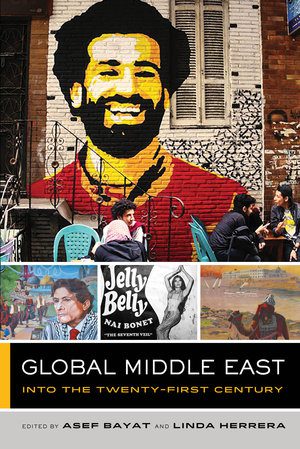
About the Book Global Middle East
Postcolonial Literature Beyond the Nation-State
Postcolonial literature often questions the borders inherited from empire: who drew them, whose interests they serve, and whether they reflect the lives of people who move across them. In “On Nations without Borders,” cultural critic Hamid Dabashi argues that countries and regions have never developed in isolation. People, languages, stories, commodities, and political ideas travel—often along routes that exceed the modern nation-state.
Dabashi develops this argument in Global Middle East: Into the Twenty-First Century, edited by Asef Bayat and Linda Herrera. His chapter moves from the formation of postcolonial nation-states to the transnational journeys of Zoroaster, Mozart, Nietzsche, and Puerto Rican author Giannina Braschi. At its center is a striking literary question: how did the ancient Persian prophet Zarathustra become a character in a post-9/11 novel about Puerto Rico and the United States?
[Image: Postcolonial literature beyond the nation-state]
Hamid Dabashi on Nations without Borders
Modern maps present nations as discrete territories separated by fixed lines. Dabashi asks how closely those boundaries correspond to the lived experience of people on either side of them.
Many contemporary nation-states emerged from the collapse of empires and the division of colonial territories. Yet the borders imposed during those processes did not contain the historical, linguistic, religious, and cultural relationships that preceded them. Iran, Afghanistan, India, and Iraq, for example, may occupy separate spaces on a political map, but their histories cannot be understood as hermetically sealed national narratives.
Dabashi describes postcolonial borders as porous rather than absolute. Nations shape the world beyond their frontiers, just as intellectual, economic, and political forces from elsewhere continually reshape them. The nation-state may organize citizenship and political power, but it cannot fully contain culture or historical memory.
This argument places Dabashi’s chapter within a central conversation in postcolonial literature: the tension between national liberation and the borders, institutions, and identities inherited from colonial rule.
How Stories and Ideas Cross Borders
Dabashi illustrates this movement through the global afterlife of Zoroaster, also known as Zarathustra. Originating in ancient Persia, the prophet became a literary and philosophical figure far beyond the historical setting of Zoroastrianism.
Zoroaster moved through Greek and Roman accounts, European Orientalism, opera, philosophy, translation, and modern literature. Mozart’s The Magic Flute invokes a fictionalized ancient world of wisdom and initiation. Friedrich Nietzsche transforms Zarathustra into the prophetic speaker of Thus Spoke Zarathustra. Walter Kaufmann’s influential English translation then helped carry Nietzsche’s figure into twentieth-century intellectual life in North America.
This is not a simple line of influence. Each cultural appearance remakes the figure for a new language, historical moment, and political purpose. Zarathustra no longer belongs exclusively to one nation or tradition. He becomes what Dabashi calls a global metaphor.
Zarathustra in United States of Banana
The journey continues in Giannina Braschi’s United States of Banana, a postcolonial novel set in New York after September 11, 2001. Braschi brings Nietzsche’s Zarathustra together with Shakespeare’s Hamlet and Giannina, the author’s fictional persona.
The trio travels to the Statue of Liberty to free Segismundo, the imprisoned prince from Pedro Calderón de la Barca’s Spanish Golden Age drama Life Is a Dream. In Braschi’s reinvention, Segismundo becomes an allegorical Puerto Rican prisoner held beneath the Statue of Liberty by his father, the king of the United States of Banana.
The multinational cast is essential to the novel’s political imagination:
- Zarathustra carries an ancient Persian figure through German philosophy and English translation.
- Hamlet brings Shakespearean tragedy into a Caribbean political comedy.
- Segismundo moves from seventeenth-century Spanish theater into an allegory of Puerto Rico’s colonial captivity.
- Giannina speaks from Puerto Rico and New York while crossing between author, narrator, character, poet, and revolutionary.
Their mission turns literary history into a jailbreak. Freeing Segismundo means confronting Puerto Rico’s political status, US imperial power, citizenship, immigration, incarceration, capitalism, and the meaning of liberation itself.
Dabashi calls United States of Banana one of the most brilliant postcolonial works produced in the aftermath of 9/11. What interests him is not merely Braschi’s use of Nietzsche. It is the way her novel gathers characters from different eras, nations, languages, and literary traditions to address a contemporary colonial predicament.
Allegories Travel
“Allegories travel. They don’t stay home.”
This concise statement contains the central argument of Dabashi’s chapter. Literary figures are not confined to the cultures that first produced them. They cross borders, enter new languages, acquire different meanings, and return in unexpected forms.
Zarathustra’s presence in a Puerto Rican novel is therefore not an anomaly requiring special permission or explanation. Dabashi reverses the question: why should such a figure not appear there?
The circulation of Zarathustra also complicates the conventional distinction between Europe and the non-European world. The Persian prophet enters European thought, becomes associated with Nietzsche, travels through English translation, and reappears in Braschi’s Caribbean and North American critique of empire. What may appear to be a European philosophical inheritance is already the product of crossings, translations, appropriations, and reinventions.
United States of Banana makes that movement visible. Its literary characters behave like migrants: they leave their original texts, cross cultural frontiers, form new alliances, and assume new political identities.
Postcolonial Literature and the Limits of Nation
Postcolonial literature has frequently been organized by national categories: Indian literature, Nigerian literature, Palestinian literature, Puerto Rican literature. Such classifications remain historically and politically meaningful, particularly when colonialism has denied a people sovereignty or attempted to suppress its culture.
But national categories alone cannot account for how literature is created or circulated. Writers work across languages, inherit forms from multiple traditions, live in diasporas, and address political conditions that cross borders. Colonialism itself was transnational; so were the anticolonial movements that opposed it.
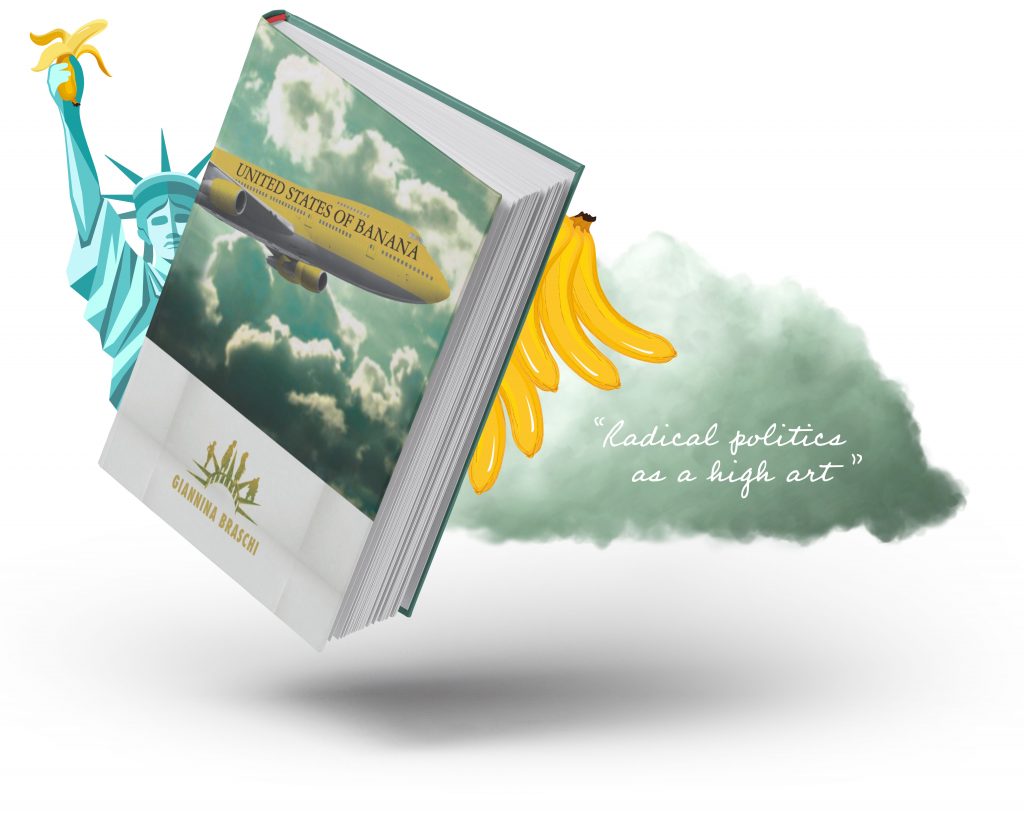
Braschi’s novel is firmly concerned with Puerto Rico’s colonial relationship to the United States, but it is not bounded by either Puerto Rican or US national literature. Its references move through ancient Persia, Greece, England, Germany, Spain, Latin America, the Caribbean, and post-9/11 New York. Its form moves among fiction, poetry, theater, political manifesto, philosophy, and satire.
This does not erase the nation. Instead, it shows how national and colonial questions are produced within wider movements of power, capital, language, and culture.
Readers interested in the work’s treatment of freedom, sovereignty, and coloniality can also consult Postcolonial Political Philosophy. That guide considers Braschi alongside a broader field of postcolonial and decolonial thinkers. Dabashi’s chapter offers a more specific lens: the movement of allegories and ideas beyond national borders.
From Postcolonial Novel to Graphic Narrative
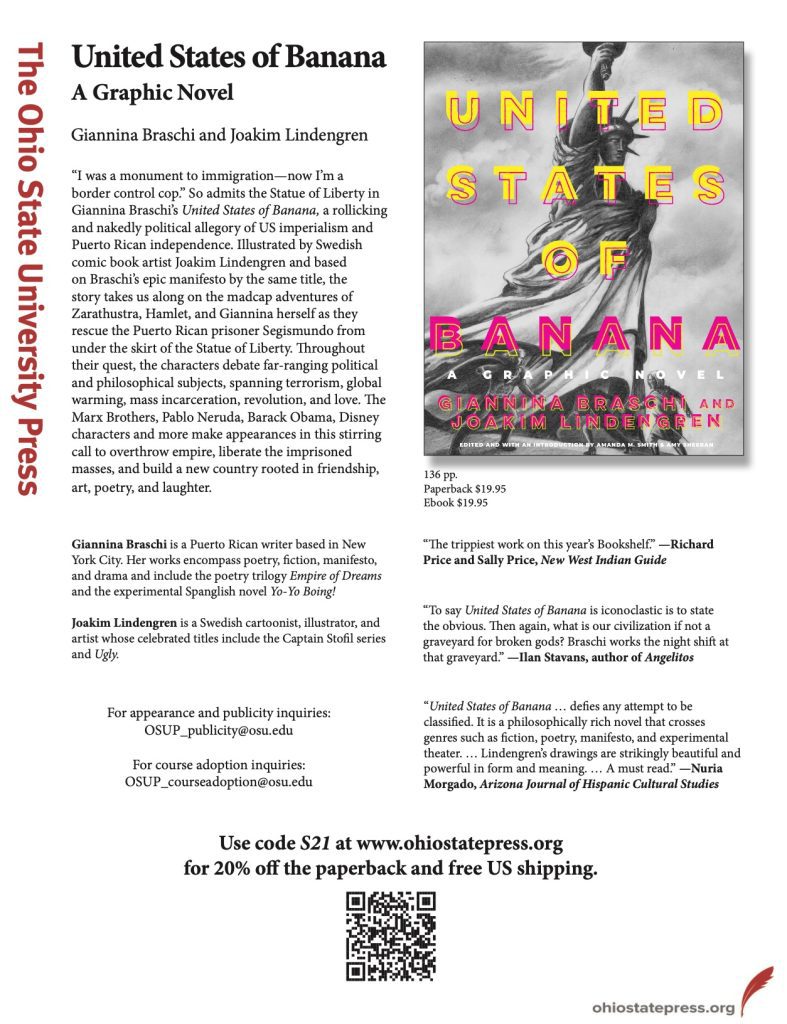
The transnational life of United States of Banana continued when Swedish cartoonist Joakim Lindengren adapted the work into a graphic novel. Originally published in Swedish in 2017, the English-language edition appeared in 2021 with an introduction and teaching guide by Amanda M. Smith and Amy Sheeran.
The adaptation carries Braschi’s characters into another language, country, and artistic medium. Lindengren translates literary parody into visual quotation, drawing on comics, painting, political imagery, film, and popular culture. The project embodies Dabashi’s argument: stories do not remain inside their original national, linguistic, or generic borders.
Teachers and scholars can explore the adaptation through Teaching Latinx Comics Studies and United States of Banana, a classroom guide to postcolonialism, migration, citizenship, visual narrative, and Latinx comics.
About Global Middle East
Global Middle East: Into the Twenty-First Century, edited by Asef Bayat and Linda Herrera, was published by the University of California Press in 2021. Its short interdisciplinary essays examine the Middle East through the global circulation of people, ideas, cultural forms, natural resources, technologies, and political movements.
The collection includes chapters on religion, science, Rumi, exile, food, film, music, fashion, oil, water, migration, Palestine, human rights, revolution, and cosmopolitanism. Rather than treating the Middle East as an isolated or self-contained region, the volume considers what enters the region from elsewhere and what moves outward from it.
Hamid Dabashi is the Hagop Kevorkian Professor of Iranian Studies and Comparative Literature at Columbia University. His chapter “On Nations without Borders” appears in Part Two of the collection.
Further Reading
- Teaching Latinx Comics Studies and United States of Banana.
- Asef Bayat and Linda Herrera, eds., Global Middle East: Into the Twenty-First Century (University of California Press, 2021).
- Hamid Dabashi, “On Nations without Borders,” in Global Middle East: Into the Twenty-First Century.
- Giannina Braschi, United States of Banana (AmazonCrossing, 2011).
- Florencia E. Mallon, “Pathways to Postcolonial Nationhood: The Democratization of Difference in Contemporary Latin America”, in Postcolonial Studies and Beyond.
- Postcolonial Political Philosophy: Freedom, Sovereignty, and Coloniality.
By the editors | Last reviewed August 2026