
The Ancient & Early Modern Roots: From Ceramics to Master Prints and Abstract Paintings Today
Nearly 2,500 Years of Translating Sophoclean Tragedy into Visual Form
Ever since Sophocles first staged Antigone in 441 BCE, each generation has relied on fresh translations and poems to reframe Antigone for its own era. Across twenty-five centuries—from ancient Greek ceramics and 19th-century history paintings to Mark Rothko’s abstractions and Alexandra Grant’s canvases paired with Giannina Braschi’s poetry—visual artists have drawn on these evolving texts to transform dramatic dialogue and moral debate into paint. This informal guide shares a few highlights of Antigone’s legacy though the visual arts and suggests key academic resources for deeper dives into learning more.
Ancient & Early Modern Roots: From Ceramics to Master Prints
Ancient Greek Red-Figure Ceramics (c. 360–340 BCE)
The earliest well-documented visual representations of the narrative appear on ancient South Italian pottery. The Antigone Krater (attributed to the Asthas or Dolon Group, now housed in the Berlin Antikensammlung) directly depicts scenes from theatrical performances of the tragedy: Antigone brought in chains before King Creon by guards after performing the forbidden burial rites for Polynices.
Renaissance & Baroque Engravings (16th–17th Century)
While Renaissance easel painters focused heavily on Ovidian mythologies, Sophocles’ play gained renewed traction through theatrical revivals and illustrated literature. Artists like Leonard Gaultier (Antigone, 1615) and Claude Vignon (Antigone Arrested by Creon’s Guards, 1640) created detailed line engravings and frontispieces for dramatic texts, establishing the visual iconography of her arrest and stoic resolve.
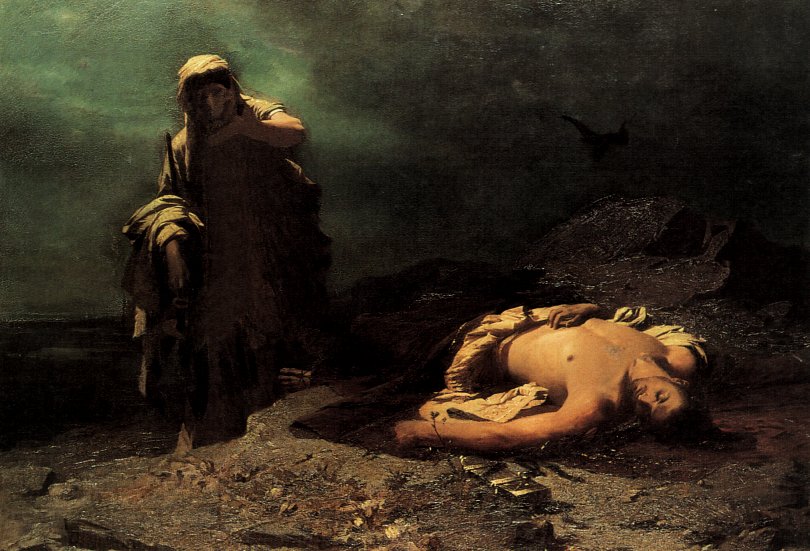
18th & 19th-Century Realism: Sophocles on the Academic Canvas
The French Revolution and the rise of 18th-century Neoclassicism transformed Antigone into a powerful political emblem. Academic painters turned directly to Sophocles’ written drama, selecting precise narrative beats to explore themes of civil resistance against tyrannical state power.
- Michel Lambert, Antigone imploring Oedipus (1795): Exhibited at the Paris Salon during the fallout of the French Revolution, Lambert’s Neoclassical canvas draws from Sophocles’ Oedipus at Colonus, capturing Antigone begging her father to lift his curse from Polynices.
- Nikiforos Lytras, Antigone in front of the dead Polynices (1865): Greek painter Nikiforos Lytras translates the climax of Sophocles’ opening acts: Antigone defying Creon’s royal decree under cover of darkness to cover her brother’s body with earth (pictured above).
- Charles Jalabert, Antigone Leading Oedipus (1842): Jalabert presents the literary archetype of filial devotion, depicting Antigone physically supporting her exiled, blinded father across barren terrain.
- Frederic Leighton, Antigone (1882): Victorian painter Lord Leighton captures the psychological weight of the protagonist as written by Sophocles, depicting her with quiet, tragic resolve before accepting her sentence of being buried alive.
Modernism: Mark Rothko’s WWII Mythmaking
By the mid-20th century, painters moved beyond illustrating narrative scenes, choosing instead to paint the emotional and philosophical atmosphere of the ancient text.
In Antigone (c. 1941), Mark Rothko used early biomorphic forms and layered register lines to process the global trauma of World War II. Influenced by Nietzsche’s writings on Greek tragedy and the original Sophoclean text, Rothko channeled the play’s themes of tyranny, sacrifice, and human suffering through psychological abstraction. Rothko used dismembered torso motifs and architectural divisions, treating the myth as a framework to address modern political catastrophe.
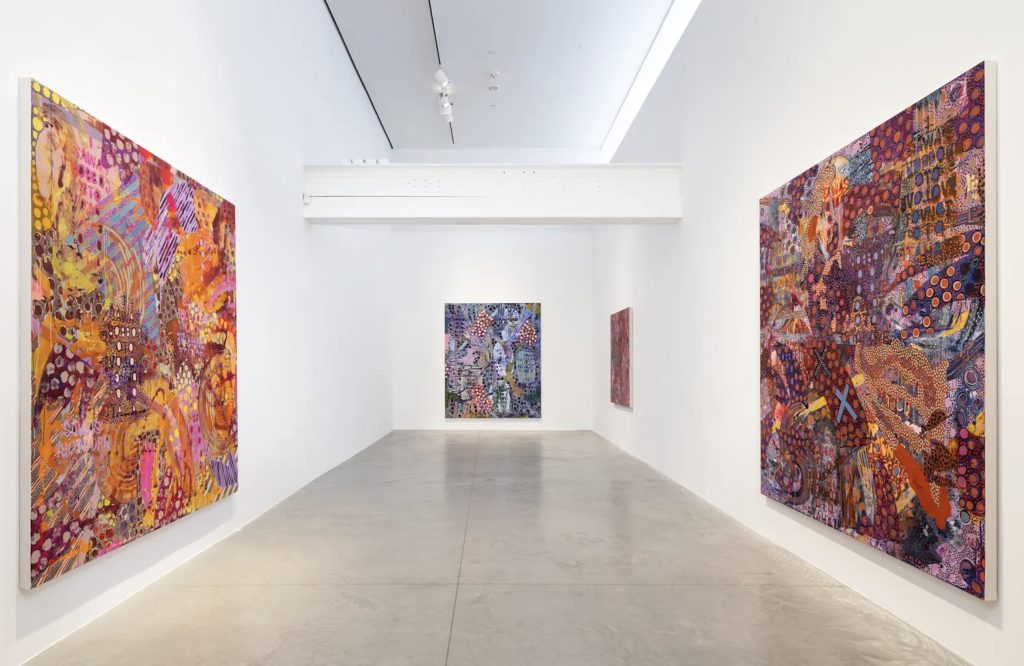
Contemporary Antigone: Canvas Scripts and Modern Poetry
The ongoing dialogue between text and paint reaches a Chelsea art gallery in the contemporary day, where abstract paintings and dramatic poetry enliven the myth for New York audiences.
As featured in ArtDaily, artist Alexandra Grant’s solo exhibition Antigone 3000 (Anakainōsis) at gallery albertz benda brings text straight onto the canvas. Rather than illustrating Sophocles from a distance, Grant physically screenprints, rubs, and squeegees the written script into her paint layers, repeatedly rendering Antigone’s core mantra: “I was born to love not to hate.”
The show’s subtitle, Anakainōsis, refers to a Greek term for renewal through the shedding of the past self—the idea that Antigone achieves immortality by being continually made new by each generation.
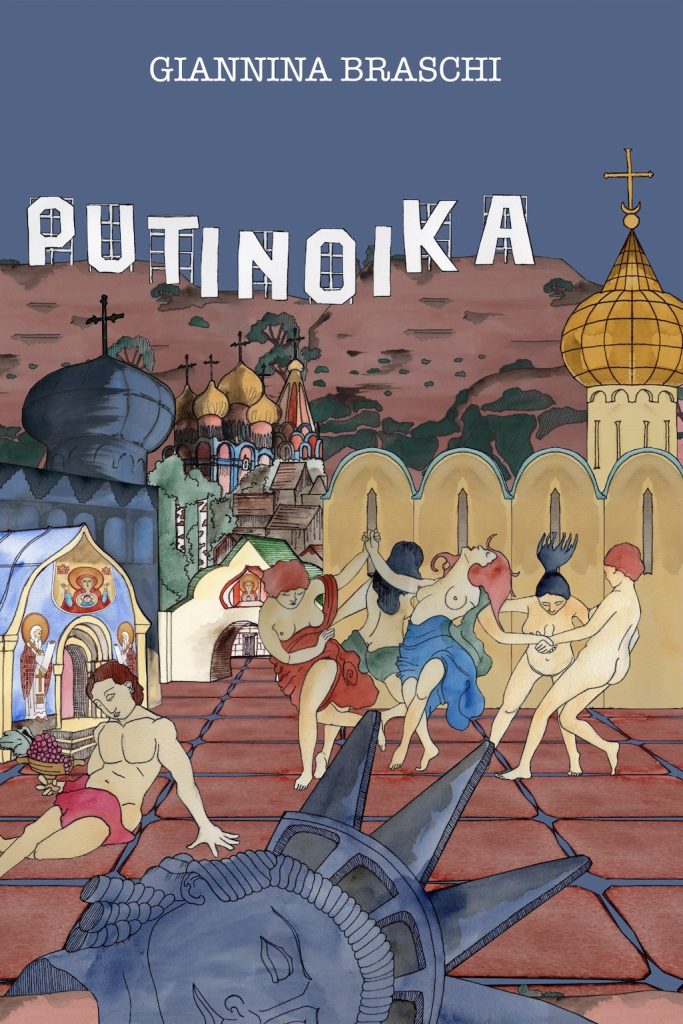
Highlighting this exact interplay between modern painting and experimental writing, the exhibition coverage in ArtDaily pairs Grant’s canvases with Puerto Rican author Giannina Braschi’s poem “Antigone” from her epic tragedy Putinoika (2024). Putinoika confronts the geopolitical turmoil, autocracy, and climate existentialism of the Putin and Trump era.
“It is the body politic persisting, insisting it has a body of work and muscles to train—and trains to catch—and it wants to rise in love—and raise humanity to a higher quality of itself—and it doesn’t want to leave us without a body of work to complete its masterpiece. Don’t even try to take Antigone from gone. Anti is the body of work that doesn’t want to leave everything unfinished before it is time to go away. And when gone comes to take anti away from body—body will manifest itself as a protest of antagonism—and contradiction—contrasting gone with the spirit of rain and wind—and flesh with earth and fire. Here, keep the torch alive!”
Key Literary & Poetic Adaptations
To understand how visual artists reinvent Antigone, one must also look to the lineage of poets and playwrights who have kept her script alive across centuries:
- Jean Anouilh, Antigone (1944): Written during the Nazi occupation of Paris, utilizing Antigone as an allegory for French Resistance.
- Bertolt Brecht, Antigone (1948): A post-WWII reinterpretation translating Hölderlin’s German text to confront fascism.
- Seamus Heaney, The Burial at Thebes (2004): A verse translation commissioning Sophocles’ language to critique state overreach and foreign intervention.
- Anne Carson, Antigonick (2012): A radical visual-poetic adaptation with hand-lettered text and illustrations by Bianca Stone; this version interrogates time, grief, and fate.
- Kamila Shamsie, Home Fire (2017): A modern novel reshaping the myth around British Muslim identity, state security, and family loyalty.
- Giannina Braschi, Putinoika (2024): An epic tragicomedy opening with a Palinode in which an ensemble of ancient Greek characters—including Oedipus, Electra, Clytemnestra, and Antigone—confront Trump era autocracy, pandemic, and political unrest.
The Endless Cycle of Text and Canvas
From 4th-century BCE ceramics and French Revolution canvases to Mark Rothko’s abstractions and Alexandra Grant’s text-infused paintings paired with Giannina Braschi’s poetry, artists continually translate Antigone‘s voice to confront modern tyranny. Through this constant reinterpretation, each generation keeps Antigone’s “torch alive.”
Chronological Index of Antigone Art Works
- c. 360–340 BCE — Asthas / Dolon Group (attributed): The Antigone Krater (South Italian Red-Figure Pelike/Krater)
- c. 1st Century BCE – 1st Century CE — Anonymous Roman Artist: Oedipus, Antigone, and Ismene (Delos / Pompeian Wall Fresco)
- 1615 — Leonard Gaultier: Antigone (Line Engraving Frontispiece)
- 1640 — Claude Vignon & Michel Lasne: Antigone Arrested by Creon’s Guards (Engraving)
- c. 1760–1761 — Anton Raphael Mengs: Oedipus before the Temple of the Furies between his Daughters Antigone and Ismene (Oil on canvas)
- 1793 — Michel Lambert: Oedipus before the Temple of the Eumenides, Held in Antigone’s Arms (Oil on canvas)
- 1795 — Michel Lambert: Antigone Imploring Oedipus to Lift His Curse from Polynices (Oil on canvas)
- c. 1795–1798 — François-Xavier Fabre: Oedipus at Colonus (Antigone and Oedipus) (Oil on canvas)
- c. 1795–1798 — Charles Thévenin: Oedipus and Antigone (Oil on canvas)
- c. 1800–1810 — Joseph Abel: Antigone Kneeling Next to the Body of Her Brother Polynices (Oil on canvas)
- 1802 — Fulchran-Jean Harriet: Oedipus at Colonus Supported by Antigone (Oil on canvas)
- 1842 — Charles Jalabert: Antigone Leading Oedipus (Oil on canvas)
- 1847 — Jules-Eugène Lenepveu: Antigone Giving Burial to Polynices (Oil on canvas)
- 1865 — Nikiforos Lytras: Antigone in Front of the Dead Polynices (Oil on canvas)
- c. 1868 — Benjamin Constant: Oedipus and Antigone (Oil on canvas)
- 1882 — Frederic Leighton (Lord Leighton): Antigone (Oil on canvas)
- 1884 — Marie-Joseph-Léon Clavel (Iwill): Antigone and Oedipus (Oil on canvas)
- 1922 — Pablo Picasso: Antigone (Illustrations for Jean Cocteau’s Antigone)
- c. 1941 — Mark Rothko: Antigone (Oil on canvas)
- c. 1960 — Max Ernst: Antigone / Oedipus Myth Series (Works on paper)
- 2014–2026 — Alexandra Grant: Antigone 3000 (Anakainōsis) (Mixed media, screenprint, and acrylic series)
Academic Resources & Further Reading
- Boardman, John. Athenian Red Figure Vases: The Classical Period. Thames & Hudson.Examines 4th-century BCE South Italian and Attic vase painting, documenting how theatrical performances of Greek tragedy were rendered on ancient ceramics.
- Karakantza, Efimia D. Antigone. Routledge (2024).Traces the post-classical receptions of Antigone across the arts, examining how her image transformed from 19th-century history painting to modern political and visual resistance.
- Söderbäck, Fanny (Ed.). Feminist Interpretations of Antigone. State University of New York Press (2010).Features scholarly essays on how visual artists, theorists, and writers reframe Antigone’s body and agency beyond traditional state narratives.
- Steiner, George. Antigones: How the Antigone Legend Has Endured in Western Literature, Art, and Thought. Yale University Press (1984).The seminal academic text exploring why Sophocles’ heroine became the primary cultural reference point for morality and politics across European art, drama, and philosophy.
- Wilmer, S. E., and Žukauskaitė, Audronė (Eds.). Interrogating Antigone in Postmodern Philosophy and Criticism. Oxford University Press (2010).Analyzes contemporary receptions of the myth, providing critical frameworks for text-based abstract art and performance art.
Related Readings
- Contemporary Bacchae Receptions
- Theater of War Productions – Antigone in Ferguson
- The Poetry Foundation – Giannina Braschi’s “Antigone” Excerpt
- PUTINOIKA by Giannina Braschi
- Latinx Philosophy & Postdramatic Theater
Editorial Note: This article was produced independently by the editorial team of the site. It was not written by Giannina Braschi.
Last updated: August 25, 2026