
American Book Review Putinoika
American Book Review Putinoka by Giannina Braschi
American Book Review 46:2
Reimagining Storytelling with Giannina Braschi
Frederick Luis Aldama interviews Giannina Braschi for American Book Review
EXCERPT
Giannina Braschi, born in San Juan, Puerto Rico, began her multifaceted journey as a fashion model, singer, and tennis champion. Her intellectual path took her across Europe, immersing herself in literature in Madrid, Florence, London, and Rouen, before earning a PhD from the State University of New York, Stony Brook. Giannina has taught at prestigious institutions such as Rutgers University, City University of New York, and Colgate University, while writing extensively on literary giants like Cervantes, Garcilaso, Machado, Bécquer, and Lorca. As an award-winning author, her genre-defying works have had a deep impact on the literary world with bold experimentation, cultural commentary, and innovative language.
An advocate for Puerto Rican independence, Giannina is an “Avant-Rican” author whose writing calls on readers to harness their collective creative power. She believes that through art, activism, and revolutionary discourse, individuals and communities can disrupt entrenched systems of inequality. This theme echoes through her groundbreaking works, including El imperio de los sueños/Empire of Dreams (1988), Yo-Yo Boing! (1998), United States of Banana (2011), United States of Banana: A Graphic Novel (2017), and her poetry collections Asalto al tiempoand La comedia profana.
Hailed as “one of the most innovative writers of our time” (CENTRO: Journal of the Center for Puerto Rican Studies), Giannina has received accolades from prestigious organizations like the National Endowment for the Arts, Ford Foundation, Danforth Scholarship, New York Foundation for the Arts, and PEN America. In 2021 she was awarded the Cambio16 Prize in Spain for her lifelong commitment to inspiring hope through literature. The following year, the North American Academy of the Spanish Language recognized her as “one of the most innovative voices in Hispanic letters” for her seamless fusion of scholarly rigor and creative brilliance.
In 2024 her hometown of San Juan honored her transformative impact on Puerto Rican culture, both locally and globally. That same year, Giannina received the Angela Y. Davis Award from the American Studies Association for her contributions to social justice, particularly her exploration of mass migration, incarceration, and the struggles of Puerto Rico.
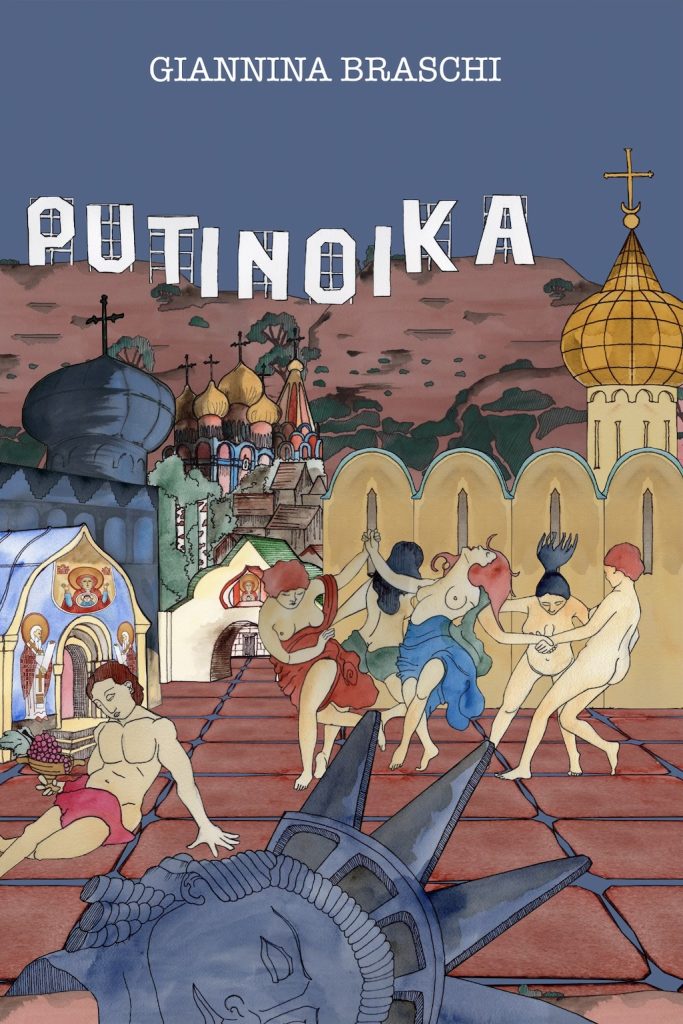
In her latest work, Putinoika (2024), Giannina shifts to a broader, fluid approach, creating a mystical experience through language, sound, and human connection. The book emphasizes creativity that challenges boundaries and evokes ancient wisdom, while advocating for new forms of expression. In Putinoika, orality represents a fluidity that contrasts with the rigid constraints of capitalist, patriarchal Western thought. Giannina calls for “soothsayers” over mere “storytellers,” urging a new kind of art that heals, reflects deeper truths, and is less tethered to commercial or economic concerns.
It was a privilege to learn from Giannina, whose work explores the power of creativity, orality, hope, and the larger cultural forces shaping art.
FREDERICK LUIS ALDAMA:
Giannina, your latest multigenre epic, Putinoika, which dropped this fall, pushes boundaries and innovates in ways that are truly groundbreaking. You aren’t shackled by the conventional constraints of what-is logic. With Putinoika, you invite audiences to explore the limitless creative possibilities of what-if thinking.
GIANNINA BRASCHI:
Exactly. In Palinode you see it right from the beginning. What if it was Agamemnon who killed the father of Oedipus? Suddenly, everything changes. Entire systems of tragedy shift, transforming the narrative into something entirely new. The beauty of this is that it frees the mind. What if Antigone doesn’t bury her brother? And what if Oedipus doesn’t marry his mother? What if the work is not about confirming fear but about liberating the mind from fear—and not making the fear come true? Fate news is fake news.
FLA:
How do you find your way to that place of boundless creativity when so much around us insists on thinking only in terms of what is?
GB:
When what is doesn’t work, we have to create possibilities that liberate us from the what is that doesn’t work. If what is is horrible. If what is is tragic. Hope is the key. It’s the beginning of we rather than I. I’m looking to “We, the chorus.” It’s about transforming myself through…
American Book Review
TABLE OF CONTENTS
Edited by Jeffrey R. Di LeoSpecial focus section: Failure
Guest edited by thom vernon
Volume 46, no. 2 (Summer 2025)
American Book Review
From the Editor
The Trouble with Experts
Jeffrey R. Di Leo
Focus: Failure
Introduction
thom vernon
Dancing on My Own
Lucas Crawford
Falling Short: Ben Lerner and Future Objects
Christian Moraru
Cara Saves the World: Digressions on Failure
Cara Benson
A Throw of the Dice
Dominique Hecq
Failure as Invitation, as Evocation
Daisy Hernández
Failing on the Margins
Sandra Ka Hon Chu
Star Trek, the Future, and Prison Abolition
Syrus Marcus Ware
On Some Uses of Architectural Failure
Vajdon Sohaili
Failure Gifts
Shannon Webb-Campbell
Interventions
Reimagining Storytelling with Giannina Braschi
Frederick Luis Aldama
History
Katlyn Marie Carter, Democracy in Darkness: Secrecy and Transparency in the Age of Revolutions
Bruce Krajewski
Fiction
Stacey Levine, Mice 1961
D. W. White
Bennett Sims, Other Minds and Other Stories
Bryan Counter
Meg Pokrass and Aimee Parkison, Disappearing Debutantes
Charles Franklin Quaas
Valerie Werder, Thieves
Gabrielle Stecher Woodward
Dan Libman, Book of Grudges
Jane Rosenberg LaForge
Tove Ditlevsen, The Copenhagen Trilogy: Childhood; Youth; Dependency
Richard Wirick
E-Feature
Love Poems for the Revolution, or How a Sonnet Turns for and against Itself
E. Ethelbert Miller
Cartographies
The Clouds Overhead, the Actual Soil, and the Map: On Hawthorne’s Literary Cartography
Robert T. Tally Jr.
Translation
Gulliver’s Travels, or Travels in Translation
Brian O’Keeffe
Poetry
Paul Celan, The Dark Oar, translated by Jaclyn Piudik
Paul Celan, Thricelandium, translated by Mark Goldstein
Frank Beck
Tina Barr, Pink Moon
Vanessa Loh
Patricia Brody, My Blazing World
Cori L. Gabbard
Ally Young, Nell
Alicia Elkort, A Map of Every Undoing
Kathryn Weld
Helen Tzagoloff, Rhythms
Ashley Mabbitt
Memoir
Summer Brenner, Dust
Lauren Keeley
Jennifer Clement, The Promised Party: Kahlo, Basquiat & Me
Jan Garden Castro
The Laureates
A Musician Who Writes Poetry: A Conversation with Marcus Amaker, the First Poet Laureate of Charleston, South Carolina
Renee H. Shea
Criticism
Latinx Poetics: Essays on the Art of Poetry, edited by Ruben Quesada
Naomi Ayala
Imani D. Owens, Turn the World Upside Down: Empire and Unruly Forms of Black Folk Culture in the U.S. and Caribbean
W. Lawrence Hogue
Theory
Leigh Claire La Berge, Marx for Cats: A Radical Bestiary
Amir Hussain
Essays
Sonya Huber, Love and Industry: A Midwestern Workbook
Paul Jaskunas
Maggie Nelson, Like Love: Essays and Conversations
Eric Bies
From Our Own
E. Ethelbert Miller, If God Created Baseball, When Your Wife Has Tommy John Surgery and Other Baseball Stories, and How I Found Love Behind the Catcher’s Mask
Paul Buhle
Scenes
Treyf Books: An Interview with Rob Kovitz
Poetics to Come
Sarah Arvio’s Poetics of the Daimon
Daniel T. O’Hara
The Departed
John Barth, missing the joke
Michael Joyce

ABR Interventions Editor
Frederick Luis Aldama
Born in Mexico to a Guatemalan- and Irish-American mamá from LA and a Mexican papá from Mexico City, raised mostly in north central California, I attended UC Berkeley (BA) and Stanford (PhD). Today I hold the Jacob & Frances Sanger Mossiker Chair in the Humanities at UT Austin where I’m also founder and director of the Latinx Pop Lab, BIPOC PoP, and editor of The Latinx Pop Magazine. As an award-winning author and editor, I’ve published dozens of books, including the Eisner-winning Latinx Superheroes in Mainstream Comics. Notable kid’s book titles include The Adventures of Chupacabra Charlie (published in English and Spanish) and the bilingual Con Papá / With Papá. I recently released Pyroclast, the YA graphic fictions Through Fences and Labyrinths Borne, and the YA novel The Absolutely (Almost) True Adventures of Max Rodriguez. I produce and co-create documentaries and animation shorts, including Carlitos Chupacabra, showcased at Cannes Animation Festival 2023. I’m honored to be inducted into prestigious organizations like the National Cartoonists Society, Texas Institute of Letters, and Ohio State University’s ODI Hall of Fame. Currently, I serve on various boards of directors, including The Academy of American Poets. Keep eyes peeled in 2025 for my Steampunkera Chronicles multiverse. Aldama coedited with Tess O’Dwyer the anthology Poets Philosophers Lovers: On the Writings of Giannina Braschi. (American Book Review Putinoika)
key words and tags: ABR Braschi, ABR Aldama, ABR Interventions, Book Review Putinoika, American Book Review Putinoika, American Book Review Putinoika interview, Interview with Giannina Braschi, interview with Rob Kovitz, John Barth, Frederick Luis Aldama interviews Giannina Braschi for American Book Review. Vol 46, no. 2, 2025 (American Book Review Putinoika) American Book Review Putinoika’s author Giannina Braschi, famous Puerto Ricans