
I have always kept my distance so it is inspirational to see the singular become a plurality.
Giannina Braschi on poetry, isolation, and the social distancing during the pandemic.
On Poetry, Isolation, and Social Distancing during the Covid-19 Pandemic.
[Archival Notes on poetry, isolation, and the pandemic: In the spring of 2020, during the initial onset of the COVID-19 pandemic and global shelter-in-place orders, the New York State Writers Institute in Albany reached out to celebrated Nuyorican poet, novelist, and philosopher Giannina Braschi to gather her reflections on social distancing, reading recommendations, and spiritual endurance. What follows is the original 2020 record, supplemented with retrospective context on her pandemic-era publications.]
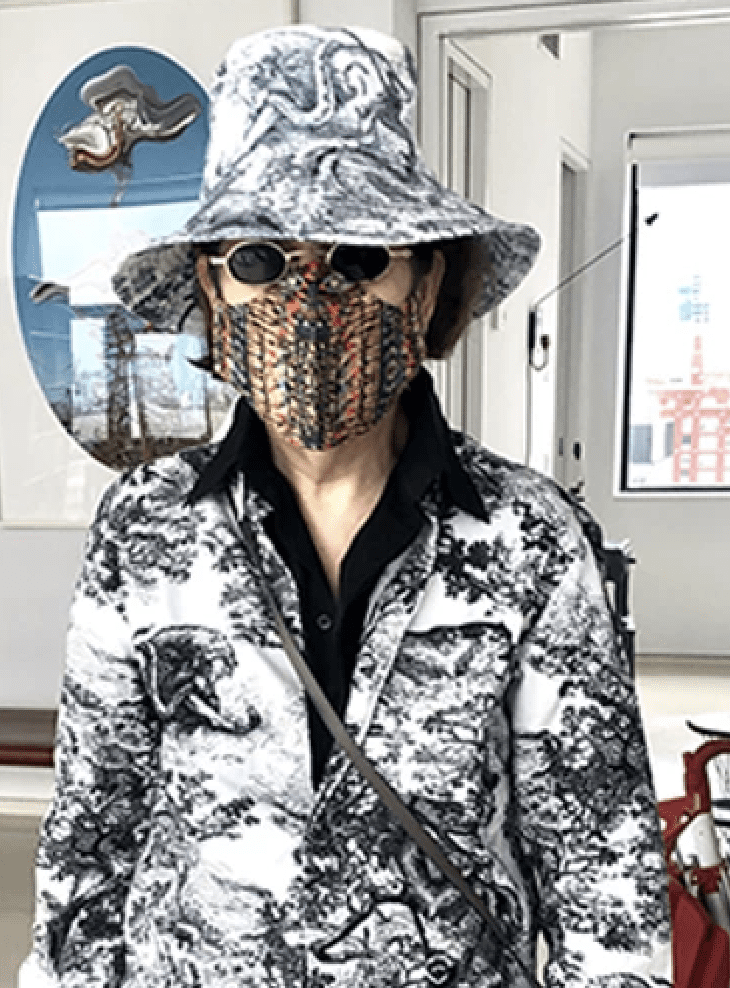
New York State Writers Institute Interviews Gianinna Braschi on Poetry, Isolation and Social Distancing

We caught up with Giannina Braschi, a celebrated figure of the Nuyorican (New York-Puerto Rican) poetry scene.
A pioneer of literary work in Spanglish—the fluid blending of Spanish and English employed by communities across North America—Giannina Braschi is the author of the postmodern classics El imperio de los sueños (Empire of Dreams), Yo-Yo Boing!, and United States of Banana.
Her cross-genre work has inspired adaptations across theater, photography, video, chamber music, graphic novels, and visual arts. Notably, New York designer Ian Stell crafted a convertible steel floor-lamp/chair named “Giannina” in homage to her literary hybrids and her passion for illumination devices and mechanical design.
Her body of work is the subject of the landmark scholarly collection Poets, Philosophers, Lovers: On the Writings of Giannina Braschi (edited by Frederick Luis Aldama and Tess O’Dwyer, University of Pittsburgh Press, 2020), featuring essays by fifteen scholars from seven countries exploring her structural and linguistic synthesis of poetry, theater, and political philosophy.
Poetry and the Pandemic: The 2020 Interview
New York State Writers Institute: Hi Giannina. Is there anything you’d like us to read as we shelter in?
Giannina Braschi: In these times when we can’t breathe, Breathing: Chaos and Poetry by Franco “Bifo” Berardi is inspirational. I’ve just ordered Immunodemocracy: Capitalist Asphyxia by Donatella Di Cesare and Irreversible Noise by Inigo Wilkins.
NYSWI: How do you cope with social distancing?
GB: I have always kept my distance so it is inspirational to see the singular become a plurality.
NYSWI: Any words of wisdom for us?
GB: Intuition is the positive energy that envy kills when it refuses to see the rainbow in the sky. For progress to happen — spiritual progress — intuition is the driving force that is not drawn back by any bad feeling — intuition renews itself — not knowing the whereabouts of progress nor questioning the origin of progress — letting it be as it is in its simplicity — it stays there — rocking its thoughts — and never letting them get old — because they are never guilty of anything — they never have to hide — or do shameless things — everything is in the open — and when you come out of the cave — it is always progress — when the obscurity is brought to tears of shame — left behind — because spiritual progress depends on escalating degrees of light — of running into the light — of shining with the light inside — of reflecting back what has shined — and dawning — giving birth to puppies of light.
NYSWI: May we share one of your poems?
GB:
What does winter or autumn or spring or summer know of memory?
Empire of Dreams
They know nothing of memory.
They know that seasons pass and return.
They know that they are seasons. That they are time.
And they know how to affirm themselves.
And they know how to impose themselves.
And they know how to maintain themselves.
What does autumn know of summer?
What sorrows do seasons have?
None hate. None love.
They pass.
Qué saben el invierno o el otoño o
El imperio de los sueños
la primavera o el verano del recuerdo.
No saben nada del recuerdo.
Saben que pasan y que vuelven.
Saben que son estaciones.
Saben que son el tiempo.
Y saben afirmarse.
Y saben imponerse.
Y saben sostenerse.
Qué sabe el otoño del verano.
Qué lamentaciones tienen las estaciones.
Ninguna odia. Ninguna ama.
Y pasan.
Retrospective Context: Putinoika & Pandemic-Era Publications
In hindsight, Braschi’s initial 2020 reflections on “spiritual progress,” “light,” and the transition from “the singular into a plurality” marked the conceptual origin of her post-lockdown epic tragicomedy PUTINOIKA and a period of significant scholarly evaluation across the Puerto Rican diaspora.
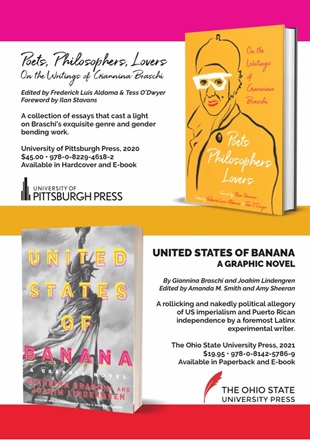
1. Poets, Philosophers, Lovers on the Writings of Giannina Braschi (2020): An Anthology of Scholarly Essays
Published during the height of the fall 2020 lockdowns, Poets, Philosophers, Lovers: On the Writings of Giannina Braschi (edited by Frederick Luis Aldama and Tess O’Dwyer; introduced by Ilan Stavans, University of Pittsburgh Press, October 2020) stands as the landmark scholarly collection on Braschi’s oeuvre. Gathering essays by fifteen scholars across seven countries, the book provided the academic framework for Braschi’s linguistic hybrids, political philosophy, and structural innovations across poetry and theater.
2. Putinoika (2024): The Pandemic Book on Plague and Frenzy
Written during the height of the COVID-19 pandemic and directly grappling with its atmosphere of frenzy, isolation, and asphyxia, Putinoika (Brown Ink/FlowerSong Press, 2024), PUTINOIKA is an epic tragicomedy by Giannina Braschi about frenzy and plague in the Trump and Putin era. Inspired by Greeks tragedies, PUTINOIKA insists that poets, philosophers, and lovers have the capacity to create on a scale greater than society’s capacity to destroy.
3. United States of Banana: A Graphic Novel (2021) on Late-Stage American Empire
In 2021, Ohio State University Press released United States of Banana: A Graphic Novel (adapted by Swedish cartoonist Joakim Lindengren), transforming Braschi’s post-9/11 political allegory into a striking visual medium during an era of global crisis and recovery. This tragicomedy dramatizes the culture and politics of the late-stage American empire.
4. Companion Diasporican Poetry of the Pandemic Era
To contextualize Putinoika within the broader movement of Nuyorican and Diasporican writers navigating the 2020–2022 period, key companion works include the following.
- Urayoán Noel – Transversal (2021): Explores digital performance, disaster capitalism, and migration between Puerto Rico and New York.
- Raquel Salas Rivera – x/ex/exis (2021) & antes que sea tarde (2022): Focuses on structural crisis, collective grief, and environmental memory.
- Vincent Toro – Tertulia (2020): Investigates communal dialogue and systemic crisis during periods of enforced isolation.
- Willie Perdomo – The Crazy Bunch (2019/2020): A retrospective reflection on community, memory, and street poetry in New York.
NYSWI History & Related Dialogues
Giannina Braschi previously visited the University at Albany in October 2012 as a featured panelist for Performing Voices of the Puerto Rican Diaspora. Held in conjunction with the 20th Anniversary Conference of the Puerto Rican Studies Association, the event was co-hosted by UAlbany’s Center for Latino, Latin American, and Caribbean Studies (CELAC) and the Department of Latin American, Caribbean, and U.S. Latino Studies, in partnership with the New York State Writers Institute.
The panel brought together prominent voices of the Diasporican literary movement, including Urayoán Noel, Magdalena Gómez, Lawrence La Fountain-Stokes, Jesús Papoleto Meléndez, and Edwin Torres, under the leadership of distinguished scholar Edna Acosta-Belén.

I