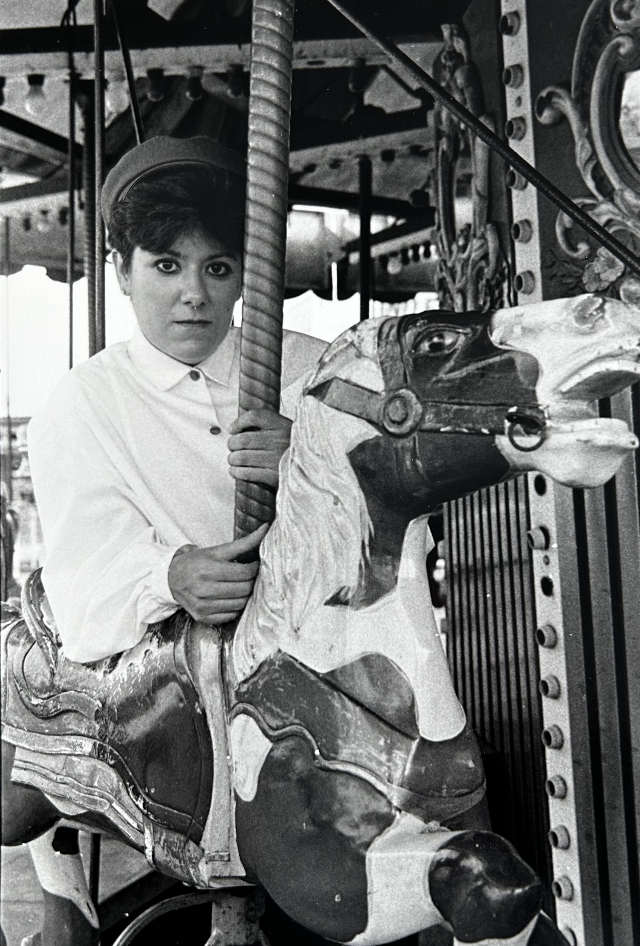
…Braschi’s writing is highly influential, yet notoriously unclassifiable. Her work blends elements of poetry, fiction, essay, theater, manifesto, tabloid, confession, and something unrecognizable that “could be considered music” (Kuebler 159). She flatly rejects the conventions of the third-person narrator in novels, the voiceover in film, and the objective voice of journalism. For Braschi, objectivity is a pretense used to disguise prejudice, bad taste, and a lack of imagination.
Rethinking the Latin American Literary Canon
“They think it’s all about storytelling. But I say it’s about geometry and architecture”, writes Braschi. ”We don’t need storytellers. We need soothsayers. I never said I am a storyteller. I said I am a soothsayer. I say the sooth” (PUTINOIKA).
By discarding conventional narrative as a passive escape, Braschi proposes a new literary architecture—one that speaks to the tone and exigencies of our time by igniting a radical confrontation with truth, futurity, and the reader’s own creative agency (Aldama, “Interventions” 64).
Braschi’s work has been widely adapted across a myriad of disciplines, including the art song cycle, post-dramatic theater, sculpture, photography, short film, and graphic novel, notably Joakim Lindengren’s United States of Banana (2021). Her “art is function” ethos has further catalyzed innovations in industrial design and architecture; a prominent example is Ian Stell’s Giannina chair, a kinetic hybrid that transforms from a chair into a lamp to exist purposefully between typologies. This conceptual framework also anchored the Harvard Graduate School of Design’s urban planning project Urbanismo Ecológico en América Latina [Ecological Urbanism in Latin America] (2019), which employed Braschi’s mixed-genre definitions to theorize the foundations of sustainable design (O’Dwyer 20). While many artists and makers find structural clarity in Braschi’s poetics, there is little consensus among literary critics as to which movement, style, or genre her writing belongs.
Eccentric, strange, bizarre, original, visionary, prophetic, revolutionary, and unclassifiable are the go-to adjectives applied to both Braschi and her lifework. However, in academic terms, Braschi is associated with a range of fields. These include stylistic movements such as postmodern literature and hysterical realism; linguistic and regional categories like Spanglish, McOndo, and Nuyorican poetry; theoretical frameworks spanning postcolonial theory, Latinx philosophy, and transnational studies; and genre-specific discourses on speculative fiction, experimental writing, and post-dramatic theater (Broncano 2023).
From Magical Realism to McOndo: Evolution of Post-Boom Aesthetics
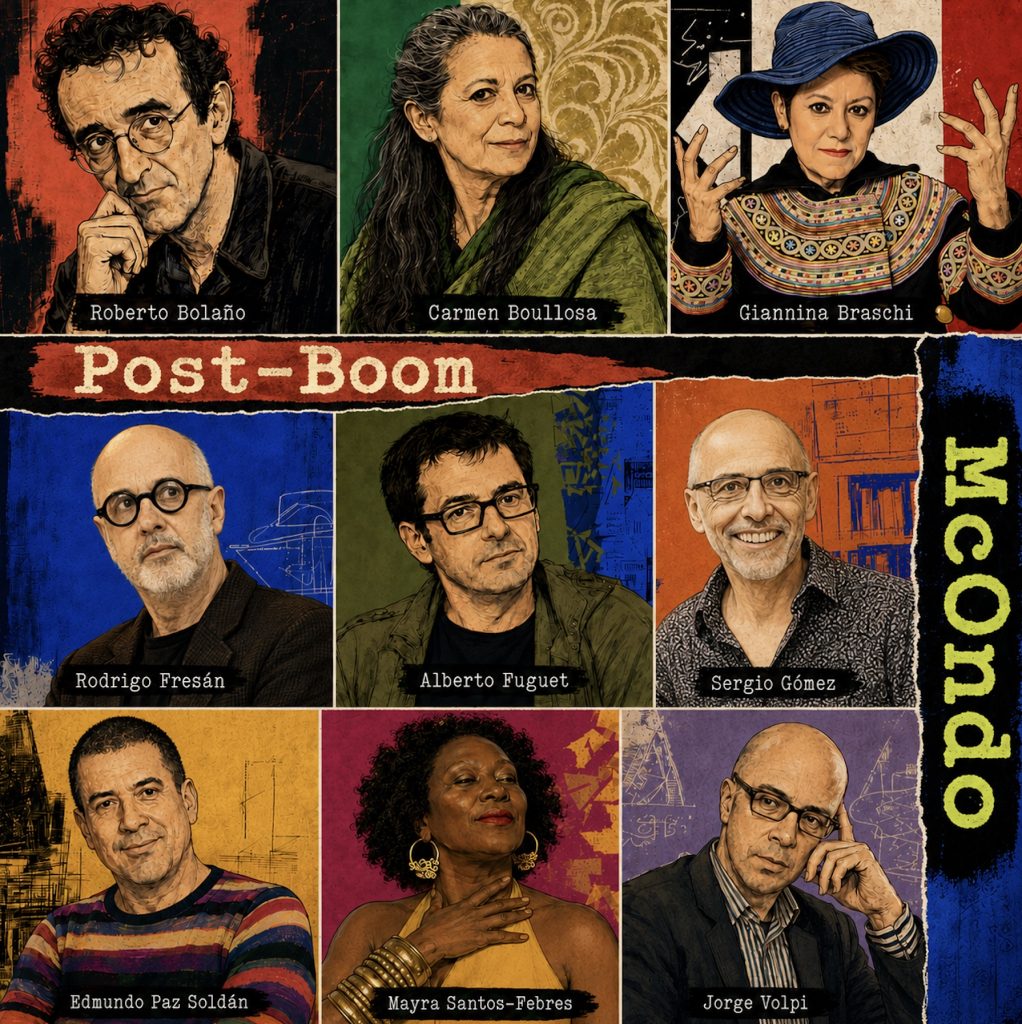
Braschi is frequently situated within the foundational Latin American canon alongside Nobel laureates Gabriela Mistral, Pablo Neruda, and Octavio Paz, yet she is equally categorized among the iconoclastic McOndo and Post-Boom novelists—including Alberto Fuguet, Sergio Gómez, Edmundo Paz Soldán, Roberto Bolaño, Luisa Valenzuela, and Diamela Eltit—whose collective project dismantled magical realism. Beyond this regional lens, scholars identify formal affinities between her work and postmodern maximalists such as Don DeLillo and David Foster Wallace, while placing her in dialogue with the radical experimentalism of Kathy Acker, Anne Carson, and Mark Z. Danielewski.
Rethinking the Latin American canon: Post Boom & McOndo Literature
Postcolonial Sovereignty in United States of Banana
United States of Banana is one of the most brilliant postcolonial works of fiction in the immediate aftermath of 9/11, savagely critical of the predatory capitalism and its ravages in Puerto Rico and around the globe.
Hamid Dabashi
This curricular versatility extends into postcolonial studies, in which critics evaluate United States of Banana alongside works by J. M. Coetzee, Maryse Condé, and Salman Rushdie to interrogate the weight of imperial legacies. Within Hispanic American literature, her translanguaging experimentation is often contrasted with the realist leanings of Sandra Cisneros and Junot Díaz, while her Spanglish ruptures are framed as structural manifestations of Gloria Anzaldúa’s Borderlands theories. In the realm of political philosophy, Braschi’s inquiries on sovereignty and liberty are seen to intersect with the discourses of Giorgio Agamben, Jacques Derrida, and Friedrich Nietzsche. Ultimately, whether situated on a syllabus alongside Dante’s epic poetry, Sophoclean tragedy, Margaret Atwood’s speculative fiction, or the Nuyorican verse of Pedro Pietri and Julia de Burgos, Braschi’s writing functions as a quintessential academic disruptor; its linguistic dynamism and prophetic imagination compel a rigorous rethinking of contemporary literary boundaries.
Hyperglossia and the Future of Experimental Writing
Consequently, critics often survey various schools of thought only to conclude—as the editor of Latin American Literature Todaydid in a dossier dedicated to her work—that Braschi, like all masters of such an unclassifiable style, “is all these things and none of them at once” (Rioseco 2023). Sergio Gutiérrez Negrón observes that Braschi’s reader—educated after the postmodern heyday—is often “at odds to explain what is happening, how it is allowed to happen, and why—despite all this—it works so well”, noting that one must simply “give in to the excess, to the vivacious audacity of the project, to the sense that something is at stake in every line, even—and especially—the funniest ones” (Negrón 2021). Synthesizing this vast stylistic range, Elidio La Torre Lagares concludes in his study of hyperglossia (excessive writing) that “Braschi is a literary genre in herself” (160).
Citation: O’Dwyer, Tess. “Giannina Braschi”. The Literary Encyclopedia. First published 19 March 2026 [https://www.litencyc.com/php/speople.php?rec=true&UID=13027, accessed 25 March 2026.]
Links to other sections of the article forthcoming here…
This blog post “Rethinking the Latin American Canon” features excepts from The Literary Encyclopedia’s article on Giannina Braschi’s life and works.