
Experimental Humanities: Teaching Giannina Braschi
Last reviewed August 2026
Experimental Humanities treats literature, philosophy, history, technology, performance, design, and the arts not only as objects of interpretation but as methods of inquiry. Students might translate a poem into sound, map the political geography of a novel, stage a philosophical dialogue, or build an archive. The premise is practical: reading leads to making, and making changes how we read.
Programs such as Harvard’s Digital and Experimental Humanities and NYU’s Experimental Humanities & Social Engagement demonstrate the field’s range, from experimental literary and media practices to interdisciplinary social engagement.
Why Teach Giannina Braschi?
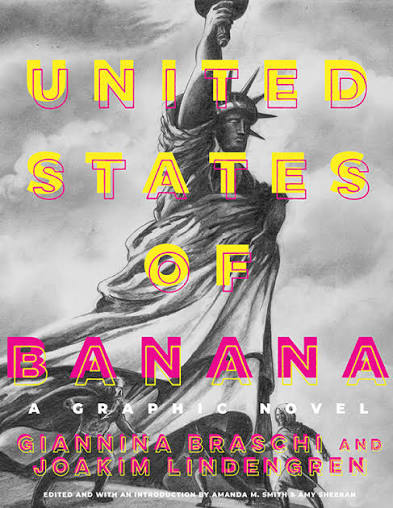
Giannina Braschi’s writing offers a strong model for this approach because it experiments simultaneously with language, genre, politics, voice, and form. Moving among Spanish, English, and Spanglish, her work combines poetry, fiction, theater, manifesto, musical structure, philosophical dialogue, and political satire.
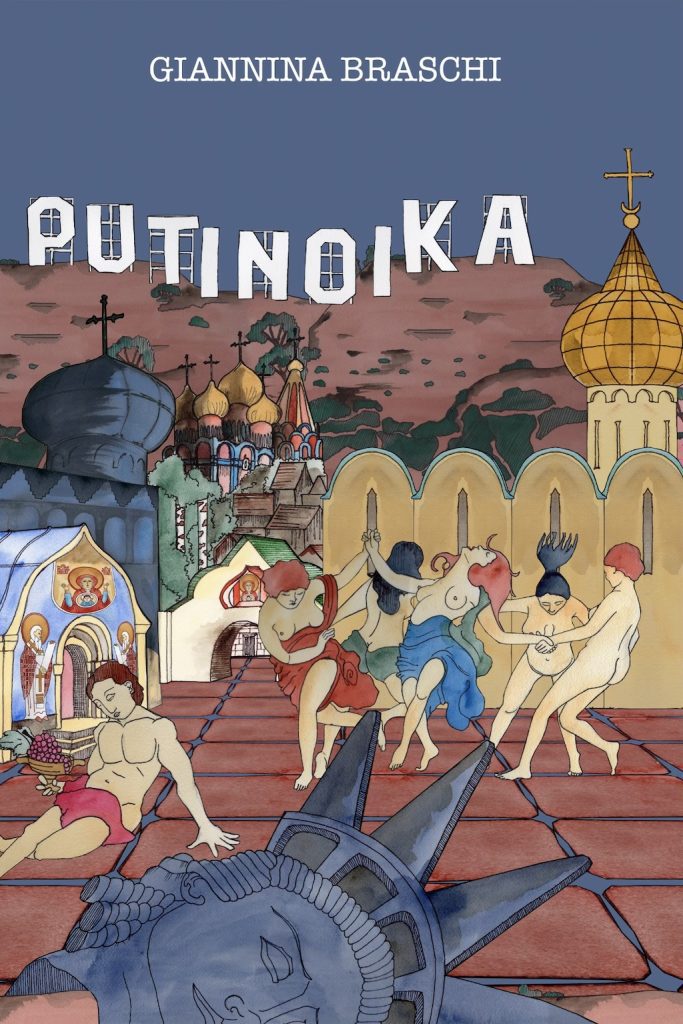
Empire of Dreams, Yo-Yo Boing!, United States of Banana, and Putinoika can anchor courses in Latinx and Puerto Rican studies, comparative literature, translation, philosophy, performance, media studies, urban studies, and theories of empire.
Braschi’s work also extends beyond the page. It has been adapted into or applied to theater, chamber music, graphic narrative, painting, photography, artists’ books, short films, industrial design, and urban-planning theory. These responses allow students to examine adaptation as critical interpretation: What does another medium discover, emphasize, or suppress?
United States of Banana: A Graphic Novel, created with Swedish cartoonist Joakim Lindengren, provides a particularly useful example. Edited and introduced by Amanda M. Smith and Amy Sheeran, the volume includes a teacher’s guide with discussion questions for classroom use.
Braschi at Bard
In November 2025, Bard College hosted “A Conversation with Giannina Braschi: Writing Beyond Dystopia” as part of its A Cartography for the Future series. Presented by Experimental Humanities, Spanish Studies, and Latin American and Iberian Studies, the event reflected the interdisciplinary reach of Braschi’s writing.
Professor Patricia López-Gay organized the conversation and used “writing beyond dystopia” as a framework for considering Braschi’s response to ecological, political, and digital crises. The event was framed around how storytelling might move beyond catastrophe and create new forms of connection, survival, and renewal.
The conversation suggests one model for teaching Braschi: Bard’s cross-program collaboration situates her work across disciplines, while López-Gay’s framework provides a focused approach to its movement across languages and forms.
The Bard event provides one point of departure. The following assignments and questions are proposed classroom applications; they were not part of the conversation.
Proposed Classroom Applications
1. Translate Form Across Media
Students select a passage and translate its governing formal principle—not simply its plot—into sound, photography, video, performance, collage, or design. A short reflection explains what the new medium revealed, transformed, or lost.
2. Write Beyond Dystopia
After examining how Braschi uses humor and genre collision to disrupt dystopian conventions, students create a short work that imagines political transformation without relying on standard apocalyptic narratives.
3. Build an Adaptation Archive
Students create a small digital exhibition connecting one Braschi text, one scholarly source, and one adaptation in another medium. A curatorial statement explains how the adaptation interprets, extends, or contests the original.
Suggested Questions for Discussion
- How do shifts among Spanish, English, and Spanglish redistribute authority between writer and reader?
- When does literature begin to operate as theater, music, philosophy, or political theory?
- What kinds of knowledge can fragmentation, contradiction, and genre collision produce?
- If a text generates new images, performances, objects, and theories, where does the work end?
Selected Reading: Experimental Literature/Experimental Humanities
- Aldama, Frederick Luis, and Tess O’Dwyer, editors. Poets, Philosophers, Lovers: On the Writings of Giannina Braschi. University of Pittsburgh Press, 2020.
- Braschi, Giannina, and Joakim Lindengren. United States of Banana: A Graphic Novel. Edited and with an introduction by Amanda M. Smith and Amy Sheeran. The Ohio State University Press, 2021.
- Bouma, Gerlof, Dana Dannélls, Dimitrios Kokkinakis, and Elena Volodina, editors. Huminfra Handbook: Empowering Digital and Experimental Humanities. Northern European Association for Language Technology, 2025.
- Kochhar-Lindgren, Kanta, editor. Transdisciplinary Experiments: Research, Teaching and Institutionalisation. Routledge, 2024.
- La Torre Lagares, Elidio. Hyperglossia and the Novel: The Production of (Non)Space. Routledge, 2025.
Editorial note
This summary is intended for educators and students. The information will be reviewed periodically as new books, scholarship, archival collections, and institutional histories become available.