
Boricua Humor upends Greek Tragedy: Giannina Braschi’s Putinoika
Giannina Braschi’s Putinoika is an audacious, genre-defying work of contemporary Puerto Rican literature. In it, Boricua humor upends Greek tragedy to interrogate the surrealities of the Trump and Putin era and the COVID-19 pandemic.
Below, we preserve the original Boricua.com announcement celebrating the book’s release in 2024, followed by recent critical insights from The Literary Encyclopedia on Putinoika’s growing impact.

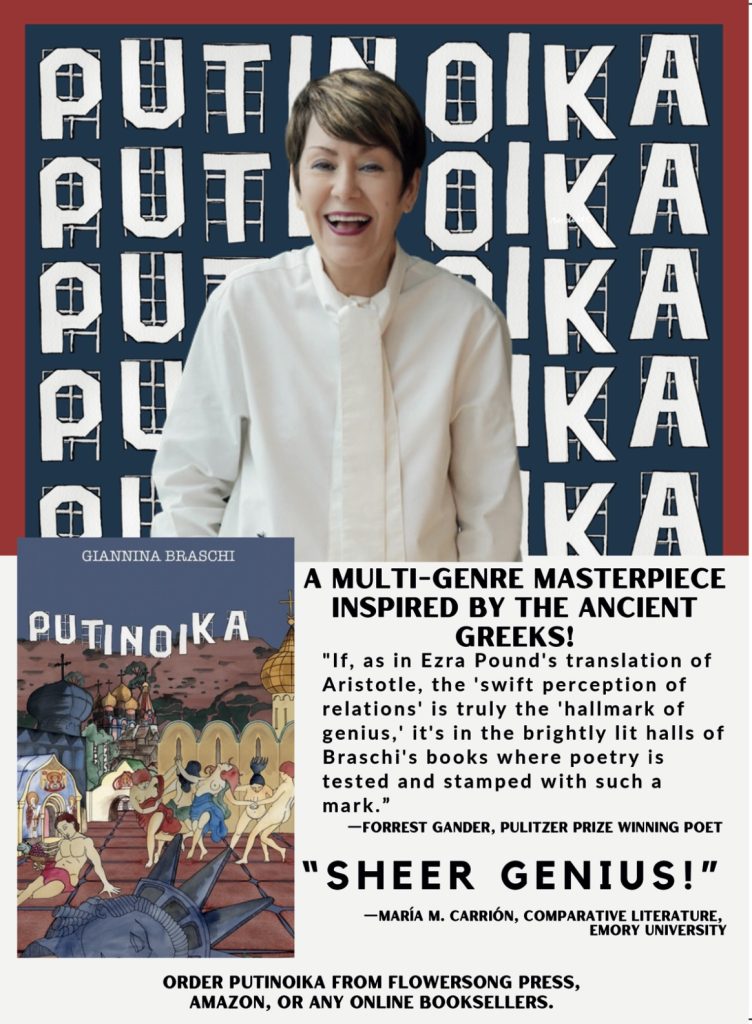
Boricua Giannina Braschi’s New Book Putinoika
Boricua author Giannina Braschi’s new book Putinoika is an epic tragicomedy of the Trump and Putin Era. Inspired by ancient Greek tragedies, Putinoika unfolds in three-parts: Palinode, Bacchae, and Putinoika. In a world flooding with collusion, delusion, and pollution, hope not only stands its ground in Putinoika, but it elevates us to higher realms with exhilarating new literary forms, poetic expressions, and a renewed faith in creativity. Putinoika insists that poets, philosophers, and lovers have the capacity to create on a scale greater than society’s capacity to destroy. If Waiting for Godot is a threnody of hope in the atomic age, Putinoika is the “Invictus” we didn’t know we were waiting for after the global pandemic.
Publisher: Brown Ink, a new imprint of FlowerSong Press, curated by Frederick Luis Aldama
Illustrators: Rosaura Rodríguez and Omar Banuchi of Días Cómic; Roi du Lac, Boricua authors new books.
ISBN-10: 1963245784
ISBN-13: 978-1963245783
Available through Amazon, FlowerSong Press, or any online bookseller.
“In Giannina Braschi’s churning imagination, in her exuberant, upwelling, hilarious and mortifying performances of wonderment, howl, synchronic time, ethical insistence, and linguistic swirl, it’s not unusual to find words such as ‘generosity’ and ‘spirit’ leading, in the same sentence, to ‘welfare,’ ‘radiation,’ and ‘tax deductions.’ If, as in Ezra Pound’s translation of Aristotle, the ‘swift perception of relations’ is truly the ‘hallmark of genius,’ it’s in the brightly lit halls of Braschi’s books where poetry is tested and stamped with such a mark. Like her character, Frenzy, she’s a provocateur who believes in and pledges her fidelity only to ‘everything that exists.’”—Forrest Gander, Pulitzer Prize-winning poet and Chancellor Emeritus of the Academy of American Poets
“Braschi’s most audacious and electrifying creation yet! This thrilling ride spans from classical Greece to front page news, where the supernatural dances with the mundane. Eccentric, hilarious, and profound, Putinoika is the rara avis of modern literature—a true original that shatters conventions and leaves an indelible mark on your soul. As Tony Kushner gives us Angels in America marking the AIDS epidemic and Perestroika, Braschi gives us Putinas in America amidst the global pandemic withPutinoika. Her fearless storytelling sweeps you off your feet.” —Nuria Morgado, Director, North American Academy of the Spanish Language
“A tour de force of philosophical poetry and poetical philosophy, offering a biting and hilarious denunciation of Trump’s America.” —Madelena Gonzalez, Chair, Anglophone Literature, University of Avignon

“This powerful, funny, profound, wise, crazed book is a wild ride. It is a bomb (a poem?, a novel?, a play?, fiction? essay?, comedy?, drama? all of the above?). It is a meditation on poetry, art, the pandemia, politics, Trump, his wall, the Putinas, the author, Puerto Rico, Oedipus, and Baudelaire. I laughed to tears here and there while the book displays one of the cruelest portraits of our times. Bravo!”
—Carmen Boullosa, award-winning novelist and playwright
Iconic Puerto Rican Author
Boricua Giannina Braschi writes poetry, fiction, and political philosophy in Spanish, Spanglish, and English. Her epic works include El imperio de los sueños (Empire of Dreams), Yo-Yo Boing!, United States of Banana, and Putinoika. The Library of Congress calls Braschi “cutting-edge, influential, and even revolutionary,” and PEN America recognizes her as “one of the most revolutionary voices in Latin America today.” Her lifework is the subject of the anthology Poets Philosophers Lovers: On the Writings of Ghttps://gianninabraschi.com/read-latinx-philosophers/iannina Braschi, edited by Frederick Luis Aldama and Tess O’Dwyer. Braschi has received awards and grants from the National Endowment for the Arts, New York Foundation for the Arts, Ford Foundation, Instituto de Cultura Puertorriqueña, and PEN America—as well as Lifetime Achievement honors from the North American Academy of the Spanish Language (ANLE), Cambio 16 news in Spain, and her native city of San Juan, Puerto Rico.
Terms frequently associated with Braschi include Postcolonial Literature, Latinx Philosophy, Postdramatic Theatre, McOndo, and Post-Boom. She goes simply by poet.
Literary Analysis & Reception of PUTINOIKA
Critical Commentary from The Literary Encyclopedia
In an entry on Giannina Braschi, The Literary Encyclopedia evaluates the broader scope and formal ambition of Putinoika:
“Inspired by ancient Greek tragedies, PUTINOIKA is a multi-genre epic about frenzy and plague in the era of Vladimir Putin and Donald Trump. Braschi takes Trump’s America head-on, interrogating its rule of White supremacy, its disdain for immigrants, its response to the COVID-19 pandemic, the loneliness epidemic, tech addictions, election fraud, fake news, and the 2021 January 6 insurrection. She portrays the frenzy of a society-in-crisis that suffers from delusion, punctuating the work with a clarion call for the creation of new genres.
The tripartite structure of PUTINOIKA—”Palinode”, “Bacchae”, and “Putinoika”—unleashes a symphony of voices against political and cultural rot. Through “excessive writing”, Braschi captures the frenzy of “unspeakable horrors”, bringing Bacchus, Oedipus, and Antigone into a Menippean circus alongside Putin, Trump (“Pendejo”), and icons like Maria Callas and Greta Thunberg. This energy is crystallized in comedic choral arrangements—the Muses of Bacchus, the Agents of Pendejo, and the Putinas of Putin—whose collective registers bridge ancient myth and modern theater. Braschi’s wit acts as a seismic force, dismantling the pomposity of tyrants through a visceral “anti-dystopian” lens. In this arena, hope wins. By pitting intellectual slapstick against high-stakes ruin, Braschi asserts loud and clear that our collective creativity is the only rival force to the state’s capacity for destruction.”
Beyond Putinoika: What to Read in Contemporary Puerto Rican Literature
The political frenzy and historical exorcisms of Putinoika belong to a vibrant line of contemporary Puerto Rican literature that confronts historical memory, displacement, and colonial precarity. For readers and scholars looking to dive deeper into Boricua literature, several essential curated folios and digital archives offer a direct window into this work.
Essential Collections & Recommended Reading
Big Other’s Puerto Rican Writers Folio: A Hauntology
Edited by John Madera for Big Other, this collection gathers fresh work by Giannina Braschi, Willie Perdomo, Caridad De La Luz, Ángel Lozada, and Edwin Torres—offering what Madera describes as a phantasmagoria that conjures historical ghosts to disturb the peace of the present.
“Contemporary Puerto Rican Poets To Read Right Now”
Published on Leyendo Lat Am (edited by Lauren Cocking), this comprehensive digital primer provides an invaluable guide to both island-based and diasporic poets—featuring writers like Mara Pastor, Raquel Salas Rivera, Ana Portnoy Brimmer, and Giannina Braschi.
Diasporic Journeys: Interviews with Puerto Rican Writers in the United States.
Edited by Carmen Haydée Rivera (CENTRO Press), this foundational interview collection gathers in-depth conversations with essential Puerto Rican writers—including Giannina Braschi, Lin-Manuel Miranda, Quiara Alegría Hudes, and Raquel Salas Rivera. The anthology explores how history, language merging, geographic dispersal, and cultural identity converge in contemporary Puerto Rican literature.