
The habits, the habitation, the routines give me security, and I need that security to make big leaps.
Giannina Braschi
What does a writing day look like for a famous Puerto Rican writer whose books move between Spanish, Spanglish and English, and between poetry, fiction, theater and philosophy? For Giannina Braschi, poet, novelist and author of the first Spanglish novel, the answer is not a schedule. She rocks from side to side, listens to music, and lets boredom acquaint her with herself. Routine, she says, is “the habit of the route.” Ritual is where poetry begins.
In this interview, the Puerto Rican writer ranges from the Spanglish of Yo-Yo Boing! to the September 11 displacement at the heart of United States of Banana. In a 2025 follow-up, she describes writing Putinoika during the pandemic. Exercising in a park woke parts of her body she hadn’t used in years, and new fragments of the book came with them.
Famous Writing Routines Interviews a Puerto Rican Poet
Famous Writing Routines studies how great books get written: the schedules, tools, habits and rituals behind them. Its interviews and profiles range from Ernest Hemingway, Stephen King and Gillian Flynn to Haruki Murakami, John Grisham and Margaret Atwood, and serve both first-time authors looking for a way in and established writers curious about how their peers work. In that company, Braschi offers something unusual: a writing routine that is less a timetable than a rocking chair, music and the patience to be bored until the poem arrives.
Giannina Braschi is a celebrated Puerto Rican poet and author whose work spans across genres and languages. She has been hailed by PEN America as “one of the most revolutionary voices” in Latin American literature today.
Braschi’s iconic titles include the poetry collection Empire of Dreams, the first Spanglish novel Yo-Yo Boing!, and the geopolitical tragicomedy United States of Banana, which explores themes of American immigration, economy, and colonialism. Her writing is a hybrid of poetry, fiction, theater, and Latinx philosophy.
Born in San Juan, Braschi pursued various interests in her teen years, including fashion modeling, singing, and tennis. She went on to study Hispanic literatures in Madrid, Rome, London, and Rouen before settling in New York City. With a Ph.D. in Hispanic Literatures from State University of New York, Stony Brook, she taught at Rutgers University, City University of New York, and Colgate University.
Famous Writing Routines Interviews Giannina Braschi
Your writing spans Spanish, Spanglish, and English, and includes poetry, novels, and scholarly publications. What motivates you to experiment with language and genre, and how do you approach these experiments?
As one of my characters says in Yo-Yo Boing!, “Poetry has been the useless art for too long. It’s been absent from life, history making, and the Daily News. It doesn’t matter how political it strives to be. To make a political statement is not to be politically alive. Poetry should jump out of the system like Tinguely’s machines out of good and bad, beauty and ugliness, right and wrong. Poetry is fun. Poetry hasn’t been fun for ages. It should give pleasure.
We’ve grown accustomed to unhappy poetry. My poetry is happy not to be sad. I steal pleasure from toys, movies, television, videos, machines, games—and put the fun back in function so the work runs like an engine that clinks and clanks, tingles and tangles, whirs and buzzes, grinds and creaks, whistles, and pops itself into a catabolic dämmerung of junk and scrap.”
Your book Yo-Yo Boing! is credited with being the first novel to be written in Spanglish. Can you talk a bit about your decision to write in Spanglish and what it means for your writing and for Latinx literature as a whole?
It’s giving voice to a new language, a language of the Americas. It’s giving way to a new genre. As I say in my new book Putinoika: “When you create a genre which is not a movement—because it has no past—and if it has a past—its past is pregnant with a future bigger than its past—its past is its post-creation—only a point of departure—it created modes of thinking. A genre has in itself movements, generations—and after all these concepts expire in time—the genre—that is an artifact—that is a fact made shift—it doesn’t belong to a date—it is not dated—it includes all the expirations that expire in its belly—and it is still pregnant with new beginnings. It allows transformations, revolutions—but in itself it is a discovery, an invention like the stars Galileo discovered and dedicated to Cosmo de Medici.”
Writing After 9/11: United States of Banana
United States of Banana is a cross-genre work that blends experimental theater, prose poems, short stories, jingles, and Latinx philosophy. What inspired you to blend these different genres together, and how did you approach writing in such a unique style?
I am attracted to the exceptional—what is extra—what gives gifts—generosity and light. The writing that goes overboard and over borders—and that is on the edge of breaking—and finds a light—and beams. The writing is not good but extra—because it has extra points, extra credit—and it goes higher and lower with charm—and love is essential—it is the driving force—but good writing is not good—it’s normal—and the norm is useless at this time.
The book dramatizes the global war on terror and narrates your displacement after the attacks from your home in the Battery Park neighborhood in New York City. What was your experience of living in New York City at the time of 9/11, and how did it shape your writing?
The events of 9/11 unsettled my being, and for the first time I felt American. I participated in the most important mythic event since the Horse of Troy. It marked the end of the 20th century and the beginning of the 21st.
As I said in United States of Banana, “I mourned—but not in a personal way—it was a cosmic mourning—something that I could not specify because I didn’t know any of the dead. I felt grief without knowing its origin. Maybe it was the grief of being an immigrant and of not having roots. Not being able to participate in the whole affair as a family member but as a foreigner, as a stranger—estranged in myself and confused.”
Your works have been noted for their cutting-edge, influential, and even revolutionary qualities. How have you developed your unique style over the course of your career?
In this era of surveillance where everything is shown, I’ll take a cue from Ovid who says: To live well is to live unseen. And he also says: it’s a perfect thing when the art can’t be seen. The unseen should remain unseen. There can be revelations in the final product. But what produces those revelations in the writing should remain unseen.
The Writing Routine of a Famous Puerto Rican Writer
Can you tell us about your writing routine? What does a typical day look like for you?
I rock from side to side. I can spend the whole day rocking. And there’s no limit. Hearing music. I am inhabiting my possibilities when I do this. My unlimited possibilities. Because there is no alarm clock to wake me up. Boredom can be good. Boredom acquaints me with myself. The habits, the habitation, the routines give me security, and I need that security to make big leaps.
Routines have to do with the route that one follows. The usual and profane path. Routines give us a sense of permanence. And protect us from the precariousness that surrounds us. Routine is the habit of the route. It is banal and has no personality. The ritual needs a ceremony and an initiation. From the rituals, the mysteries and the poetry are born. And so, the exceptional.
What does your current writing workspace look like?
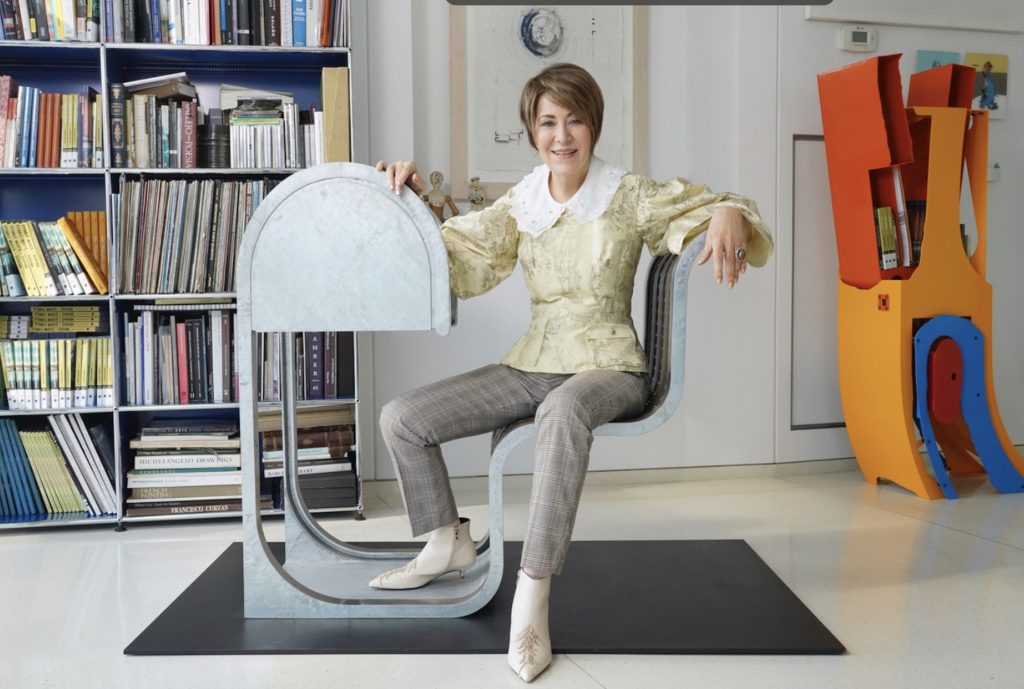
It looks like me.
This interview first appeared in Famous Writing Routines on April 16, 2023. Read the original.
More Interviews with the Puerto Rican Writer
- On Putinoika, shifting forms and collaboration (Famous Writing Routines, 2025)
- A Choral Response to Disaster: Mónica-Ramón Ríos interviews Braschi on Putinoika (Adi Magazine, August 19, 2025)
- Frederick Luis Aldama interviews Braschi (American Book Review)
Famous Puerto Rican Writers and Poets
- Famous Puerto Rican Writers: Puerto Rican literature beyond the island
- Puerto Rican Diaspora Writers: interviews from Diasporic Journeys
- Puerto Rican Poetry: from Julia de Burgos to today
- Nuyorican Women Leaders across American Life