
Teaching Puerto Rican Graphic Novels: United States of Banana
Teaching Puerto Rican Graphic Novels: United States of Banana
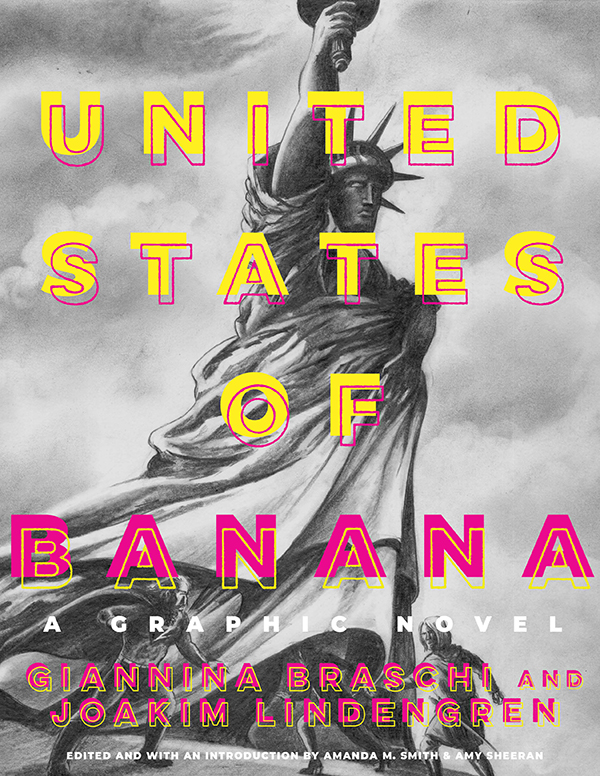
Puerto Rican graphic novels bring the island’s history, politics, visual culture, and literary traditions into the classroom. In United States of Banana: A Graphic Novel, Giannina Braschi and Joakim Lindengren turn U.S. imperialism and Puerto Rican independence into a wild visual allegory shaped by philosophy, art history, and popular culture.
Published in English by The Ohio State University Press in 2021, the graphic novel was edited by Amanda M. Smith and Amy Sheeran, who contributed the introduction, “United States of Banana: A Graphic Revolution,” and questions for classroom discussion.
The book adapts Braschi’s 2011 postmodern tragicomedy about the fall of the American empire and the liberation of Puerto Rico. Giannina, Hamlet, and Nietzsche’s Zarathustra travel to the Statue of Liberty to free Segismundo—the imprisoned prince of Pedro Calderón de la Barca’s Life Is a Dream. In Braschi’s allegory, Segismundo is also Puerto Rico, confined beneath the monument that claims to represent freedom.
Complimentary copies for instructors: THE Ohio State University Press provides a free desk copy of United States of Banana to instructors who adopt the book for a course with a minimum enrollment of ten students. See the publisher’s desk-copy requirements and request instructions.
An Entry Point for Every Reader
Amy Sheeran, a professor of Spanish at Otterbein University, sees the book’s collision of cultural references as an invitation rather than an obstacle.
“One of the things that I really love about this novel is that there is an entry point for everyone,” Sheeran told Otterbein University. “It’s a lot of collage and riffing and bringing things that seem unconnected, together.”
Some students may recognize Hamlet, Zarathustra, or Segismundo. Others may enter through commercial jingles, political caricature, movies, advertising, comic-book conventions, or familiar phrases. Readers do not need to identify every allusion before participating in the work.
“There are characters from different works of literature, a bunch of pop culture references, commercial jingles, everyday sayings,” Sheeran explained, “so I think there’s some way for everyone reading it to get into it, regardless if they have read Hamlet or works of philosophy.”
That observation offers teachers a way into a formally demanding book: begin with what students recognize. Ask which references they understood, which images unsettled or amused them, and what happened when distant cultural materials collided on the page. The goal is not to solve every allusion but to study how collage creates new meanings.
The graphic novel’s many voices also allow students to see connections across historical periods, languages, genres, and cultural traditions. Shakespeare encounters Nietzsche; Calderón meets the Statue of Liberty; Rubén Darío enters post-9/11 New York; European art history collides with advertising and American popular culture.
Connecting Teaching and Research
The English edition was conceived with the classroom in mind. Its introduction situates the adaptation historically and politically, while the discussion questions invite students to consider its literary sources, visual strategies, and central arguments.
“My co-editor conceived it specifically as something that would be useful in the classroom because we wanted to be able to connect teaching and research,” Sheeran said. “We have discussion questions in the back of the book to help us and other educators find ways to use it in their classrooms.”
That bridge between teaching and research makes United States of Banana useful in courses on:
- Latinx comics and graphic literature
- Puerto Rican and Caribbean studies
- American and comparative literature
- Postcolonial and decolonial studies
- Adaptation and intermediality
- Visual culture and political satire
Recommended levels: Advanced high school (grades 10–12), undergraduate, and graduate courses. High school instructors may wish to provide additional context on Puerto Rican political history, post-9/11 literature, and the book’s philosophical allusions.
Lindengren’s drawings do more than illustrate Braschi’s words. They interpret and extend them through art history, cinema, advertising, comics, and political iconography. The adaptation therefore allows students to ask what happens when a postmodern literary work moves into the comics form: what is condensed, added, exaggerated, contradicted, or made newly visible?
From Life Is a Dream to Puerto Rico’s Political Status
The book’s surreal comedy rests on a serious political structure. Segismundo’s imprisonment transforms Calderón’s captive prince into an allegorical figure for Puerto Rico and its unresolved political status.
The Statue of Liberty admits the contradiction:
“I was a monument to immigration—now I’m a border control cop.”
Freedom becomes a prison, and a national symbol becomes an agent of exclusion. The mission to liberate Segismundo raises questions about sovereignty, citizenship, migration, colonialism, and the authority to determine Puerto Rico’s future.
Sheeran hopes the book will lead students toward precisely this history: “the history and culture of Puerto Rico” and the role of the United States in defining the island’s “contested political status.”
Students can approach that condition through Braschi’s three comic formulations: “wishy,” “wishy-washy,” and “washy.” Lindengren represents the political options of independence, commonwealth, and statehood as three chicks. The visual joke makes an abstract debate memorable without resolving it. Instead, it asks who is permitted to choose among those futures—and whether the available choices are adequate.
Students might pair this sequence with research on the 1898 transfer of Puerto Rico to the United States, the Jones Act of 1917, commonwealth status, the independence movement, status plebiscites, migration, debt, or federal responses to Hurricanes Irma and María. They can then return to the graphic novel and consider how political history is compressed into allegory, caricature, and satire.
Reading Art and Pop Culture Politically
Lindengren reworks recognizable images from Goya, Dalí, Magritte, Munch, Escher, Hopper, and other artists. He also draws on movies, advertising, political figures, and comic-book imagery.
In “The Wedding of the Century,” published by Intervenxions at NYU’s Latinx Project in 2024, scholar and translator Thomas Rothe examines this meeting of literary and visual traditions. He identifies such transformations as The Last Supper staged inside Edward Hopper’s Nighthawks, Escher’s staircases winding through the Statue of Liberty, and Munch’s screaming figure trapped in a bottle of Liberty Cola.
These images do more than reward recognition. They make arguments about art, commerce, national mythology, imprisonment, and political power. A Liberty Cola bottle, for example, turns freedom into a branded commodity.
The graphic novel does not simply borrow canonical works. It relocates them inside a Puerto Rican and anti-imperial frame.
Classroom Approaches to United States of Banana
Trace a literary character
Follow Hamlet, Zarathustra, or Segismundo through the graphic novel. What remains of the original figure, and what changes when the character enters a Puerto Rican and post-9/11 political drama?
Analyze a visual allusion
Identify an artwork reimagined by Lindengren and compare the original image with its function in the graphic novel. How does the new setting change its meaning?
Map Puerto Rico’s political status
Use the “wishy,” “wishy-washy,” and “washy” chicks to begin a research project on independence, commonwealth, and statehood.
Study the Statue of Liberty
Track how the Statue shifts among monument, commodity, border authority, prison, and speaking character.
Compare the novel and graphic adaptation
Place a passage from Braschi’s 2011 book beside Lindengren’s graphic treatment. Identify what is removed, added, condensed, or made visible.
Follow popular culture into politics
Investigate how a commercial jingle, film image, political figure, or celebrity changes when it enters the book’s critique of empire.
Growing Scholarship on Latinx Comics
Sheeran’s 2021 classroom reflections anticipated questions that now occupy a growing field: how comics carry historical memory, how adaptation produces new political meanings, how multilingual and diasporic works unsettle national canons, and how graphic narratives represent colonial violence without surrendering humor or imaginative freedom.
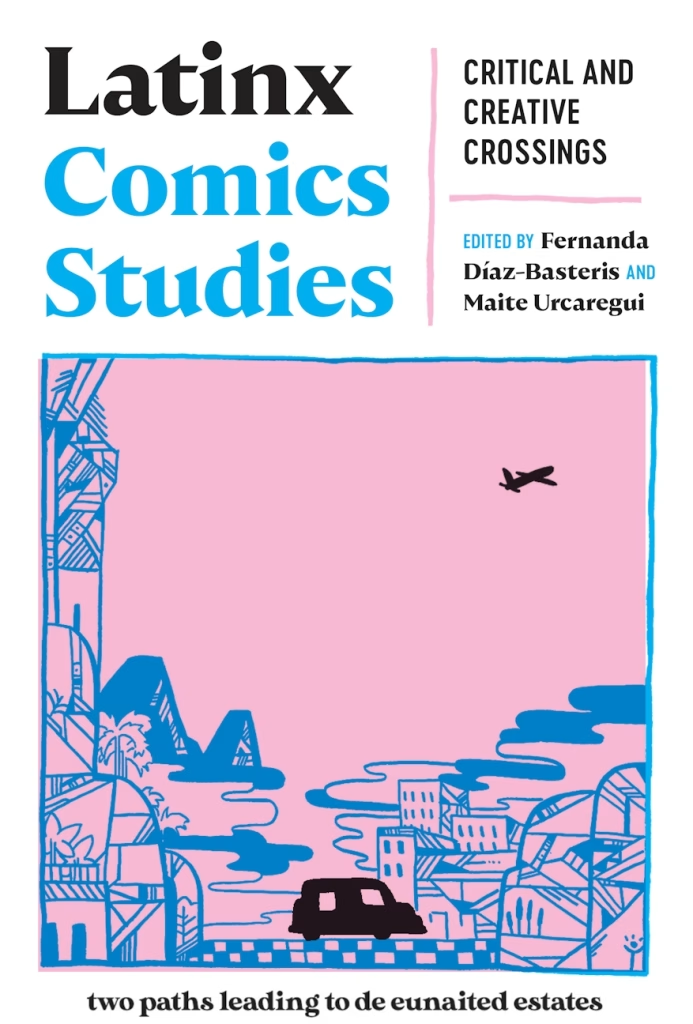
The 2025 anthology Latinx Comics Studies: Critical and Creative Crossings, edited by Fernanda Díaz-Basteris and Maite Urcaregui, brings together scholarship, pedagogy, and original comics. Its subjects include national memory, undocumented narratives, Indigenous and Afro-Latinx experiences, multilingual identities, colonial violence, queer and feminist interventions, and Latinx futurities.
Frederick Luis Aldama’s chapter, “United States of Banana: A Graphic Novel as Decluttering and Decolonizing Doubled Journey of the Self,” places Braschi and Lindengren’s collaboration directly within that expanding field. Rothe’s “The Wedding of the Century” approaches the work through art history, multilingualism, migration, intermediality, and transatlantic cultural exchange.
Together, these studies confirm what Sheeran recognized in the classroom: the book’s seemingly incongruous voices and images allow readers to build connections among literature, visual culture, history, and politics.
Scholarship and Research Resources
- Teach Latinx Comics Studies — A guide to the 2025 anthology, its chapter on United States of Banana, and major archives and research resources in the field.
- Latinx Comics Studies: Critical and Creative Crossings — Edited by Fernanda Díaz-Basteris and Maite Urcaregui; Rutgers University Press, 2025.
- “The Wedding of the Century” — Thomas Rothe’s 2024 review for Intervenxions at NYU’s Latinx Project.
- Latin American Comics Archive — Carnegie Mellon University’s digital collection of Spanish-language comics for teaching and research.
- Latinographix — The Ohio State University Press series devoted to Latinx graphic narratives.
- ¡Wepa! Puerto Ricans in the World of Comics — The New York Public Library’s exhibition and archival resource on Puerto Rican comics.
- Tales from la Vida: A Latinx Comics Anthology — Frederick Luis Aldama’s collection of work by more than eighty Latinx creators.
United States of Banana can be taught as adaptation, political allegory, post-9/11 literature, Puerto Rican graphic narrative, philosophical fiction, or visual satire. Its richest classroom possibilities emerge when those approaches are allowed to meet.
By the Editors | Last reviewed August 2026