
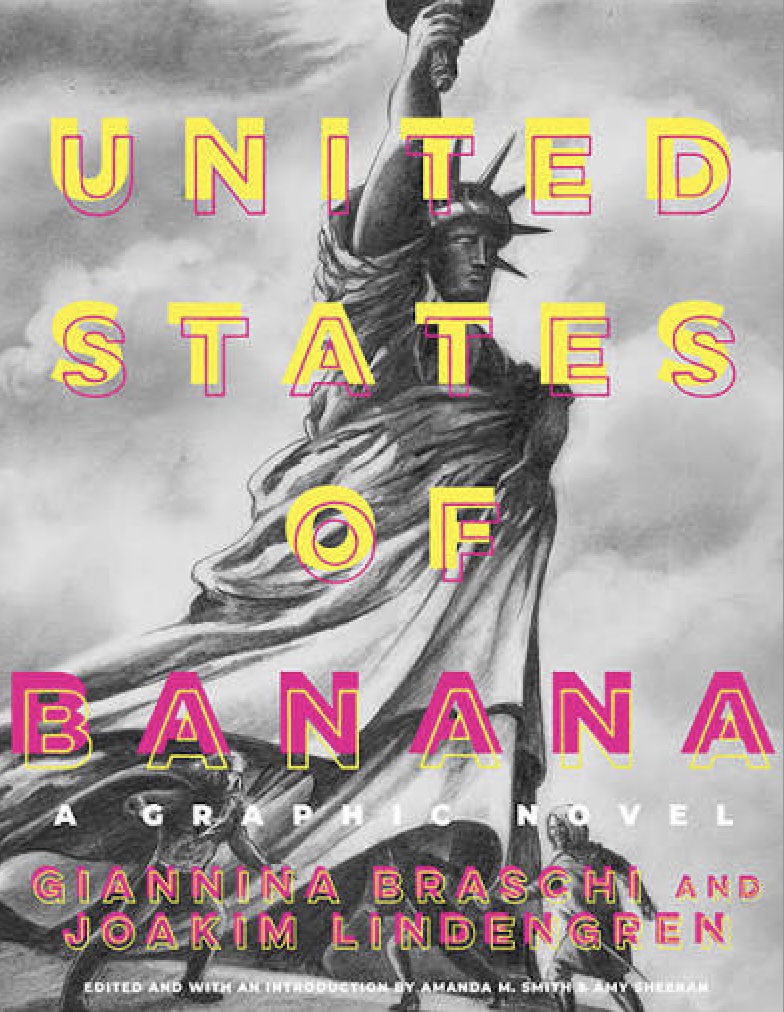
Puerto Rican comic books bring the island’s colonial history, political debates, visual culture, and literary traditions into graphic narrative. In United States of Banana: A Graphic Novel, Puerto Rican writer Giannina Braschi and Swedish cartoonist Joakim Lindengren transform questions of US imperialism, Puerto Rican independence, immigration, liberty, and revolution into visual satire.
Presented below is Nuria Morgado’s original review from the Arizona Journal of Hispanic Cultural Studies. Morgado examines how Lindengren’s images draw upon modern art, political caricature, advertising, and popular comics to extend Braschi’s postcolonial allegory.
The page concludes with classroom resources and further reading on Puerto Rican comic books, Boricua superheroes, Latinx comics, and Puerto Rican graphic novels.
United States of Banana: A Graphic Novel includes discussion questions for classroom use.
United States of Banana: A Declaration of Puerto Rican Independence
Arizona Journal of Hispanic Cultural Studies
Book Review by Nuria Morgado, PhD
United States of Banana
The Ohio State University Press, 2021
By Giannina Braschi and Joakim Lindengren
Edited by Amanda M. Smith and Amy Sheeran
Masterfully illustrated by the Swedish cartoonist Joakim Lindengren, and with a robust and solid introduction by editors Amanda M. Smith and Amy Sheeran, United States of Banana. A Graphic Novel (2021) (first published in Swedish in 2017 by Cobolt), is an adaptation of the postmodern allegorical novel United States of Banana (2011), masterfully written by Giannina Braschi, a Puerto Rican writer based in New York who defies any attempt to be classified.
We can argue that United States of Banana (USB) also defies any attempt to be classified. It is a philosophically rich novel that crosses genres such as fiction, poetry, manifesto, and experimental theater. It is a political allegory of US imperialism and Puerto Rican independence; the autobiographical character Giannina, along with Shakespeare’s Hamlet and Nietzsche’s Zarathustra, go in a mission to liberate Segismundo, another literary character from La vida es sueño (Life is a Dream) by Pedro Calderón de la Barca, who is imprisoned beneath the skirt of the Statue of Liberty. As a metaphor, liberating Segismundo would mean liberating Puerto Rico from the US.
Puerto Rican comics and graphic literature
USB is also described as a manifesto on democracy in a post-9/11 world, and as a declaration of personal independence. It touches on many topics, relevant not only in today’s world, but also in tomorrow’s world, since they engage with anything and everything that makes us human: feelings, thoughts, emotions, or behaviors when confronted with politics, language, immigration, love, friendship, terrorism, global warning, revolution.
Giannina Braschi understands the temperament of humanity. And nothing more human than the characters that navigate the worlds and underworlds of this novel since, in their quest for liberation, they meet and confront the insecurity and uncertainty found in our current precarious, unstable, dangerous, difficult world.
Using the interplay of Braschi’s philosophical, poetic prose and Lindengren’s captivating and thought-provoking drawings “with playful images worthy of the text’s ludic spirit” (xiv), this graphic novel helps to interpret the moral or political significance of the allegorical characters, places, or events of the text, and renews its relevance, especially after experiencing Trump’s presidency and the US response to the devastation of Hurricanes
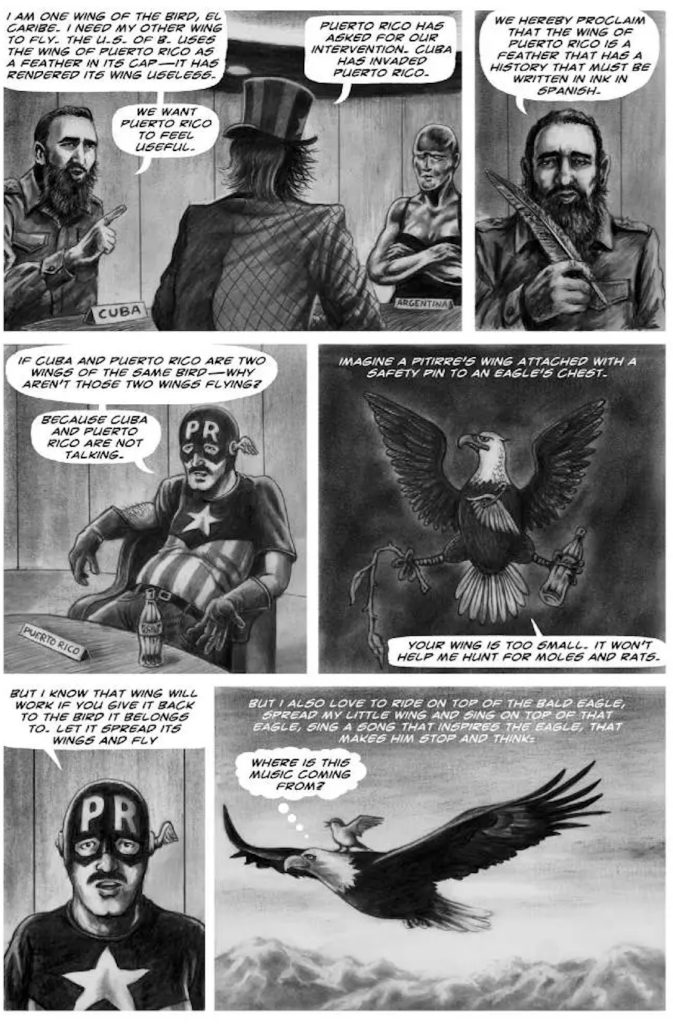
Irma and María in Puerto Rico in September 2017. USB’s relevance is rigorously explained by United States of Banana. A Graphic Novel’s editors, Amanda M. Smith and Amy Sheridan, in their illuminating “Introduction,” where they consider “what new meanings might arise when readers encounter USB as a graphic novel in the current political context” (vii). Lindengren’s images play a central role. For example, in this graphic version, the three political options of Puerto Rico—i.e., independence (nation), commonwealth status (colony), and statehood (state)—described in USB as “wishy” (independence: their wish), “wishy-washy” (commonwealth status: washing their wishes, neither a nation nor a state), and “washy” (statehood: no more nation, no more wish), are visually represented by Lindengren as three playful chicks (20, 30, 35, 48-9, 73).
And Donald Trump appears as the character Oliver Exterminator (30, 76), “advisor to the king of the United States of Banana” (30), a figure that Braschi invented based on a popular Puerto Rican pest control jingle (xiv). Lindengren’s images bring USB into the era of the Trump administration, emphasizing the continuity of Puerto Rican trauma across time and thus enhancing the text’s relevance for the current political moment.
United States of Banana, a Puerto Rican comic book
His drawings are strikingly beautiful and powerful in form and meaning, such as the ones that represent the Statue of Liberty. On their quest to liberate Segismundo from the dungeon at the Statue of Liberty, Giannina, Zarathustra and Hamlet confront a Statue that steps down from her podium and dialogues with her visitors. When the character Giannina tells her that “human beings can’t bear very much reality. They need a prop in their hands. It used to be the cigarette” (12), we see Lindengren’s image of the Statue lighting a cigarette with her torchlight. At one point of their politically and philosophically rich conversation, with the liberation of Puerto Rico always in mind,
Giannina tells the Statue that what she desires most of all is to love, and that she tried to love her, but to love her was against herself because the Statue, symbol of the empire, never wanted the best for her; quite the opposite, she always wanted less of her, to the extent that she denied her “spiritual progress” (26). And she did that by making her crave what she does not want or need, by making her forget who she is and who she was, and therefore debilitating her intuition. Giannina imagines new worlds far from a mentality of domination, with a system “where the ones on top aren’t whipping the ones on the bottom into hard labor” (10), far from the colonial system that is “bankrupting creativity” (10).
The Statue of Liberty needs to liberate herself from her condition as a commodity: “[. . . ] they bottled your essence so they could sell you [. . . ] But once your genie is out of the bottle, you will become a creative process again” (11). Lindengren depicts this scene with the agonizing face of “The Scream,” by Norwegian painter Edvard Munch, wearing the Statue of Liberty’s crown inside a bottle. This illustration reminds us of Braschi’s words in her “Book of Clowns and Buffoons” of Empire of Dreams (1988): “Poetry is a screaming madwoman.”
Along with Munch’s “The Scream,” there are many other references to modern art, including Goya (13, 39, 90), Dalí (13, 56), Picasso (15), Magritte (15). For example, when Segismundo explains that “sometimes the dungeon of Liberty looks like the black paintings of Goya [. . .]” (39), a rendering of one of Goya’s black paintings, “A Pilgrimage to San Isidro,” illustrates Segismundo’s words with distorted faces full of fear and insanity. And when Giannina tells the Statue “We were set to take a ferry to Liberty Island when the Twin Towers melted down. I thought: Am I melting? Where is my creative energy?” (13), Lindengren represents this moment with the melting clocks of Salvador Dali’s “The Persistence of Memory.” His visual interpretations of Giannina’s words and worlds not only enhance the text’s relevance for the current political moment, but they also make it more accessible, since the images relieve “some of the interpretive burden thrust onto readers of USB” (xv).
United States of Banana. A Graphic Novel includes discussion questions at the back of the book “to stimulate meaningful reflections on the graphic novel’s main themes”. This is a must read for anybody interested in Cultural Studies, Latin American Studies, Latinx Studies, Transatlantic Studies or Hispanic Studies in general.
Complimentary copies for instructors: The Ohio State University Press provides a free desk copy of United States of Banana to instructors who adopt the book for a course with a minimum enrollment of ten students. See the publisher’s desk-copy requirements and request instructions.
Puerto Rican Comic Books and Graphic Novels for Teaching
Puerto Rican comics encompass superheroes, political allegory, colonial history, migration, environmental justice, and visions of the island after Hurricane María. The following graphic novels, scholarly studies, archives, and teaching resources offer different points of entry into Puerto Rican and Latinx comics.
United States of Banana: A Graphic Novel is a must read for anybody interested in Cultural Studies, Latin American Studies, Latinx Studies, Transatlantic Studies or Hispanic Studies in general.
Nuria Morgado, Arizona Journal of Hispanic Cultural Studies
Puerto Rican Comics and Graphic Novels
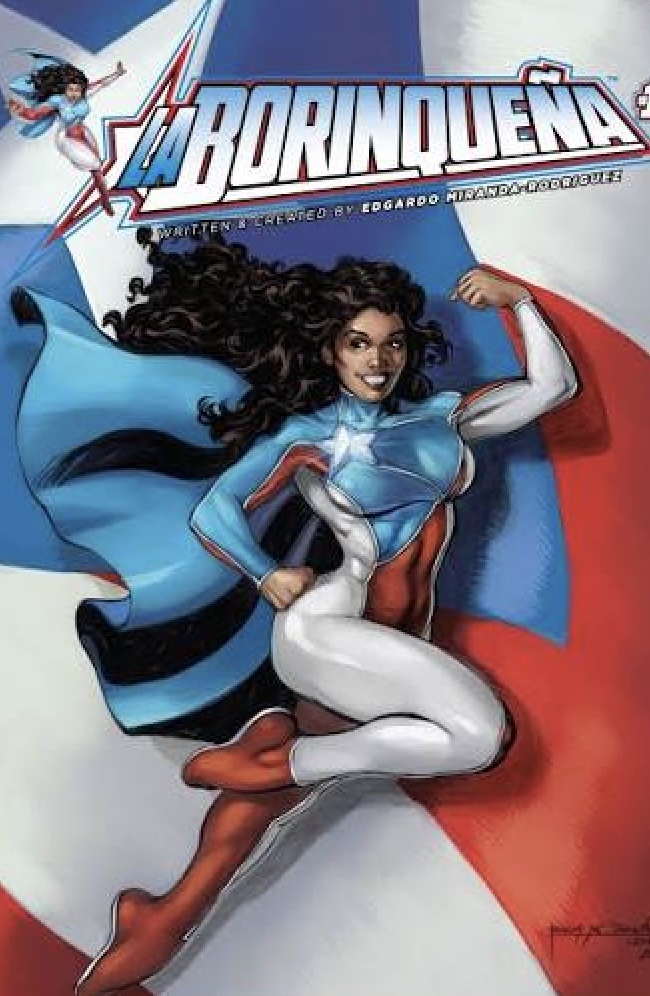
- La Borinqueña by Edgardo Miranda-Rodriguez introduces Marisol Rios De La Luz, an Afro-Puerto Rican superhero whose powers emerge from the island’s history, mythology, and environment.
- United States of Banana: A Graphic Novel by Giannina Braschi and Joakim Lindengren transforms questions of US imperialism, Puerto Rican independence, immigration, and liberty into political satire and graphic narrative.
- Ricanstruction: Reminiscing & Rebuilding Puerto Rico, created by Edgardo Miranda-Rodriguez with contributions from Gail Simone, Rosario Dawson, Rubén Blades, and others, brings Puerto Rican heroes together with well-known comic book characters in response to Hurricane María.
Scholarship and Classroom Resources
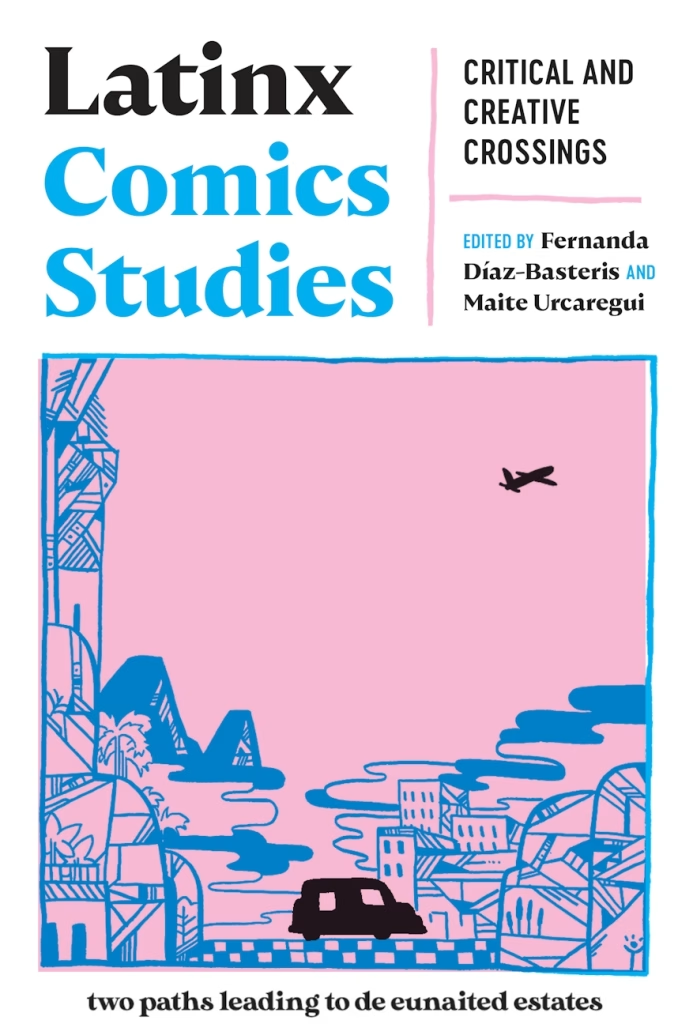
- Latinx Comics Studies: Critical and Creative Crossings, edited by Fernanda Díaz-Basteris and Maite Urcaregui, brings together critical essays, pedagogical reflections, and original comics addressing memory, migration, multilingual identity, colonial violence, gender, sexuality, and Latinx futurity.
- “The Gifts of the Hurricane: Reimagining Post-María Puerto Rico through Comics” by Daniel Arbino examines how works including Ricanstruction, Puerto Rico Strong, Nublado: Escombros de María, María, and Temporada imagine decolonial futures after Hurricane María.
- “Traumatic Displacement in Puerto Rican Digital Graphic Narratives” by María Fernanda Díaz-Basteris considers how digital comics represent displacement, colonial vulnerability, and the aftermath of natural disaster.
- Graphic Borders: Latino Comic Books Past, Present, and Future, edited by Frederick Luis Aldama and Christopher González, surveys Latino comics as a field of cultural production and scholarly study.
- The Latinographix Series at Ohio State University Press publishes graphic narratives engaging Latinx identities, histories, politics, and creative expression.
Puerto Rican Comic Books Archives
- ¡Wepa! Puerto Ricans in the World of Comics, an exhibition at the New York Public Library, traces representations of Puerto Rican life, history, migration, and imagined futures across decades of comic art.
- The Manuel Martínez Nazario Collection of Puerto Ricans in the World of Comics preserves more than 1,500 items documenting Puerto Rican comics creators, characters, publishers, and readers from the mid-twentieth century onward.
Editorial note: The review by Nuria Morgado is reproduced for archival and educational purposes. The introductory and resource material on this page was prepared by the editorial team of the Giannina Braschi website and should not be attributed to Giannina Braschi. Last reviewed and updated; September 2, 2026