
Postcolonial Graphic Novels and the Art of Resistance
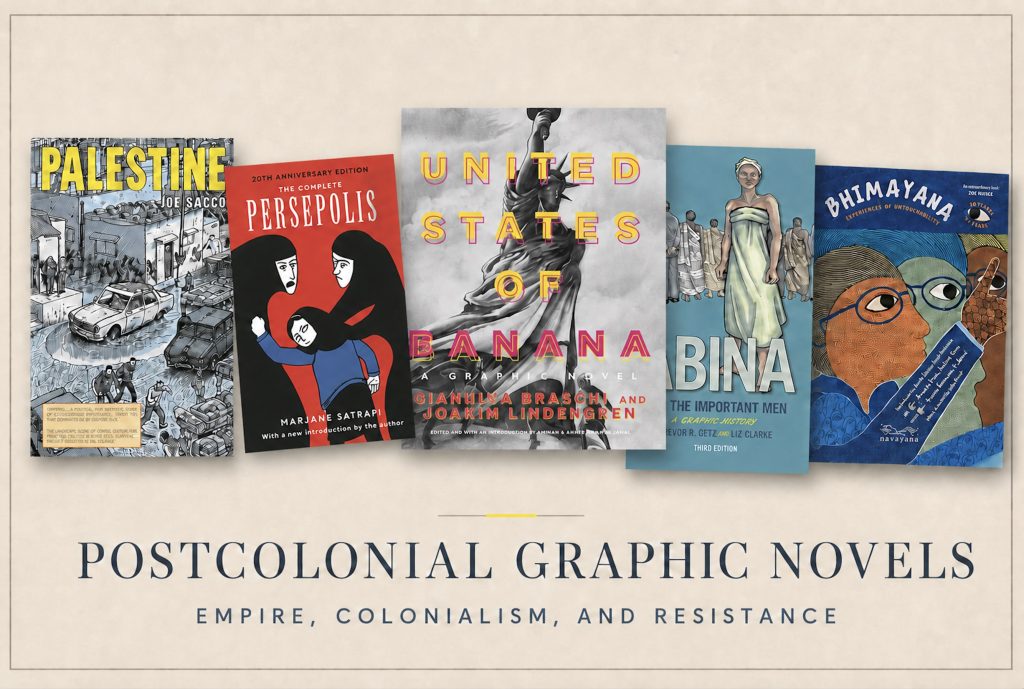
Postcolonial Graphic Literature
Postcolonial graphic novels turn histories of empire into visual arguments. Across fiction, memoir, biography, history, and comics journalism, these works examine colonial rule and its afterlives: contested borders, racial and caste hierarchies, migration, war, cultural erasure, national independence, and resistance. Their combination of words and images makes visible what official histories often suppress—including whose stories are recorded, whose bodies are controlled, and who is permitted to belong.
“Postcolonial graphic novels” is not a rigid publishing genre. It is also a critical category used by scholars and teachers to study graphic narratives that confront colonial history, imperial power, and their continuing effects. Some works below are explicitly postcolonial; others are more precisely described as colonial histories, settler-colonial narratives, diasporic memoirs, or comics journalism. Reading them together illuminates both their shared concerns and their important historical differences.
United States of Banana in Postcolonial Comics Studies
Giannina Braschi and Joakim Lindengren’s United States of Banana: A Graphic Novel belongs to this international field through its treatment of U.S. imperialism, Puerto Rico’s political status, mass incarceration, immigration, terrorism, and freedom. Published in English by Ohio State University Press in 2021, the graphic novel adapts sections of Braschi’s 2011 postmodern work through Lindengren’s densely referential black-and-white artwork.
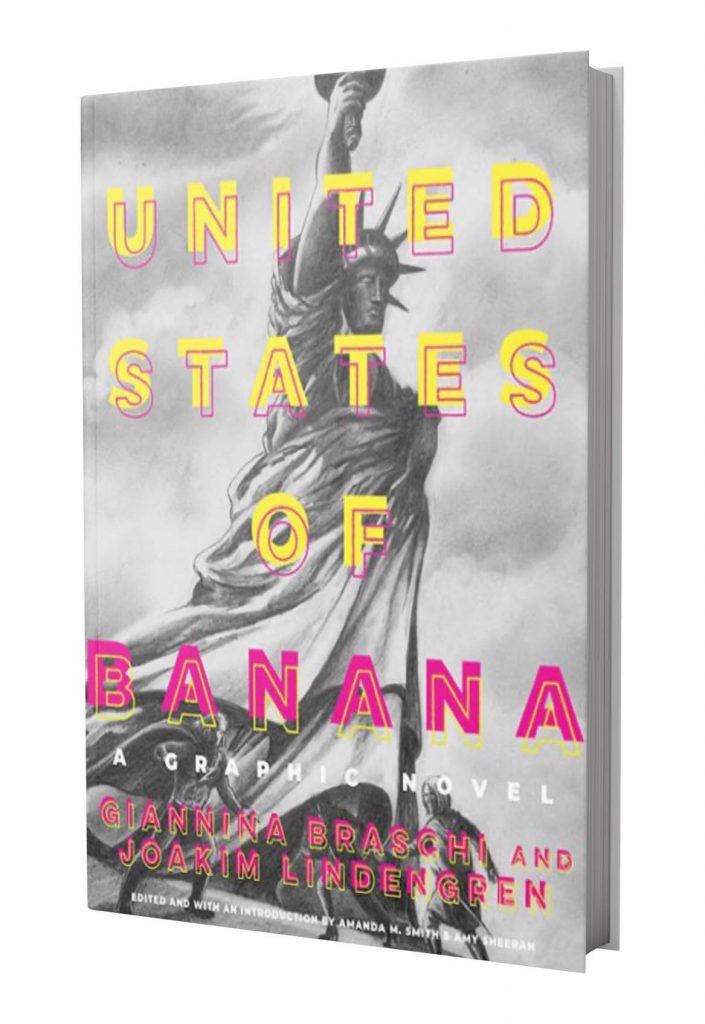
The story begins at Ground Zero after the collapse of the World Trade Center. Giannina, Hamlet, and Zarathustra travel to the Statue of Liberty to free Segismundo, a Puerto Rican political prisoner held beneath the monument. Their revolutionary mission develops into a debate about independence, statehood, colonial power, citizenship, and competing definitions of liberty.
Reviewing the book in Bookshelf 2021, published by Brill in the New West Indian Guide, Peter C. Haney called it “the trippiest work in this year’s Bookshelf,” noting its collision of political argument, literary characters, historical figures, and contemporary crises.
The book treats Puerto Rico not simply as a cultural identity but as an unresolved colonial and political condition. Segismundo’s imprisonment beneath the Statue of Liberty turns that condition into a visual metaphor, while the monument’s transformation from an emblem of welcome into a border-control figure exposes contradictions among liberty, citizenship, migration, and exclusion.
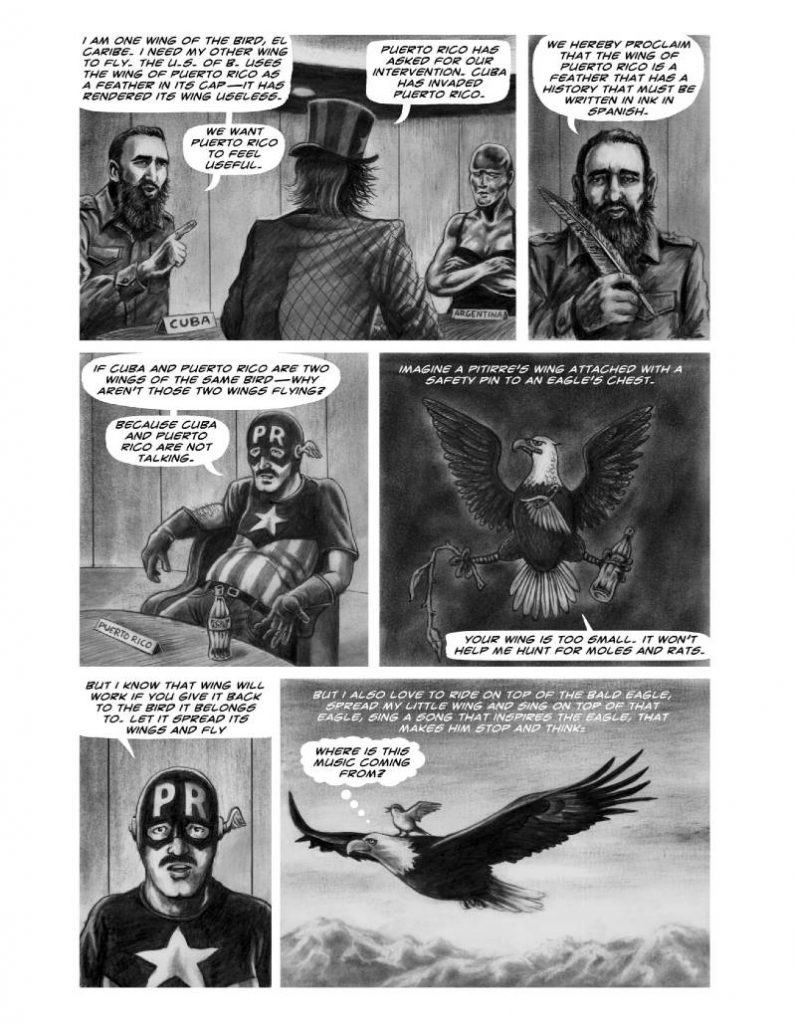
The graphic novel is also postcolonial in form. Braschi and Lindengren seize characters and images from Western philosophy, literature, art history, advertising, and popular culture and subject them to parody. Rather than accepting the authority of that cultural archive, they rearrange it into a Puerto Rican and Latinx argument about empire and liberation. As Rolando Pérez argues in “A Book of Liberation and Becomings,” the collaboration creates “an artistic event” in which words and images resist established distinctions.
Postcolonial Graphic Narratives
The following books offer points of comparison across Africa, Asia, the Caribbean, and their diasporas. They do not present a single model of colonialism or resistance. Each emerges from a distinct history and employs the graphic form differently.
The Art of Charlie Chan Hock Chye
Sonny Liew
Through the invented career of a Singaporean comics artist, The Art of Charlie Chan Hock Chye reimagines Singapore’s colonial and post-independence history. The book combines fictional biography, political satire, archival illusion, and changing comic-book styles to question how national histories are constructed—and which political possibilities disappear from official accounts.
Aya: Life in Yop City
Marguerite Abouet and Clément Oubrerie
Set in Côte d’Ivoire during the 1970s, Aya: Life in Yop City follows the ambitions, friendships, romances, and family conflicts of young people in a thriving Abidjan neighborhood. Its attention to ordinary life challenges representations of postcolonial Africa limited to poverty, warfare, or disaster.

The Best We Could Do
Thi Bui
This illustrated memoir connects one family’s displacement to French colonialism, the division of Vietnam, war, refugee experience, and resettlement in the United States. Moving between generations, Bui shows how political upheaval survives within family relationships, inherited fears, and competing memories of home.
Bhimayana: Experiences of Untouchability
Durgabai Vyam, Subhash Vyam, Srividya Natarajan, and S. Anand
Bhimayana recounts episodes from the life of Indian jurist, political leader, and social reformer B. R. Ambedkar. Through Pardhan Gond visual traditions, the book examines caste discrimination and the institutional forms through which social exclusion persists. Its rejection of conventional rectangular panels joins its political critique to an alternative visual language.
United States of Banana: A Graphic Novel
Giannina Braschi and Joakim Lindengren
A postmodern Puerto Rican tragicomedy that uses literary collage, political satire, and visual parody to challenge U.S. imperialism and inherited definitions of freedom. Its collision of Caribbean politics with Western literature, philosophy, art history, and popular culture distinguishes it from the documentary and autobiographical works in this list.
Vanni: A Family’s Struggle Through the Sri Lankan Conflict
Benjamin Dix and Lindsay Pollock
Vanni follows a Tamil family through the Sri Lankan civil war, displacement, detention, and migration. Drawing on eyewitness accounts, the graphic narrative places an intimate family story within histories of ethnic conflict, colonial borders, nationalism, and the failures of international institutions.
Colonial and Settler-Colonial Graphic Narratives
The next works are relevant to postcolonial courses, but they should not all be classified simply as postcolonial graphic novels. They approach colonial history, occupation, and settler colonialism through graphic history, Indigenous testimony, and comics journalism.
Abina and the Important Men: A Graphic History
Trevor R. Getz and Liz Clarke
Based on the 1876 court testimony of an enslaved West African woman, Abina and the Important Men reconstructs an individual struggle for freedom within the British colonial system. The graphic history reveals the distance between imperial antislavery claims and the economic and political interests that allowed coercion to continue.
Palestine
Joe Sacco
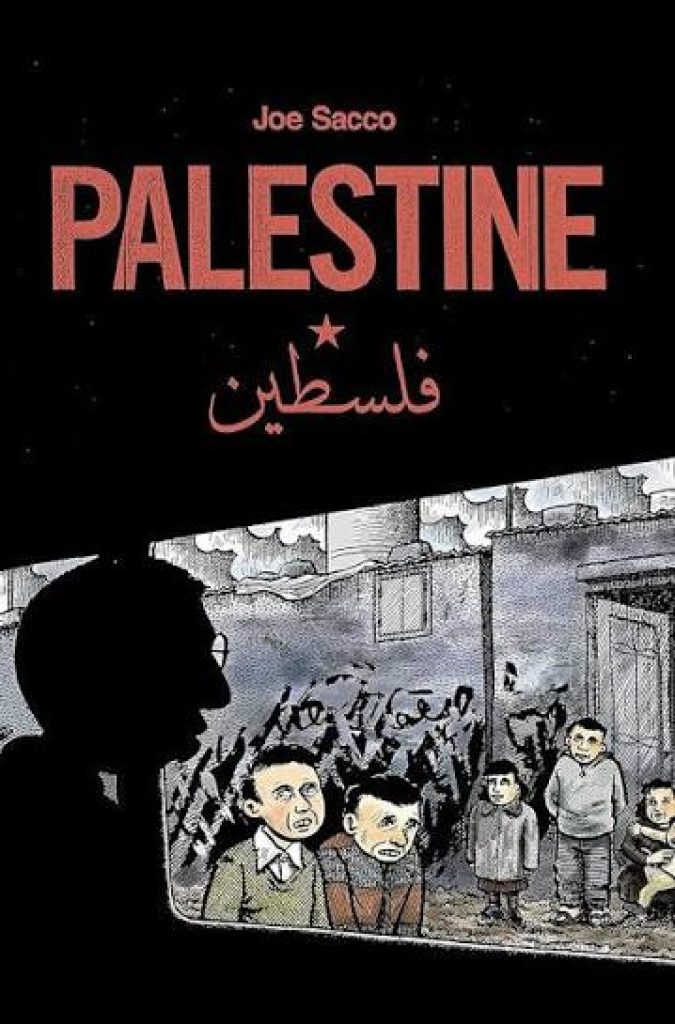
Joe Sacco’s Palestine is a foundational work of comics journalism about occupation, displacement, borders, surveillance, and daily life. Sacco places his position as an observing journalist within the narrative, raising questions about testimony and the ethics of representing another population’s suffering. Scholarship has emphasized his complex use of framing, layering, and juxtaposition. Cambridge University Press
Paying the Land
Joe Sacco
Based on extensive interviews with members of Canada’s Dene communities, Paying the Land examines Indigenous relationships to land alongside mining, resource extraction, residential schools, cultural loss, and settler colonialism. It also considers the tensions created when economic survival becomes tied to industries that threaten the land and traditional ways of life.
Revolution, Exile, and Diasporic Memory

Some graphic memoirs are frequently taught in postcolonial courses without belonging exclusively—or unambiguously—to the category.
Persepolis
Marjane Satrapi
Marjane Satrapi’s graphic memoir places childhood, revolution, war, exile, and return within the political history of modern Iran. Its stark black-and-white images confront both political repression inside Iran and Western assumptions about Iranian culture. Persepolis is most precisely described as revolutionary, diasporic, and transnational, although it is often interpreted through postcolonial theory.
Reading These Graphic Narratives Comparatively
These books do not make colonialism, occupation, caste, exile, or displacement interchangeable. Their comparative value lies in their different historical and formal approaches.
Abina and the Important Men reconstructs colonial history from legal testimony. Aya resists reductive images of African life through comedy and the everyday. Bhimayana joins anticaste politics to an Indigenous visual practice. Persepolis and The Best We Could Do approach political history through personal and family memory. Sacco uses comics journalism to document occupation and settler colonialism. The Art of Charlie Chan Hock Chye invents an archive to challenge an official national narrative.
United States of Banana contributes a postmodern, Puerto Rican, and Latinx critique of empire built from satire, philosophy, dramatic dialogue, and cultural collision. Rather than documenting colonial power from a stable historical distance, it stages colonialism as an absurdity that remains active in the present.
Teaching Postcolonial Graphic Novels
The introduction to United States of Banana: A Graphic Novel by Amanda M. Smith and Amy Sheeran provides historical and literary context for the book’s treatment of Puerto Rico, U.S. politics, Spanish theater, and visual culture. The volume concludes with discussion questions designed for classroom use.
For a closer examination of its artwork, cultural references, grade levels, classroom approaches, and growing scholarship, see Teaching Puerto Rican Graphic Novels: United States of Banana.
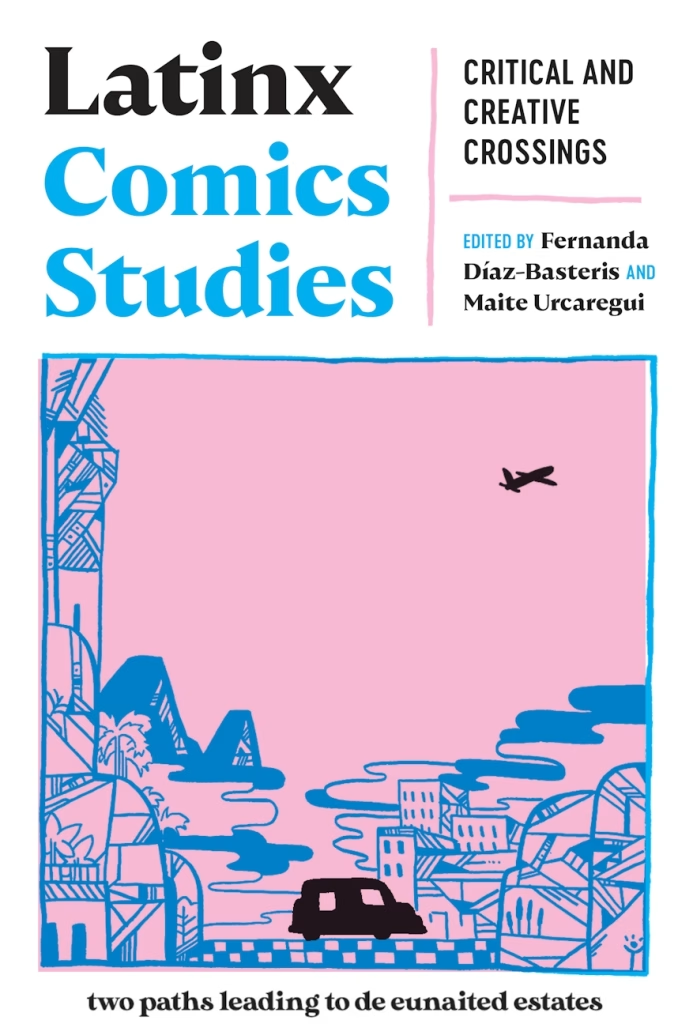
Teaching Latinx Comics Studies and United States of Banana pairs the graphic novel with Latinx Comics Studies: Critical and Creative Crossings, edited by Fernanda Díaz-Basteris and Maite Urcaregui. Published by Rutgers University Press in 2025, the anthology combines critical essays, pedagogical reflections, and original and republished comics.
Frederick Luis Aldama’s chapter, “United States of Banana: A Graphic Novel as Decluttering and Decolonizing Doubled Journey of the Self,” provides a critical framework for teaching the collaboration. Other chapters address Puerto Rico Strong, independent Puerto Rican comics, U.S.–Mexico border narratives, queer Afro-Latinx autobiography, Caribbean citizenship, migration, multilingual identity, and placemaking. The anthology is available as an open-access title from Rutgers University Press.
Scholarship and Teaching Resources
- Binita Mehta and Pia Mukherji, editors, Postcolonial Comics: Texts, Events, Identities
- Pramod K. Nayar, “Towards a Postcolonial Critical Literacy: Bhimayana and the Indian Graphic Novel”
- Fernanda Díaz-Basteris and Maite Urcaregui, editors, Latinx Comics Studies: Critical and Creative Crossings
- Rolando Pérez, “United States of Banana: A Graphic Novel: A Book of Liberation and Becomings”
- The Oxford Handbook of Comic Book Studies
- Teaching Puerto Rican Graphic Novels: United States of Banana
- Teaching Latinx Comics Studies and United States of Banana
.
Editorial note: This article was originally published in October 2022 and expanded and reviewed in August 2026.